Cultures
Celtic Symbols and Their Meanings
A guide to knots, crosses, spirals and Irish emblems that separates documented history from meanings assigned much later.
 Celtic cross
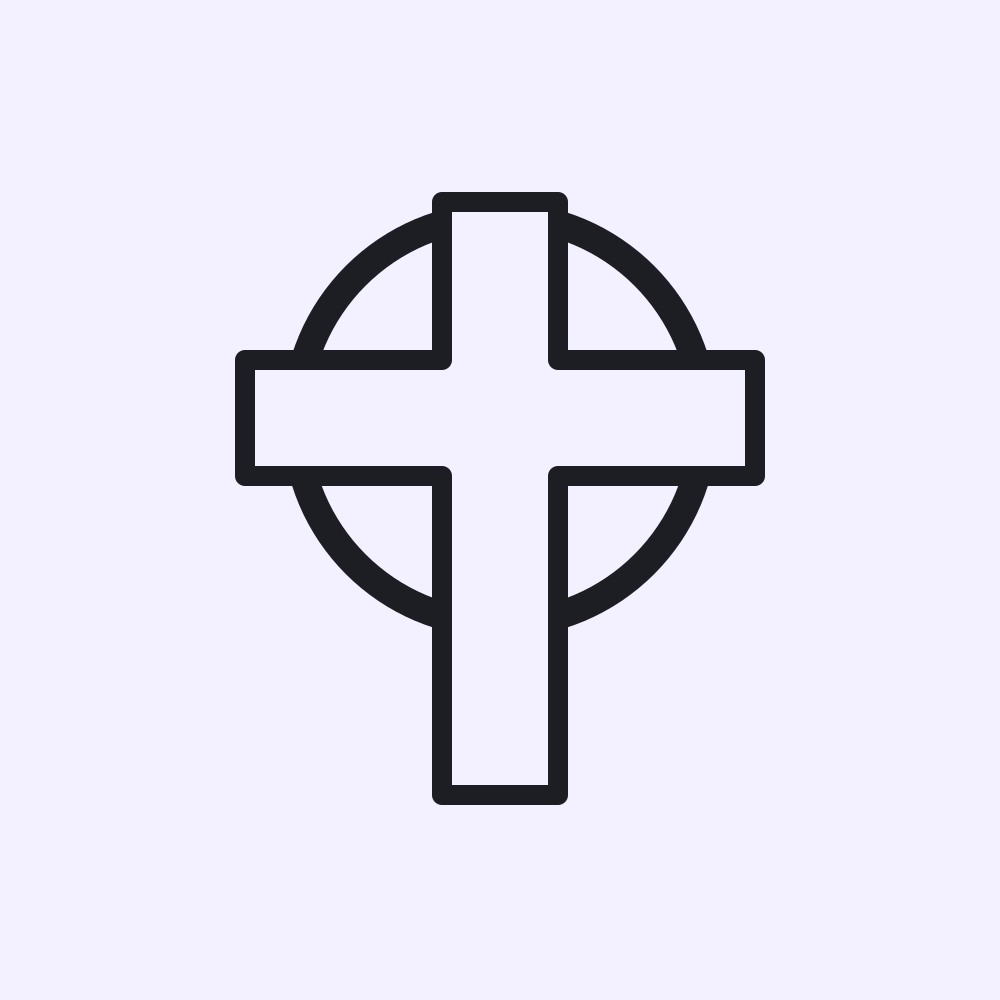
A ringed Christian cross with later heritage associations.
Original illustration · Symbolism.co editors — original vector illustration · CC0-1.0 · Source record · LicenseTriquetraA three-lobed knot with meanings shaped by its setting.
Original illustration · Symbolism.co editors — original vector illustration · CC0-1.0 · Source record · License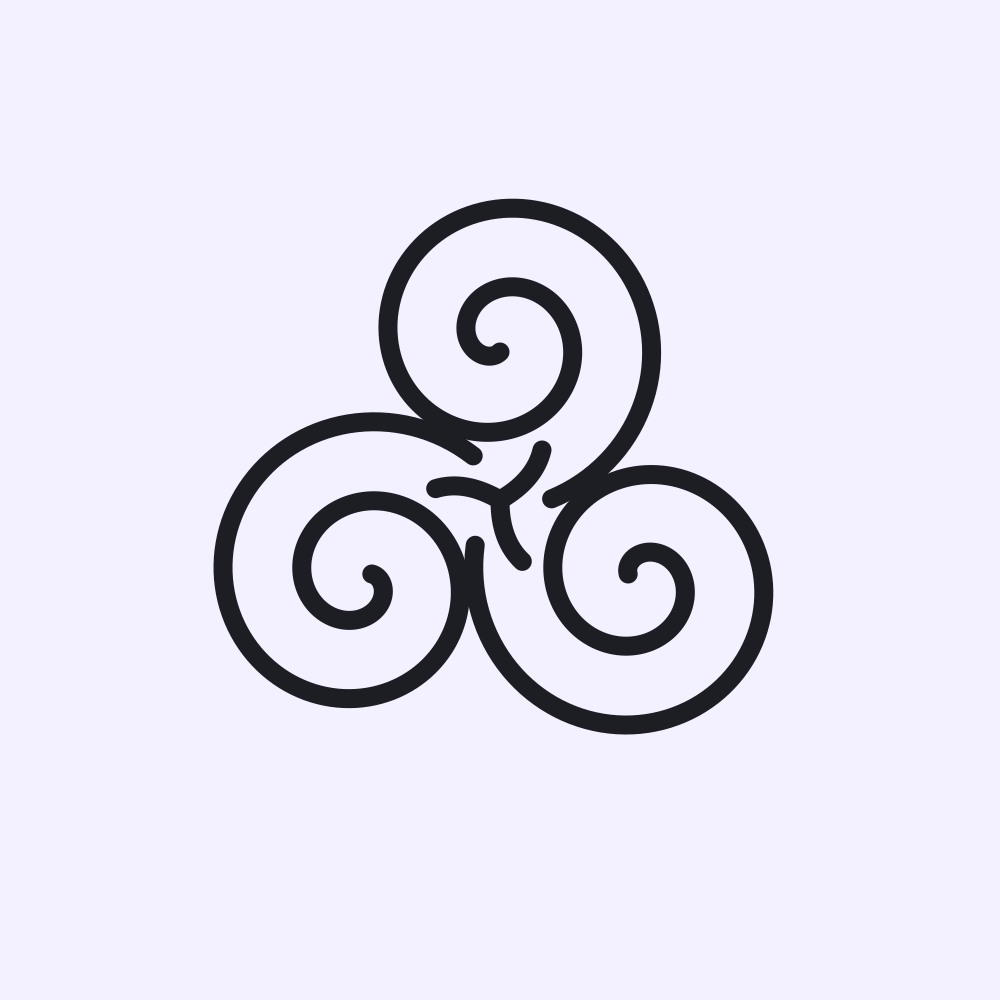 Triskelion
A three-armed revolving design; ancient examples do not all share a known meaning.
Original illustration · Symbolism.co editors — original vector illustration · CC0-1.0 · Source record · License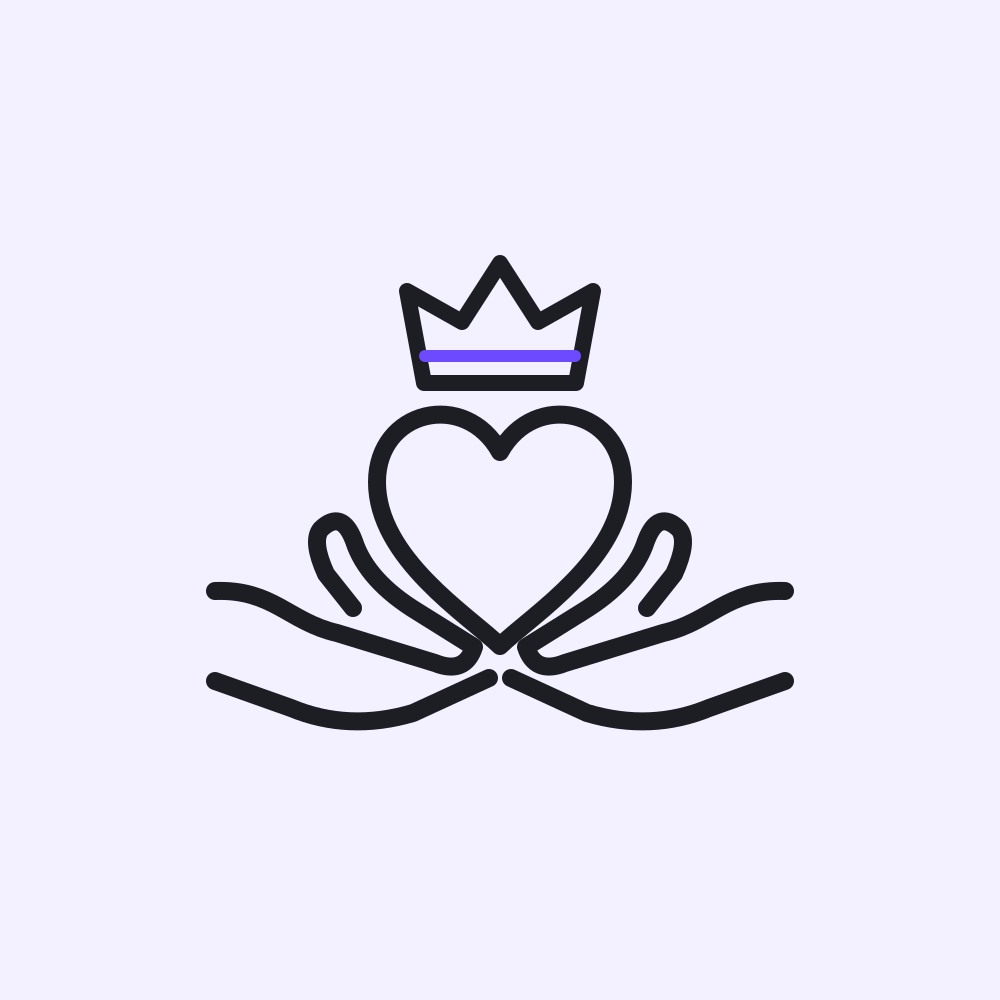 Claddagh
A crowned heart held by hands: love, loyalty and friendship.
Original illustration · Symbolism.co editors — original vector illustration · CC0-1.0 · Source record · License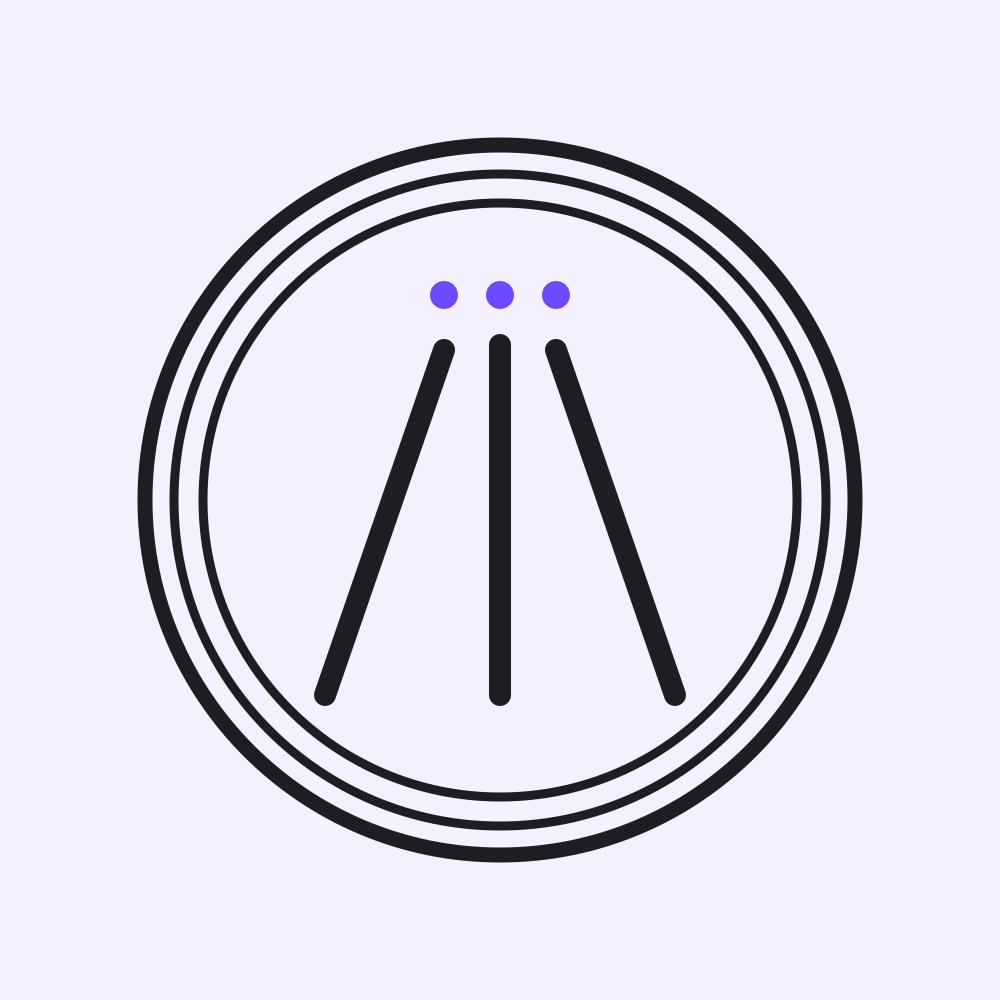 Awen
Inspiration in modern Druid traditions.
Original illustration · Symbolism.co editors — original vector illustration · CC0-1.0 · Source record · LicenseCeltic symbols include Iron Age animal designs, medieval Christian crosses and interlace, Irish national emblems, and signs used in modern Druidry. They do not form a single ancient code. A spiral carved at a prehistoric tomb, a knot painted in a Gospel book, and a Claddagh ring belong to different periods, even when a modern chart places them side by side.
The most useful question is therefore not just “What does this shape mean?” Ask who made it, when, where, and for what purpose. This guide distinguishes a documented use from a later interpretation without dismissing the meaning a symbol holds for people today.
Celtic symbols and meanings chart
| Symbol | Recognizable form | Meaning and historical caution |
|---|---|---|
| Celtic cross | A cross with a ring around its intersection | A Christian cross; also an Irish or Celtic heritage emblem today. A universal solar explanation is not established. |
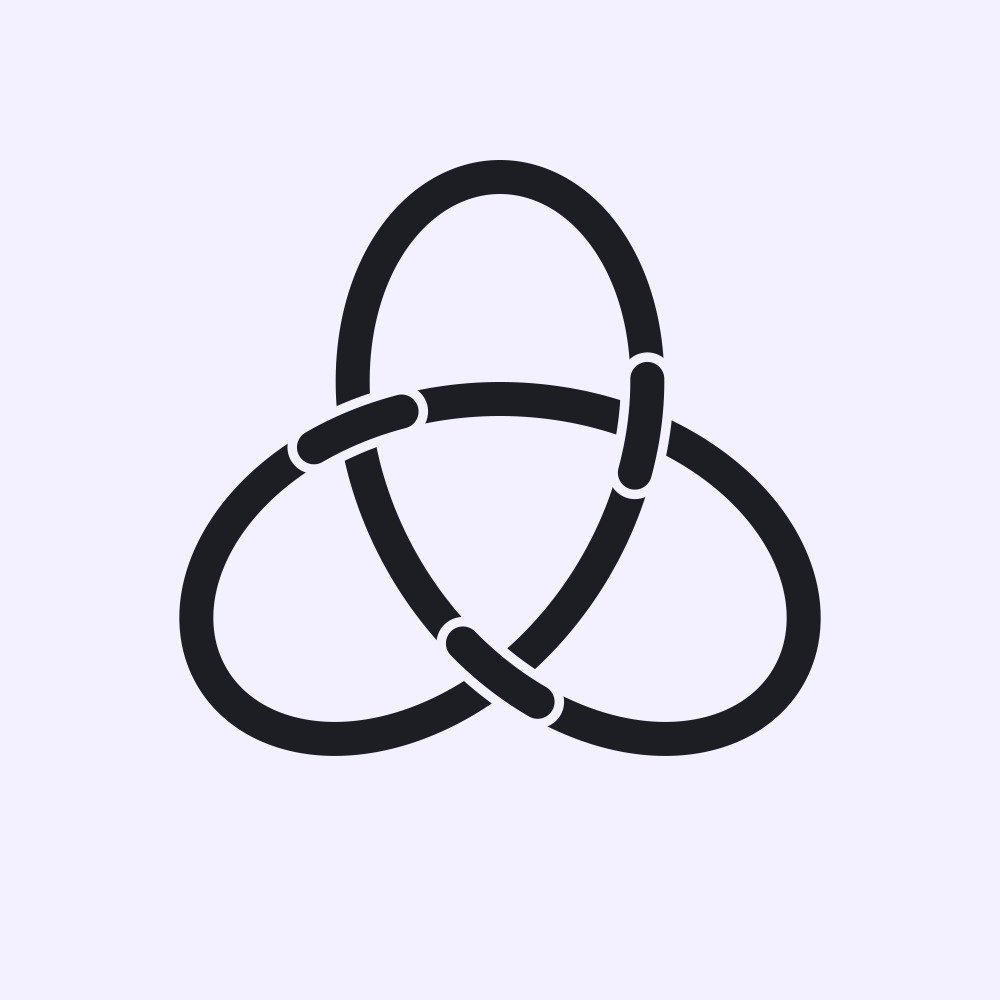
| Triquetra | Three interlaced pointed loops | A three-part ornamental knot; Christian and modern spiritual readings depend on context. |
| Triskele or triskelion | Three arms revolving around a center | A threefold design, often associated today with motion or cycles. Individual ancient examples require their own interpretation. |
| Knotwork | Interwoven bands passing over and under | Decoration in medieval manuscripts and metalwork; continuity and connection are common contemporary readings. |
| Claddagh | Hands holding a crowned heart | Friendship, love and loyalty; a Galway ring tradition, not an Iron Age emblem. |
| Shamrock | A three-leaf sprig | An Irish emblem with associations with Saint Patrick; not evidence of a universal Celtic number code. |
| Awen | Three spreading rays, often beneath three points | Inspiration in modern Druidry; its familiar graphic form belongs to the Druid revival. |
| Fivefold design | Four outer circles linked with a central circle | Often interpreted today as balance or connected elements; not a securely decoded ancient formula. |
What does “Celtic” mean here?
“Celtic” can describe languages, archaeological art styles, regional identities, or a modern cultural revival. Those categories overlap, but they are not interchangeable. The British Museum's discussion of the Celts emphasizes the difficulty of treating the people grouped under that label as one uniform population.
The National Museum of Ireland identifies La Tène ornament as an art style developed in central Europe that appears on Irish Iron Age objects. Curving lines, spirals, scrolls and stylized natural forms are important to that vocabulary. Early medieval artists subsequently used other combinations of spirals, animal ornament and interlace in Christian settings.
This is why “ancient Celtic symbol for family,” for example, needs more evidence than a modern product name. A present-day artist can create a meaningful family knot. Calling that design an inherited prehistoric sign makes a different claim, one that should have a dated object or a historical text behind it.
The Celtic cross: a Christian symbol first
The Celtic cross is recognized by the ring surrounding the meeting of its upright and crossbar. Irish high crosses can combine ornament with biblical figures and narrative scenes. The National Museum of Ireland places these monuments within early medieval Christian craftsmanship, not a separate, secretly pagan system.
The ring invites theories about the sun, eternity or a joining of religions. Such readings may matter to individual users, but the shape alone cannot establish the original intention of every carver. A cross with Gospel scenes supplies clearer evidence of Christian purpose than a resemblance between its ring and the sun supplies of solar worship.
Today the design can signify Christian faith, Irish identity, family remembrance or cultural heritage. Read the setting: a churchyard monument, a national emblem and a personal pendant may emphasize different parts of that history. For the wider religious vocabulary, compare Christian symbols and their meanings.
The Celtic triangle: triquetra and threefold meanings
The triangular loop design commonly called a Celtic triangle is the triquetra. Its three pointed lobes distinguish it from a simple triangle, while an added circle is a variation rather than a requirement. A drawn triquetra is not necessarily one mathematically perfect, unbroken strand in every decorative adaptation.
In Christian use, threefold imagery can evoke the Trinity. Contemporary wearers also associate the triquetra with family, connection or a three-part view of life. Those are meanings in particular settings, not a translation that lets us decode every medieval triangular knot as the same statement.
The expression “Celtic triad” also needs care. A triad can be a grouping of three ideas, not the name of one graphic sign. Numbering three things does not prove that a specific knot represented those things historically. If a chart assigns body, mind and spirit to a design, look for the source and the date of that interpretation.
Celtic knots: names, patterns and continuity
Celtic knotwork is a family of interlaced patterns, not one symbol with a fixed definition. In manuscript painting, carving and metalwork, bands can turn, cross and link into dense fields. The National Museum of Ireland's learning material treats knotwork alongside the practical skills of scribes and craftspeople.
Some modern knot names describe appearance: circular knot, square knot or triangular knot. Others, including love knot and family knot, describe an intended modern message. Neither kind of name is automatically a historical name used by the object's maker. “Shield knot” similarly should not be treated as proof that every four-cornered interlace was a protective device.
An endless band makes continuity an understandable contemporary reading. It can represent lasting affection, shared ancestry or connection without requiring a claim that every medieval artist meant eternal life. Start with what is visible, then distinguish the documented setting from the meaning a current designer or wearer gives it.
Spirals, triskeles and the Newgrange problem
A spiral curls around a center. A triskele arranges three arms around one. These visual descriptions are safer than assigning one universal religious meaning. Motion, growth and cycles are common present-day associations, but ancient examples need evidence specific to their location and period.
Newgrange is especially important. Heritage Ireland dates the great passage tombs of Brú na Bóinne to around 3200 BCE and identifies their triple-spiral carvings. These are Neolithic monuments, much older than Ireland's Iron Age La Tène art. Calling the Newgrange spiral simply an “ancient Celtic symbol” collapses a large stretch of prehistory.
The monument's winter-solstice alignment is documented; a precise verbal translation of every carved spiral is not. Architecture and ornament may be related without allowing us to translate a spiral as “birth, death and rebirth.” Explore the triskelion as a shape with several histories rather than one timeless definition.
Was there one Celtic sun symbol?
Searches for a Celtic sun symbol often return wheels, spirals, ringed crosses and combinations of these. Similar circular forms can occur in unrelated contexts, so a round outline is not enough to identify a solar emblem. A wheel in an attributed religious scene has a different evidential value from an isolated modern icon.
Do not assume that the ring of a high cross, a coin's wreath, and a spoked wheel all carry the same meaning. They may share geometry while differing in function. Where an artifact is identified with a deity or a solar association, retain that object's attribution rather than extending it to every circle in Celtic art.
Claddagh, shamrock, Awen and the fivefold symbol
The Claddagh has firmer evidence for its familiar meaning than many internet knot charts do. The National Museum of Ireland describes its clasping hands, crowned heart, and associations with friendship, love and loyalty. Galway City Museum locates the ring within the history of European fede rings and Galway goldsmithing.
The shamrock is another Irish emblem rather than a generic label for all three-part Celtic ornament. Its place in Irish identity and the Saint Patrick tradition should not be confused with a claim that every three-leaf form has the same ancient meaning.
Awen is associated with inspiration in modern Druidry. The British Druid Order traces its familiar three-ray design to the revivalist Iolo Morganwg. That modern history does not make it meaningless or inauthentic to current practitioners. It does mean that “prehistoric Druid logo” is an inaccurate description.
The fivefold symbol, sometimes written “five-fold symbol,” is often presented as four circles surrounding a fifth. Modern accounts may assign elements, directions or balance to it. Without a securely identified early object and an explanation connecting that object to those ideas, present these as contemporary interpretations. The same caution applies to a generic “Celtic tree of life”: trees have rich histories, but a modern symmetrical tree logo is not automatically a recovered ancient diagram.
In the museum: horses and wreaths on British coins
Two gold staters in the Cleveland Museum of Art offer a useful contrast with a modern meaning chart. Both belong to the Catuvellauni in Britain and are cataloged to around the turn of the Common Era. One shows crossed wreaths on its obverse and a horse with an ox-head motif on the reverse. The other has a wreath and a horse with an armed rider.
These objects document particular images in a named community and a dated medium. They do not establish that horses meant one thing to all Celtic-speaking peoples, or that their wreaths explain later ringed crosses. Even when an image is recognizable, its complete significance may remain uncertain. The coin's title, date and cultural attribution are evidence; a modern spiritual translation would be an additional claim.
How to read a symbol responsibly
- Identify the actual form. A triquetra is not the same design as a triple spiral.
- Find the earliest relevant example. Distinguish a Neolithic carving from a medieval manuscript and a revival emblem.
- Check the setting. A biblical scene, inscription, ring inscription or ritual use may explain more than geometry.
- Label later meanings. A modern association can be valuable without being ancient.
- Leave uncertainty visible. An unknown meaning is more accurate than a confident invented translation.
For a broader explanation of how forms acquire associations through use, see what symbolism is. Celtic art rewards close looking: its historical richness is more interesting than a single chart of supposedly secret definitions.
In the museum
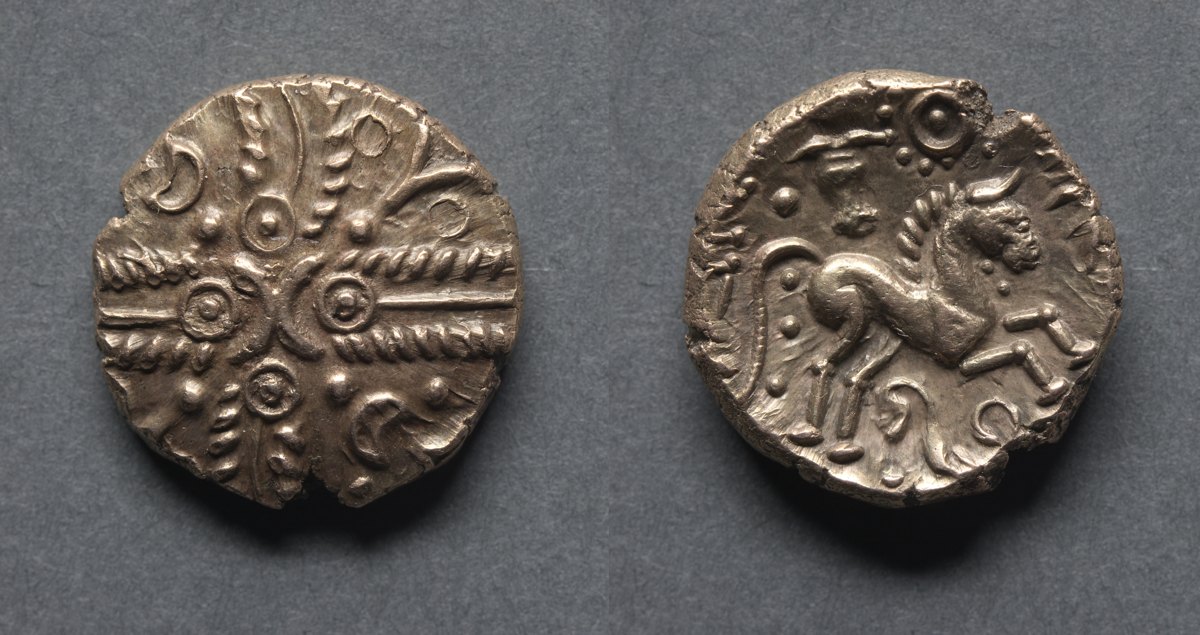
Crossed wreaths and a horse with an ox-head motif on a Catuvellaunian coin; their presence does not supply a universal Celtic meaning.
20 BCE–10 CE · England, Catuvellauni · The Cleveland Museum of Art · 1969.150 · CC0
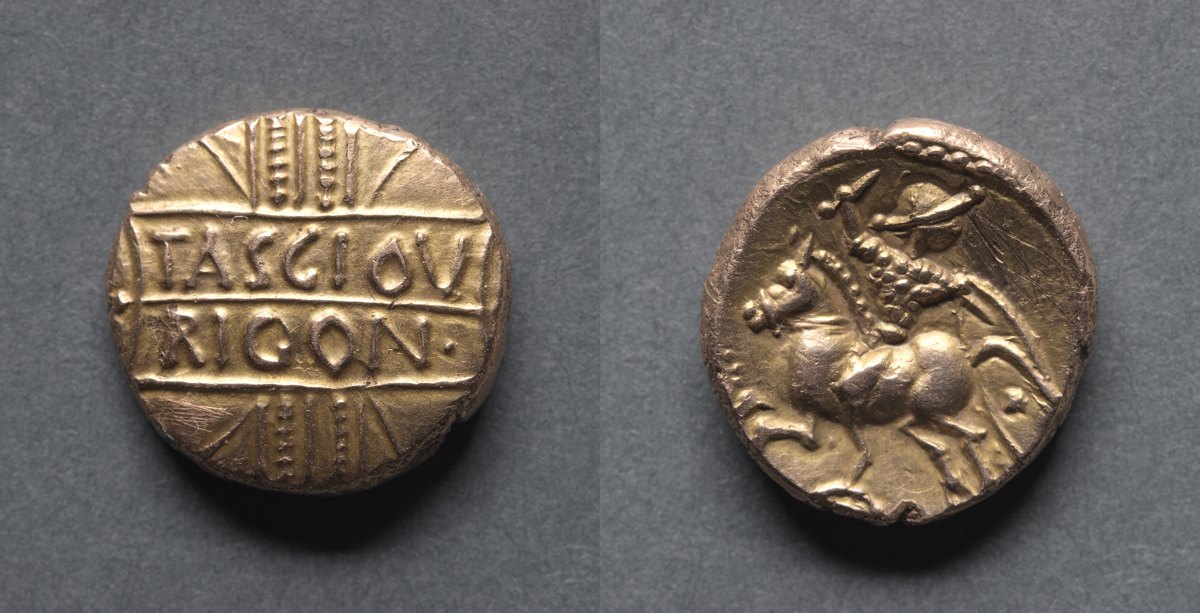
A second documented combination of wreath and horse imagery, not evidence for later knot interpretations.
c. 20 BCE–10 CE · England, Catuvellauni · The Cleveland Museum of Art · 1969.151 · CC0
Frequently asked questions
What is the most famous Celtic symbol?
The ringed Celtic cross and interlaced knotwork are among the most recognizable. The shamrock and Claddagh are especially familiar Irish emblems, but they have distinct histories rather than one shared ancient origin.
What does the Celtic triangle mean?
The three-lobed knot is usually called a triquetra. It can carry Christian Trinitarian or modern threefold meanings, but no single interpretation should be applied to every historical example.
Is the Newgrange spiral Celtic?
The Newgrange carvings are Neolithic, from a monument built around 3200 BCE. They precede Ireland's Iron Age Celtic art by millennia, although modern Celtic-inspired designs often include them.
Is there an ancient Celtic symbol for balance?
Modern designs, including fivefold circles and symmetrical knots, are often assigned that meaning. A claim that one was a standardized ancient sign for balance needs a dated artifact and supporting historical evidence.
Are all Celtic symbols pagan?
No. Medieval high crosses and much surviving interlace appear in Christian settings. Other designs are prehistoric, Iron Age, civic, personal or associated with modern religious traditions.
Sources & further reading
- British Museum: Who were the Celts?
- National Museum of Ireland: Iron Age
- National Museum of Ireland: Early Medieval
- National Museum of Ireland: Secrets of the Scribes
- Heritage Ireland: Brú na Bóinne
- National Museum of Ireland: Claddagh Rings
- Galway City Museum: Claddagh Ring
- British Druid Order: Awen
- Cleveland Museum of Art: Tasciovanus stater, crossed wreaths and horse
- Cleveland Museum of Art: Tasciovanus stater, wreath and armed rider