Cultures
Triquetra Meaning and the History of the Trinity Knot
The triquetra is a three-cornered interlace design, often called the Trinity knot. Its Christian and personal meanings are real, but a medieval pattern does not automatically reveal its maker's exact intention.
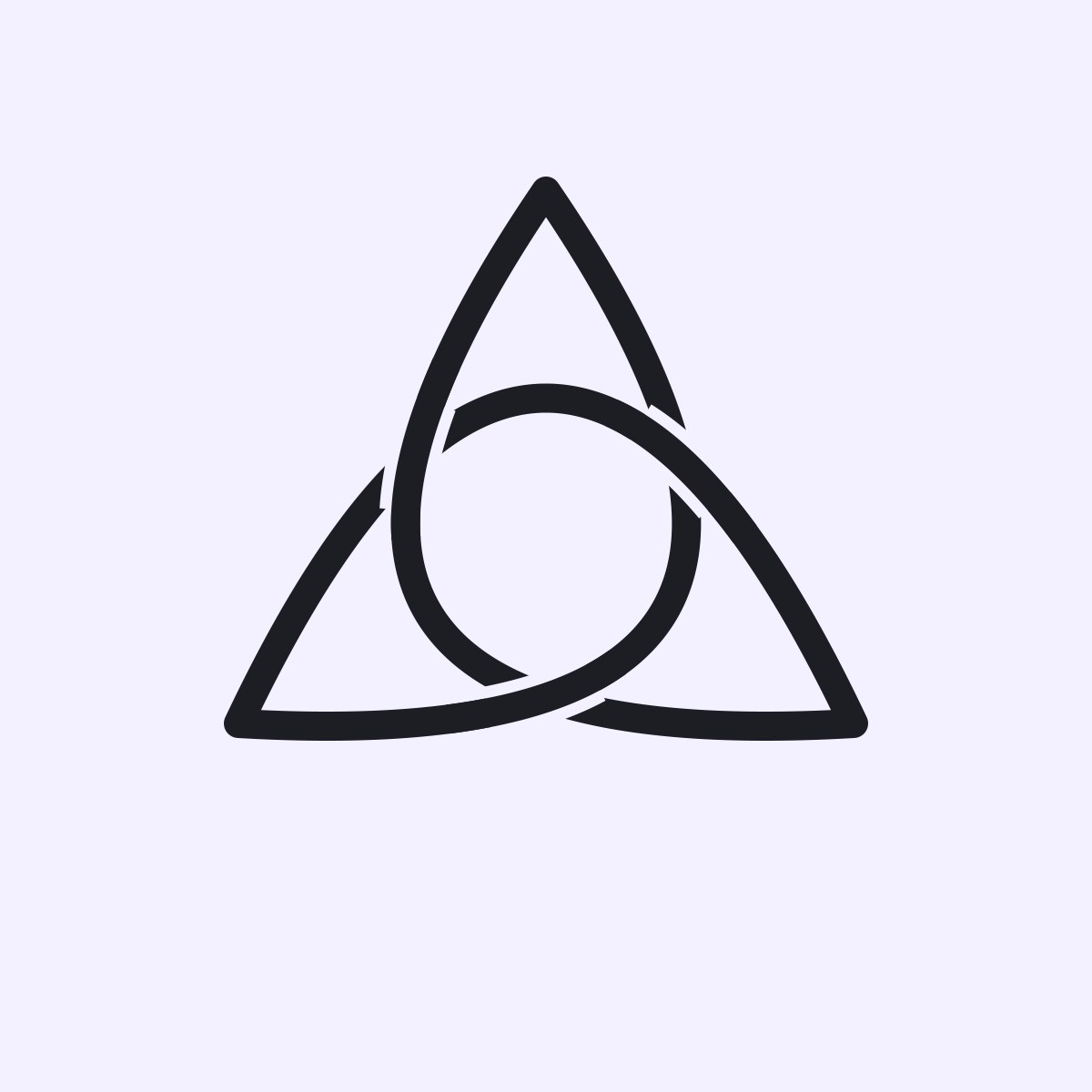
The triquetra is a three-cornered design formed by interlaced curves, usually drawn as one continuous band. Often called the Trinity knot, it can represent the Christian Trinity or, in modern personal use, a threefold bond. Its recognizable shape is old, but there is no single proven original meaning that applies to every historical example.
That distinction is central to triquetra meaning. A medieval object can securely show that the pattern was used in a particular place and period. It may not tell us what its maker called the pattern, whether it represented a doctrine, or whether it was chosen primarily as ornament.
What does a triquetra look like?
The familiar form has three pointed lobes arranged around a small central space. A line passes over and under itself to create the appearance of a woven knot. Some versions add a surrounding circle; others leave the knot alone. Either can be recognizable as a triquetra.
To understand the drawing, follow the band rather than counting separate petals. In the common continuous version, the three lobes belong to a single route. The alternation of over and under is what makes the figure interlace rather than simply three overlapping outlines. A modern designer may simplify the crossings, but that changes how clearly the knot structure reads.
It is not the same as a triskelion, which normally emphasizes three turning arms or spirals. Nor is it the same as the valknut, a different threefold figure made from triangular forms. Similar numbers and broad associations do not make the shapes interchangeable.
What medieval evidence actually shows
A useful securely cataloged example is a silver side panel from a house-shaped shrine in the British Museum. The museum dates it to the early tenth century and describes three roundels containing equal-armed crosses, with interlaced triquetras in the remaining spaces. The object combines elements described as Anglo-Saxon and Viking in its cataloging.
This is better evidence than an undated picture labeled “ancient Celtic symbol.” It places the motif on a real object with a material, function, and approximate date. The crosses and shrine context make its Christian setting clear. They do not, by themselves, prove that each knot was intended as a diagram of the Trinity.
The distinction matters because interlace is a whole visual language, not a dictionary in which every knot has one fixed translation. Patterns can fill a field, structure a border, display a maker's skill, and contribute to a sacred setting without operating as individually captioned doctrinal signs.
Triquetra meaning in Christianity
In Christian use, the threefold figure is read as an image of the Father, Son, and Holy Spirit. The continuous design makes it an appealing visual expression of unity and distinction. This is the meaning behind the familiar name “Trinity knot.”
The underlying doctrine should be described accurately. The Church of England's explanation of the Nicene Creed summarizes it as belief in one God in three persons. It is not three separate gods, three gods joined by a circle, or one god simply changing costumes. A small ornament can suggest an idea; it cannot reproduce all the qualifications of a theological statement.
There is also a difference between a well-established Christian interpretation today and a claim about the intention of every early medieval artist. Finding a three-part design in a Christian manuscript or on church metalwork makes a Trinitarian reading understandable. Proving a particular maker intended it requires more specific contextual or textual evidence.
Is it a Celtic symbol?
The triquetra belongs comfortably in a discussion of Celtic and Insular ornament, but “Celtic” should not be used as a universal date or explanation. Interlace circulated across communities in Ireland, Britain, and northern Europe. The British Museum shrine panel alone shows why a sharply bounded ethnic label can be too simple.
Trinity College Dublin describes early medieval Insular art through repeated spirals, knotwork crossings, and fretwork. Its research on the Book of Kells treats interlace as something that can be studied through design, repetition, and geometry. That approach helps avoid the assumption that every decorative unit records a secret religious formula.
The Book of Kells is important background for understanding the art of interlace. It should not be used as a catch-all proof for any modern knot graphic. Identifying a specific occurrence requires a folio and a visible matching pattern, not merely the statement that a manuscript contains elaborate decoration.
Modern spiritual and personal meanings
Modern users may connect the three lobes with family, the stages of life, past-present-future, or a relationship among three people. These can be meaningful choices. They are best described as the wearer's interpretation rather than as the documented explanation of every medieval triquetra.
The same caution applies to claims about an original pagan triple goddess or a universal earth-sea-sky code. A particular modern religious community or artist may use those readings. The knot alone does not establish their antiquity. Neither a Christian nor a non-Christian modern interpretation can erase the need for evidence when discussing origins.
An added circle can suggest continuity or eternity to a contemporary viewer. That is a plausible design reading, not a rule requiring every historical circle to mean exactly the same thing. Ask who made or selected the image, where it appears, and what explanation accompanies it.
Why endless knots suggest lasting bonds
A line without an obvious beginning or end is well suited to ideas of continuity. This helps explain why knot designs work effectively in contemporary jewelry, memorials, and family emblems. The visual structure offers a metaphor even when no ancient explanatory text survives.
That metaphor also links the triquetra with the broader Celtic knot family, while the particular three-lobed structure gives it a distinctive identity. Compare it with the infinity symbol: both can express lasting connection today, but their shared modern use does not imply a shared historical origin.
How to interpret a triquetra responsibly
First identify the form: three pointed lobes, interlace, and perhaps an added circle. Then establish the context. A church emblem, a museum shrine panel, a contemporary pendant, and an entertainment logo may all use related shapes while making different statements.
Finally, separate observation from interpretation. “This early tenth-century panel contains interlaced triquetras” is an object-based claim. “Every knot on it represents Father, Son, and Holy Spirit” goes further than its catalog description supports. Respecting that difference preserves the pattern's richness without inventing certainty.
The featured image is a new schematic illustration of the knot, not a reproduction of medieval metalwork. The British Museum object is linked below as historical evidence. Its catalog is a useful starting point for distinguishing a documented medieval motif from the broader meanings attached to the design today.
Frequently asked questions
What does the triquetra symbolize?
It often represents the Christian Trinity. In modern personal use it can express a threefold bond or continuity. No one meaning is proven for every historical occurrence.
Is the triquetra Christian or pagan?
The design has documented medieval Christian contexts and several later interpretations. The shape alone does not establish a user's religion or prove an original pagan meaning.
What is the difference between a triquetra and a triskelion?
A triquetra is a three-cornered interlace knot. A triskelion normally has three turning arms, legs, or spirals rather than that knot structure.
Does the circle change the meaning of the Trinity knot?
An added circle may suggest continuity or eternity in modern use, but it does not impose one universal meaning on every example.