Religion
Triple Moon Meaning and the Modern Triple Goddess
A full moon between two crescents represents lunar change and, for many modern Pagans, the Triple Goddess. Its living religious meaning should be distinguished from claims of an unchanged ancient emblem.
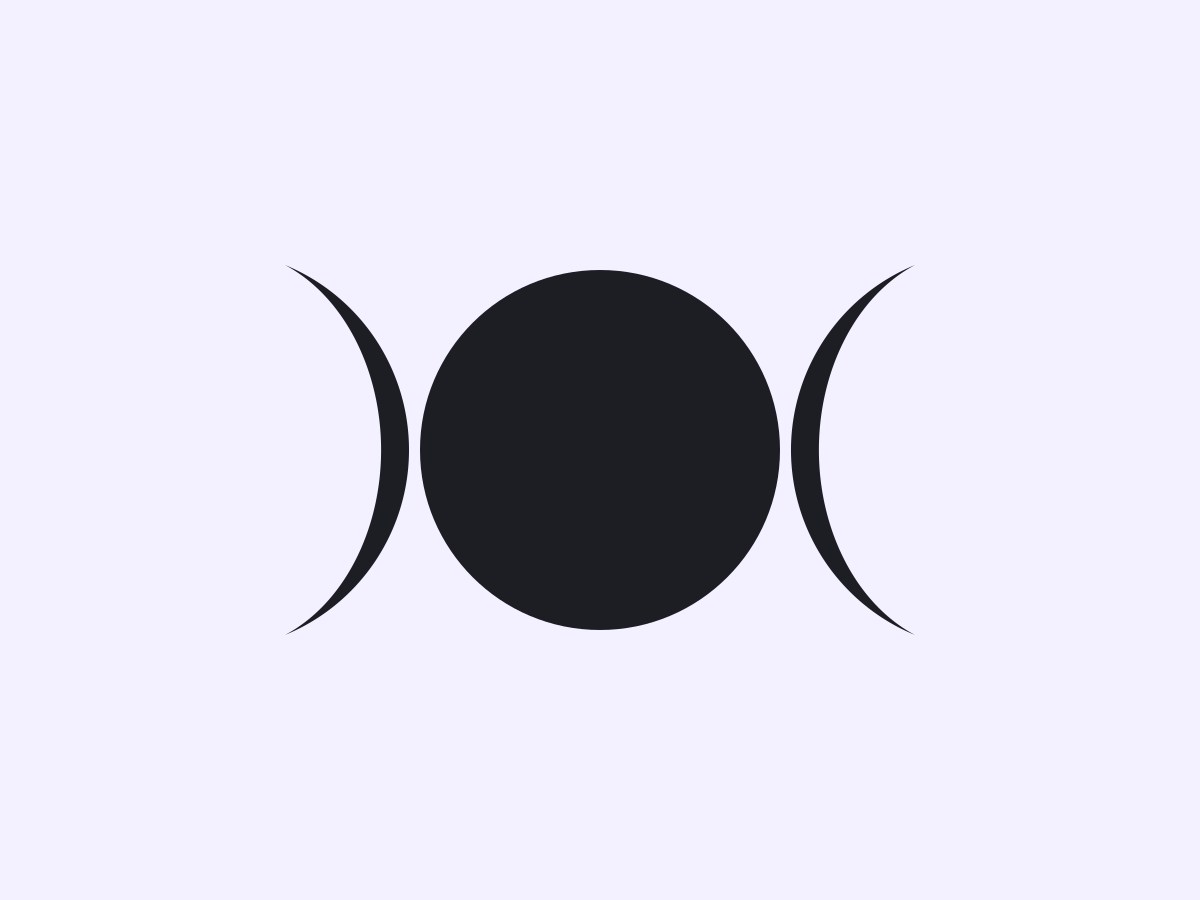
The triple moon is a full circle flanked by two crescents, commonly read as the waxing, full, and waning Moon. In Wicca and some other modern Pagan traditions, triple moon meaning centers on the Triple Goddess, often described through the aspects Maiden, Mother, and Crone. It can also express growth, fullness, decline, and renewal. These are religious and symbolic interpretations, not scientific claims about lunar influence.
The familiar emblem belongs to the vocabulary of modern Pagan religion. Ancient cultures certainly honored lunar deities and grouped deities in threes, but those facts alone do not establish that this exact crescent-circle-crescent design had the same meaning in antiquity.
How to read the three moon shapes
The usual reading moves from a waxing crescent to a full moon and then to a waning crescent. The first suggests increase or emergence, the central disk fullness or culmination, and the last decrease or release. Together they make change appear as a sequence rather than an isolated event.
The University of Kansas's Religion in Kansas collection describes the Triple Goddess symbol through the Moon's phases, phases of human life, and the cycle of things. That record documents a contemporary religious interpretation. It does not claim that every Pagan or every person wearing the design understands it identically.
The arrangement is deliberately selective. NASA lists eight commonly named lunar phases, not three. The emblem chooses three recognizable conditions to convey a theological or poetic idea. It is therefore better understood as a symbolic summary than as a complete astronomical diagram.
Maiden, Mother, and Crone
A widespread modern interpretation associates the waxing crescent with the Maiden, the full moon with the Mother, and the waning crescent with the Crone. These aspects are often read as beginnings, maturity or generativity, and wisdom or the later part of life.
These categories should be described as a religious model, not as a compulsory biography. They do not establish that all women must become biological mothers or that all people experience life in three neat stages. Nor should an editor assign a practitioner's personal identity or theology from the necklace they wear.
Practitioners interpret the model in different ways. Some emphasize personified divine aspects; others emphasize changing seasons, creative processes, or recurring transitions. Explaining that range is more accurate than giving each crescent one supposedly universal message.
Jason Mankey's scholarly chapter on the Triple Goddess specifically examines the evolution and reinterpretation of Maiden, Mother, and Crone in Wiccan-Witchcraft practice. A living tradition can develop new language and retain religious significance. Historical development is not evidence that the people using a symbol are insincere.
Is the triple moon an ancient symbol?
The safest answer distinguishes ingredients from the finished design. Lunar worship, threefold divine figures, and crescent imagery have ancient histories. The particular modern Triple Goddess model, and the familiar emblem used to express it, need their own evidence.
Ronald Hutton's study A Goddess Arrives: Nineteenth Century Sources of the New Age Triple Moon Goddess challenges claims that today's threefold lunar goddess can simply be taken as an unchanged survival from remote antiquity. His work traces literary and intellectual contributions to a modern religious idea.
Mankey likewise describes Maiden-Mother-Crone as absent from early Wiccan materials and influential after its introduction in print in the 1950s. This is more precise than saying that one ancient culture invented the present symbol, or that a single modern book instantly created every part of it.
Robert Graves is important to discussions of modern goddess imagery, but naming an influential writer is not the same as identifying the first person to draw the emblem. The sources used here do not establish a secure first designer or first dated use of the exact graphic. We therefore leave those questions open.
Is the triple moon a symbol of Hecate?
It can be used in modern devotion to Hecate. That does not make every ancient image of Hecate an example of the triple moon emblem. A three-bodied figure and a line of three lunar shapes are different visual forms, even when modern practitioners bring them into a shared interpretation.
The Museum of Witchcraft and Magic catalogs a contemporary print called Triple Moon Goddess “Hecate”. This is useful evidence for a modern association between Hecate and triple-moon goddess imagery. Its contemporary title does not turn it into evidence of an ancient crescent-circle-crescent sign.
The distinction also protects ancient religions from being reduced to a modern diagram. Different deities, local cults, and historical periods require their own sources. “Three” and “moon” are not enough to prove that two religious images meant the same thing.
Triple moon, pentacle, and crescent-and-star
The triple moon is sometimes combined with a star inside the central disk. If the star is five-pointed, compare the pentagram; if enclosed within a circle, the term pentacle may be relevant to the design. The added element does not make every triple moon a pentacle.
The crescent moon and star is another distinct combination with different historical and cultural contexts. Sharing a crescent does not make two signs equivalent. The same caution applies to the triquetra, whose three-part structure is not, by itself, a diagram of lunar phases.
A useful identification begins with shape: two opposed crescents and a central disk make the familiar triple moon. After that, an inscription, ritual context, artist's explanation, or community source can help determine what the combination means in that setting.
Does the emblem describe the actual Moon?
It draws on real changes in appearance, but the Moon does not physically grow into a disk and then shrink. NASA explains that lunar phases result from our changing view of the Moon's sunlit half as it orbits Earth. A phase cycle takes about 29.5 days.
Waxing means the visible illuminated portion is increasing; waning means it is decreasing. The phases between crescent and full include quarter and gibbous stages. Keeping that science clear allows a symbolic reading without presenting metaphor as astronomy or claiming that a phase dictates someone's health or behavior.
Museum evidence and digital use
No genuinely matching, downloadable CC0 object from the Met or Cleveland was verified for this entry. We have deliberately not filled the gap with an ancient lunar ornament or a triple deity that lacks the emblem. The modern museum and scholarly sources below document the subject without implying a false object history.
The featured illustration is a newly drawn geometric rendering, not a reconstructed antiquity. We do not assign it a dedicated Unicode code point: individual moon characters or a typed approximation are not the same as one encoded triple-moon character. For a living religious emblem, an honest modern illustration is more useful than an unrelated ancient artifact.
Frequently asked questions
What does the triple moon symbol mean?
In many modern Pagan and Wiccan settings it represents the Triple Goddess through waxing, full, and waning lunar phases. Cycles, change, and renewal are related interpretations.
Does the triple moon mean Maiden, Mother, and Crone?
That is a widespread modern reading: waxing crescent for Maiden, full moon for Mother, and waning crescent for Crone. It is not a universal doctrine for all Pagans or a rule about how people must live.
Is the triple moon an ancient Celtic symbol?
This entry found no evidence establishing the familiar emblem as an ancient Celtic sign. Older lunar imagery and triple deities do not by themselves prove the history of the modern design.
Is the triple moon the same as a pentacle?
No. A triple moon has two crescents flanking a disk. A pentacle commonly includes a five-pointed star within a circle, though artists sometimes combine the designs.
Sources & further reading
- University of Kansas Religion in Kansas collection: Triple Goddess Symbol
- Ronald Hutton: A Goddess Arrives: Nineteenth Century Sources of the New Age Triple Moon Goddess
- Jason Mankey: The Triple Goddess, in The Routledge Handbook of Contemporary Witchcraft
- NASA Science: Moon Phases
- Museum of Witchcraft and Magic: Triple Moon Goddess Hecate print