Religion
Pentacle Meaning and How It Differs from a Pentagram
Often an encircled five-pointed star, the pentacle is a living religious emblem and an older term for a talismanic object. Context explains the difference.
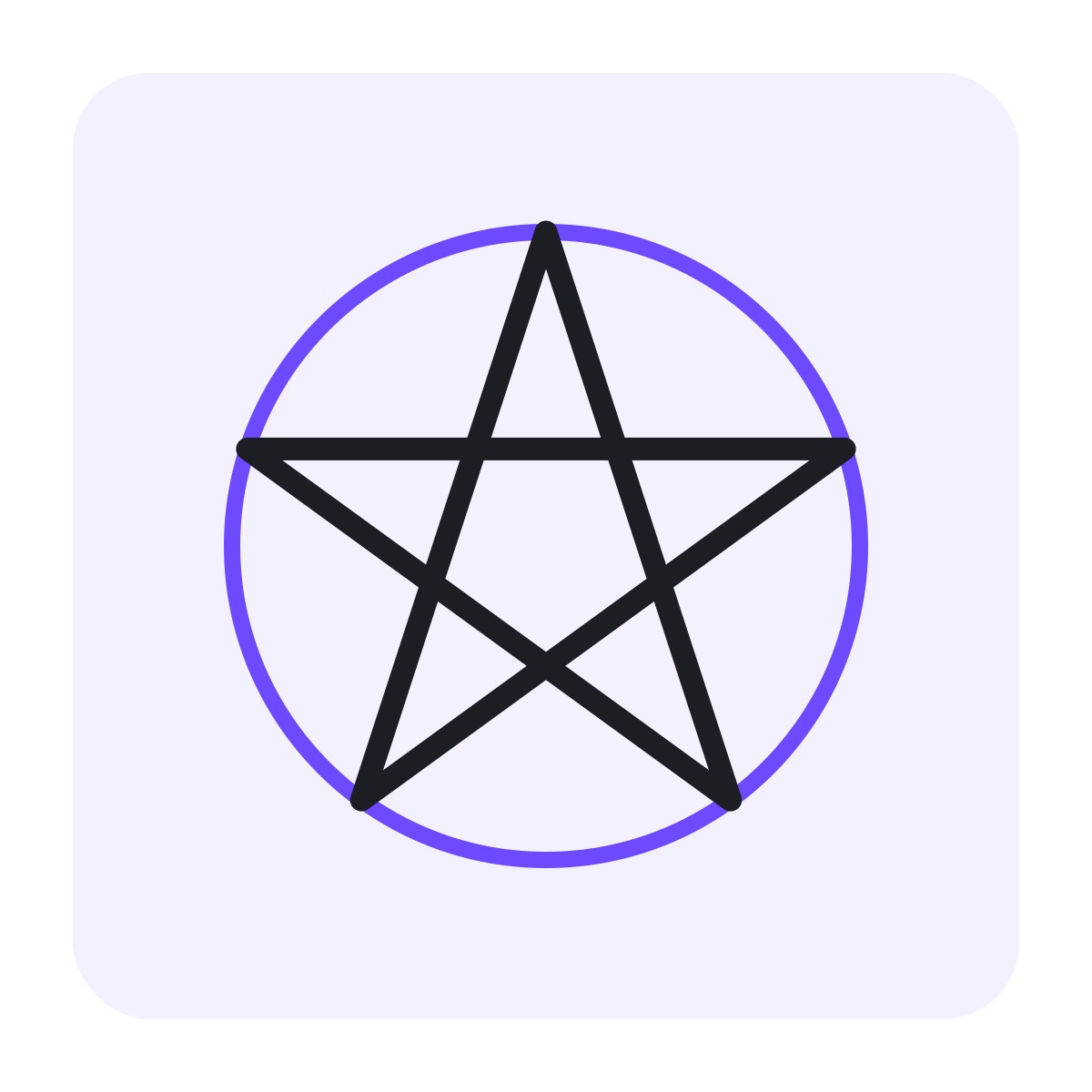
A pentacle is commonly a five-pointed star enclosed in a circle. In Wicca and some other modern Pagan settings, it represents the relationship of earth, air, fire, water, and spirit. It can also express religious identity. The word has older, broader meanings for talismanic objects, so it does not always name exactly the same design.
The key distinction is between a shape and an object’s use. A pentagram names a five-pointed crossing-line star. “Pentacle” may name an encircled version, a ritual object, or a design described in a particular historical text. Context prevents a convenient modern definition from becoming a misleading universal rule.
What does the pentacle mean in Wicca?
Harvard’s Pluralism Project describes the pentacle as a symbol of life and the union of four elements with spirit. Its account associates the upright star with an upright human figure. Many Wiccans wear the emblem, making it a public sign of belonging as well as a religious image.
These meanings should be stated as teachings and interpretations, not claims about measurable forces. Describing a pentacle as protective explains how some people understand it; it does not establish that wearing one prevents danger or treats an illness.
The circle brings the five-pointed star into one bounded composition. It is often read in contemporary practice through ideas of unity or wholeness, but there is no single official interpretation binding every Pagan. A practitioner’s community and explanation are better guides than a generic chart assigning fixed powers to each line.
Pentacle versus pentagram
For everyday identification, the usual distinction is straightforward: the pentagram is the star, and the pentacle is the star within a circle. It is a helpful way to describe jewelry, icons, and many modern religious images without writing a long visual description each time.
Historical language is less tidy. Oxford Reference defines a pentacle more broadly as a talisman or magical object, typically a disc inscribed with a pentagram or another figure. That “other figure” matters. The name of an object does not guarantee that it contains the familiar five-pointed star.
Conversely, a catalog may call an encircled star a pentagram while emphasizing the star itself. That is not automatically an error. When comparing sources, check whether they are naming geometry, an entire emblem, or an object used in ritual. Those are related but different tasks.
What can older objects tell us?
A British Museum gold signet-ring and amulet, catalog number AF.1022, shows a pentagram within a serpent whose tail meets its mouth. The catalog identifies both the star and the enclosing serpent. This is a useful reminder that a star’s frame can itself be another symbol rather than a neutral circle.
That object should not simply be relabeled a modern Wiccan pentacle. Its inscriptions, material, and historical setting belong to its own record. Calling every earlier encircled star “Wiccan” would erase the distinction between an older visual form and a modern religion’s use of it.
The enclosing tail-biting serpent also has a separate history, discussed in our entry on the ouroboros. Here the example is cited for comparison only. We do not reproduce a British Museum image because this site’s artifact-image policy is limited to verified Met and Cleveland CC0 photographs.
The pentacle as a ritual object
In some modern Pagan practice, a pentacle is a physical item placed on an altar rather than only a symbol worn around the neck. Oxford’s definition links the object with the element earth. Circle Sanctuary’s published description of its Circle Craft path includes a pentacle among ritual tools.
That does not mean every practitioner owns the same object or uses it in the same way. Materials and forms vary, and a community’s account describes its own practice rather than all Pagan religion. A pendant, an altar disc, and an illustration can share a design while serving different purposes.
For a museum-style description, begin with what can be observed: “disc with an engraved five-pointed star,” for example. Add a religious identification when an object record, maker, or user supports it. This separates visible evidence from an attractive but uncertain interpretation.
Why is the pentacle on veterans’ headstones?
The United States Department of Veterans Affairs lists “Wicca (Pentacle)” among approved emblems of belief for government headstones and markers. The current list identifies it as emblem 37. This is a concrete example of the symbol’s role in public religious identity.
Circle Sanctuary’s account of the Veteran Pentacle Quest records the campaign that led to the emblem’s addition in 2007. The issue was recognition for the beliefs of deceased veterans and their families, not government endorsement of a religion’s teachings.
This history is worth knowing because popular horror imagery can obscure the lives of people who actually use the emblem. A pentacle on a grave marker is not a puzzle requiring an occult decoding scheme. It identifies an accepted emblem of the deceased person’s belief.
What does pentacles mean in tarot?
Oxford Reference notes that pentacles is the name of a suit in some tarot packs, corresponding to coins in others. That is a use within a card system, not proof that every historical coin or circular charm was a pentacle.
Interpretations of individual cards vary by deck and reading tradition. The suit name alone does not supply one objective prediction about money, work, or the future. If discussing a particular illustration, identify the deck and describe its actual imagery instead of treating modern card meanings as universal historical facts.
Reading the symbol without stereotypes
A pentacle is not automatically Satanic, and it is not a generic badge for everyone outside a major world religion. Wiccans, other Pagans, ceremonial practitioners, artists, and jewelry wearers may understand related designs differently. Orientation alone does not tell the whole story either.
There is also no reason to confuse it with the six-pointed Star of David. Count the points, check the surrounding form, and consult the stated context. For broader comparisons, the religion hub keeps distinct traditions visible rather than reducing them to one shared secret vocabulary.
No verified museum photograph is included here: Cleveland’s CC0 search and the Met search returned no exact pentacle matches. The featured image is a modern geometric illustration of the common encircled-star form. It is labeled as an illustration, not presented as an excavated object or a reconstruction of a specific antique.
Frequently asked questions
Is a pentacle the same thing as a pentagram?
In common modern usage, a pentacle is a pentagram enclosed in a circle. Historically, pentacle can also mean a talismanic object bearing a pentagram or a different figure.
What do the five points of a pentacle mean?
Many Wiccans understand them as earth, air, fire, water, and spirit. Details differ among practitioners, and this is not a universal explanation for all older stars.
Is the pentacle a recognized religious emblem?
Yes. The U.S. Department of Veterans Affairs lists Wicca (Pentacle) as emblem 37 among approved emblems of belief for government headstones and markers.
Does every Pagan wear a pentacle?
No. Paganism includes multiple traditions and personal practices. The pentacle is important to many Wiccans and other Pagans, but it does not represent everyone.