Cultures
Pentagram Meaning, History and the Five-Pointed Star
The pentagram is a five-pointed star formed by connected crossing lines. Its history includes geometry, protective uses, personal emblems, and modern religion.
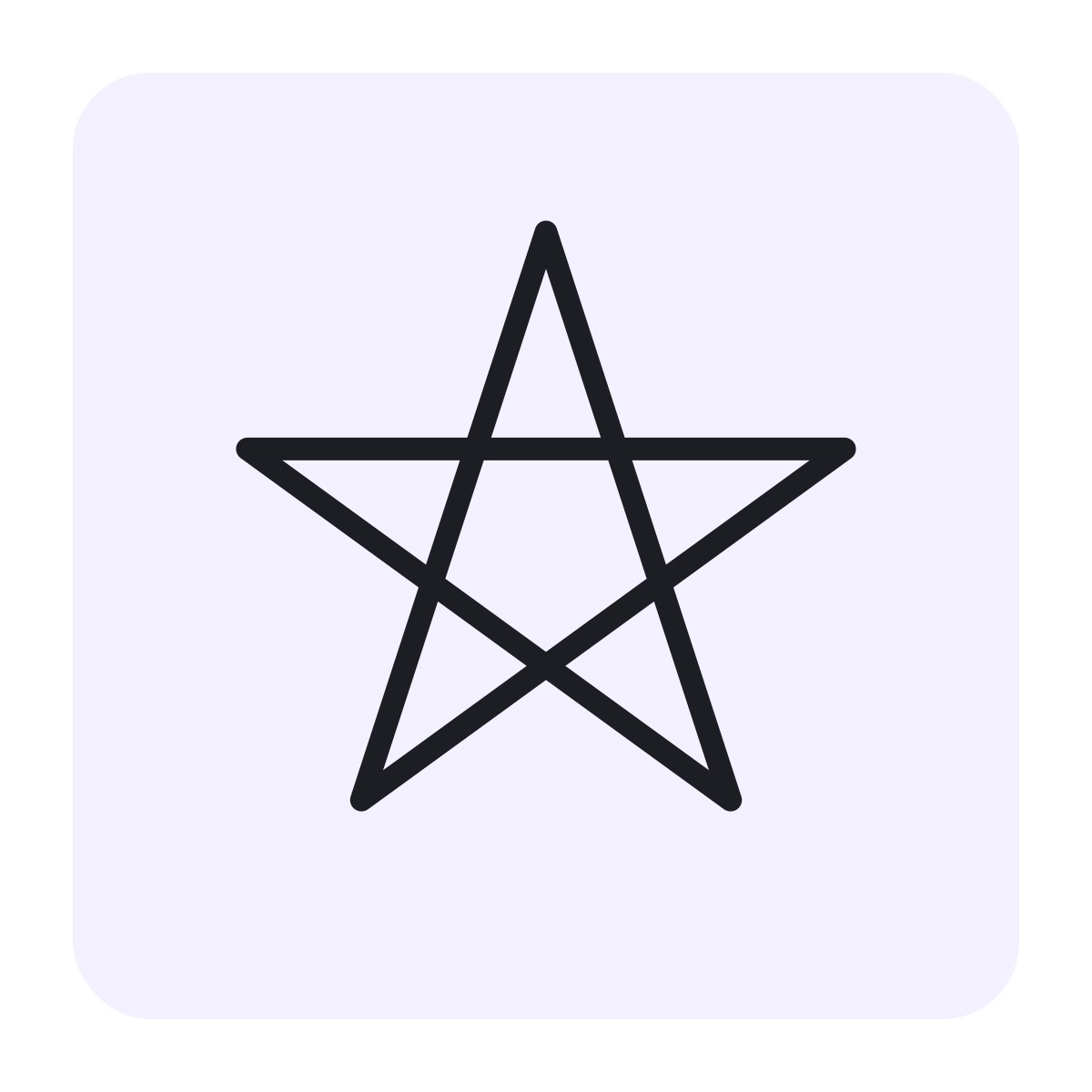
A pentagram is a five-pointed star drawn with five connected straight segments that cross one another. Its meaning depends on its setting. It has appeared as a geometric figure, a protective sign, a personal emblem, and a religious symbol. It does not have one timeless meaning, and it is not automatically a sign of evil.
In many modern Pagan and Wiccan settings, its five points represent earth, air, fire, water, and spirit. That interpretation is important to living practitioners, but it should not be projected backward onto every five-pointed star in a museum.
What is a pentagram, exactly?
The easiest way to recognize a pentagram is to follow its line. Starting at one point, the line crosses to a nonadjacent point, then continues until all five points are connected and the figure closes. A regular version has a small pentagon at its center.
A solid five-pointed star is visually related but does not display those crossing lines. A Star of David has six points and is a different figure. Counting points and checking the construction prevents two common identification errors before questions of symbolism arise.
A circle may be added around the pentagram. In common modern usage that encircled form is called a pentacle. The distinction is useful, but historical vocabulary is not perfectly consistent, and some sources use the two words with overlapping meanings.
Historical meanings were not all the same
Britannica documents the pentagram in ancient Mediterranean and Near Eastern contexts, including Greek coins and the traditions associated with Pythagoras and his followers. It discusses protective uses as well as the figure’s later occult and religious associations.
Those examples establish a long history, not an unchanging code. A figure used to identify a philosophical community can acquire a different role on an amulet. A decorative star on an object can also resemble a religious sign without sharing its purpose. Provenance and accompanying text remain essential.
Claims that the pentagram was invented by one modern religious movement are therefore misleading. So are claims that every occurrence proves the presence of an ancient, continuously organized secret religion. The evidence supports repeated and changing uses of a simple, memorable form.
A pentagram on armor and a pistol
Two Met collection records offer a particularly useful correction to assumptions about the star. The museum’s Reinforcing Breastplate, attributed to Italy, probably Milan, includes an engraved pentagram alongside the letter F and a coronet surrounding crossed palm branches.
The Met’s Wheellock Pistol, French Royal Arms Collection, inv. no. 217, attributed to Italy, probably Brescia, and dated about 1625–30, has related emblems. The catalog discusses the pentagram as part of a group of personal devices, not as self-evident proof of Satanism or modern Wicca.
The photographs below are the Met’s verified CC0 images of these objects. The pentagrams form small parts of much larger decorative programs, so the collection descriptions are important companions to the overall views. The featured illustration isolates the exact geometry; it is a modern diagram, not a drawing copied from either artifact.
Pentagram meaning in Wicca and Pagan practice
Harvard’s Pluralism Project describes the pentacle worn by many Wiccans as an interlaced five-pointed star. Its account explains the star through the union of four elements with spirit, and relates an upright arrangement to an upright human body.
That is a religious interpretation within a modern tradition, not merely an aesthetic preference. A person wearing the symbol may be expressing belonging, reverence for nature, or a relationship among the elements. It is more accurate to ask about that context than to assign a threatening meaning from a film.
Not every Pagan is Wiccan, and not every Pagan uses this symbol. Even where the five-element explanation is shared, details of ritual use can differ. A diagram giving one fixed point-by-point correspondence should identify its source rather than present itself as a rule for all practitioners.
Does an upside-down pentagram mean evil?
An inverted pentagram has two points at the top and one at the bottom. Modern occult and Satanic imagery has made that orientation familiar, but orientation alone does not identify every user’s belief or intention. Additional figures, text, the date, and the setting matter.
Britannica places the strong moral contrast between upright and inverted forms within the history of modern European occult interpretation. It should not be treated as an eternal rule built into geometry. A five-pointed figure does not acquire a single universal theology when it is rotated.
Equally, acknowledging modern Satanic associations where they are documented is not a reason to mislabel Wicca. Distinct religious and philosophical communities can use related forms differently. Describing an actual emblem is more informative than treating every star as evidence for the same belief.
Geometry and the golden ratio
A regular pentagram contains repeated geometric relationships. Its intersecting diagonals divide one another in the golden ratio, and the central pentagon can provide the starting points for a smaller star. These are properties of a regular construction, not evidence for a supernatural effect.
The word “regular” matters: hand-drawn and deliberately distorted stars do not necessarily preserve exact proportions. A designer can make the points longer or change the crossing arrangement for visual reasons. For the wider distinction between mathematical structure and religious interpretation, see sacred geometry symbols.
Copying and identifying the symbol
The character ⛤ is Unicode U+26E4, named PENTAGRAM. Its appearance depends on the font. A copied text character can be useful for a label, but an image is better when the exact direction, line crossing, or surrounding circle must remain unchanged.
Our Symbol Finder offers other stars and religious characters. Choose by the actual shape and Unicode name, not by assuming that every star glyph is interchangeable. When writing a caption, “five-pointed interlaced star” can be a responsible description if the object’s specific symbolic role is unknown.
In the museum
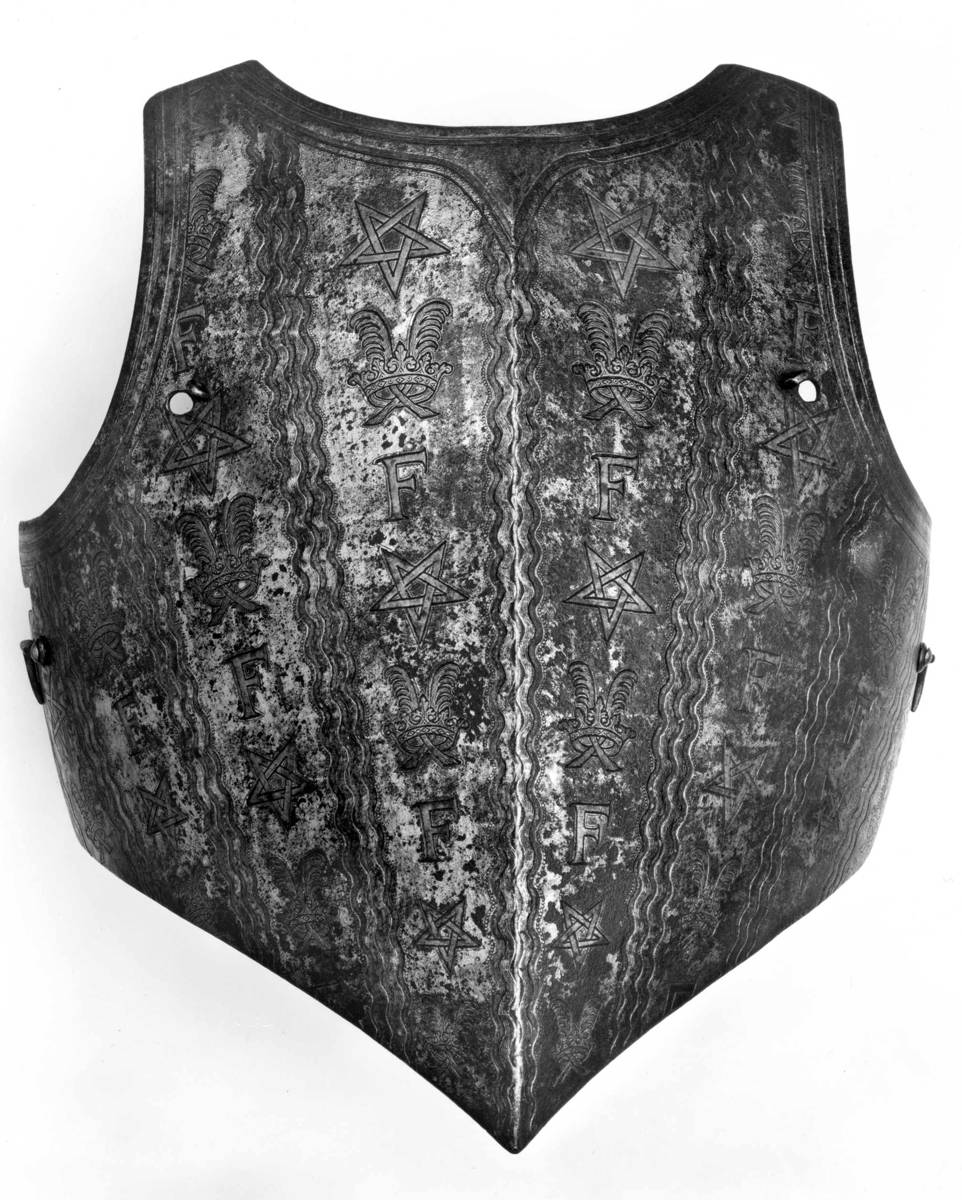
Reinforcing breastplate whose decorative personal devices include a pentagram, alongside an F and a coronet with crossed palm branches.
ca. 1625–30 · Italian, probably Milan · The Metropolitan Museum of Art · 14.25.867 · CC0
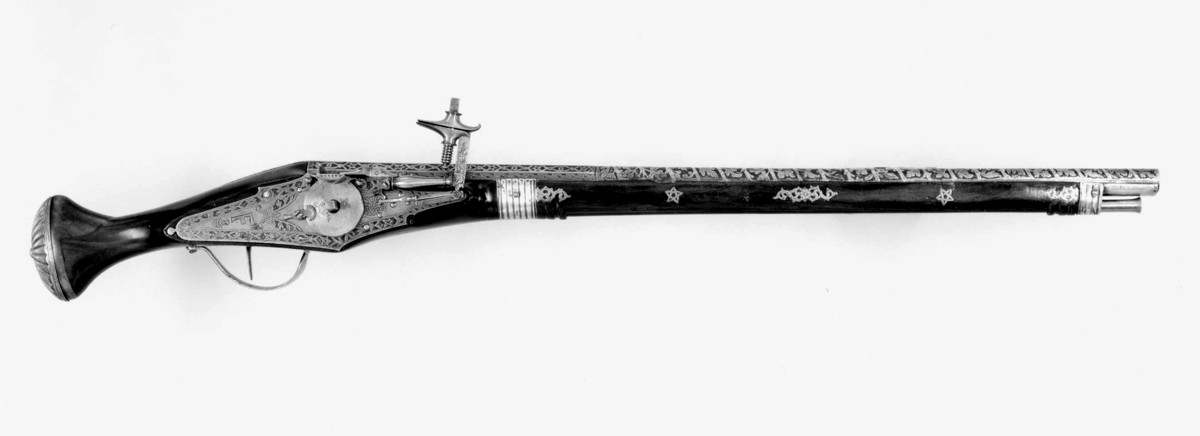
Wheellock pistol with catalog-identified pentagram devices in its decoration; the star is part of a larger group of emblems, not an isolated religious badge.
ca. 1625–30 · Italian, probably Brescia · The Metropolitan Museum of Art · 14.25.1426 · CC0
Frequently asked questions
What is the difference between a pentagram and a pentacle?
A pentagram is the five-pointed crossing-line star. In common modern usage, a pentacle is that star enclosed in a circle; historical usage also includes other talismanic objects.
Is a pentagram always Satanic?
No. It has geometric, protective, personal, and religious uses across different settings. Modern Satanic associations do not explain every occurrence.
What do the five points represent?
Many Wiccans interpret them as earth, air, fire, water, and spirit. That is not a universal explanation for all historical pentagrams.
What is the pentagram Unicode character?
⛤ is U+26E4, PENTAGRAM. The rendered shape varies by font; use an image when exact linework matters.