Religion
Crescent Moon and Star Meaning and History
The crescent and star is strongly associated with Ottoman history, modern national flags, and Islam. Its older celestial imagery does not carry one meaning in every setting.

The crescent moon and star is a widely recognized emblem associated with Islam, the Ottoman Empire, and several modern national flags. Crescent moon and star meaning depends on context: a national flag, a religious building, and an ancient seal are not using the same historical language simply because they show similar celestial shapes.
The emblem is not a universal logo required by Islam. Its familiar religious association developed through political and cultural history. Earlier crescent-and-star imagery also existed outside Islam, so neither an exclusively Islamic origin nor a single unbroken meaning should be assumed.
What does the crescent moon and star mean today?
On contemporary flags and buildings, the combination can signal a connection with a Muslim community, an Ottoman inheritance, or a particular national history. Which of those meanings matters most must be established from the object itself. The flag of Turkey is not interchangeable with the flag of Pakistan or Tunisia even though all include a crescent and star.
Britannica's account of the Tunisian flag makes a useful distinction: the forms have cultural histories but have acquired a strong association with Islam through their adoption by Muslim countries. That association is real. It does not mean every Muslim community uses the emblem, or that the emblem defines the religion's beliefs.
A crescent by itself is also a much broader image. It can represent the visible Moon in astronomy, a deity's attribute in an older artwork, or a decorative curve. A star alongside it changes the composition, but it does not eliminate the need to identify the maker, date, place, and purpose.
Did Islam invent the symbol?
No. Celestial imagery containing stars and crescents predates Islam. The Metropolitan Museum of Art catalogs an Achaemenid conoid stamp seal, dated approximately to the sixth through fourth centuries BCE, whose title identifies a star and reversed crescent with a sun disk. This is firm evidence for a much older visual vocabulary.
It is not evidence that the ancient seal means “Islam,” nor does it by itself establish a continuous line from that seal to a modern flag. A familiar shape can be reused, independently adapted, or reinterpreted. Resemblance is a starting point for historical inquiry, not its conclusion.
When examining an old image, distinguish between a crescent with one star, a Moon accompanied by several celestial signs, and a later standardized flag device. Claims that all three were originally one secret emblem usually flatten objects separated by centuries and by different religious or political settings.
How does Ottoman history fit?
The Ottoman connection is central to the emblem's modern recognition. But the popular story that the Ottomans first discovered the crescent when they conquered Constantinople in 1453 is too simple. Britannica notes that Ottoman rulers had used the crescent on standards at least a century earlier. The symbol's history cannot be reduced to that one conquest.
The later spread of Ottoman-associated forms helped make the crescent recognizable beyond a single locality. Even so, the crescent alone and the crescent-and-star pairing should not be treated as identical in every period. A source discussing one should not silently be made to establish the exact design or date of the other.
Political emblems also move into objects that are not flags. A nineteenth-century German Schellenbaum in the Met is a musical instrument of the Turkish-crescent type. Its crescent forms and attached stars belong to a European military-band object shaped by Ottoman musical influence. It is not a devotional object simply because its ornament looks familiar.
Why do several flags use it?
Flags use images to identify particular states and communities. Similar components can be combined in different colors, orientations, sizes, and positions. A crescent and star can therefore participate in a shared historical vocabulary while retaining a distinct national meaning.
For that reason, a flag's official description and history are better guides than a universal list claiming that a star always means one fixed set of duties or that every crescent has the same theological definition. Such explanations need evidence from the country or community concerned. They cannot safely be transferred from one flag to another.
Nor does the number of points on a star create a universal religious code. The five-pointed star familiar on several flags is not interchangeable with the six-pointed Star of David, which has a different history as a Jewish emblem. Shared geometry does not erase distinct communal meanings.
What do the museum objects actually show?
The Achaemenid stamp seal in the museum strip documents an early composition containing celestial signs. The star and crescent are details within a more complex scene of a king mastering lion-griffins. It should be read as an ancient seal, not displayed as if it were an early Islamic flag.
The German Schellenbaum supplies a different kind of comparison. The Met's description identifies an upward-pointing brass crescent near the top, a ball decorated with six metal stars, and another large crescent below. The stars are distributed on the instrument rather than arranged as a single modern flag emblem. Its value here is in showing how related motifs traveled into a specific object type.
These two objects are deliberately captioned as contextual evidence. Neither is presented as the first appearance of today's exact emblem. The featured image is a modern schematic, not a photograph of a historical flag, and it makes no claim to reproduce any country's legally specified proportions.
Copying the crescent and star character
The Unicode character ☪, U+262A, is named STAR AND CRESCENT. It offers a convenient plain-text representation. Its appearance varies by font, so it is unsuitable as a precise substitute for an official flag drawing. Unicode identifies the character; it does not certify a particular religious interpretation.
For other characters, use the Symbol Finder. To compare symbols historically rather than treating them as interchangeable icons, the entries for the menorah and dharma wheel show how the meanings of religious emblems emerge from particular communities and practices.
In the museum
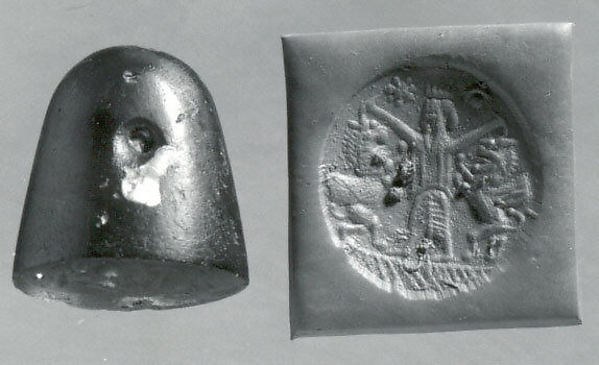
Achaemenid seal and modern impression: a king with lion-griffins, with a star and a reversed crescent containing a sun disk. Earlier celestial imagery, not an Islamic emblem.
ca. 6th–4th century BCE · Achaemenid · The Metropolitan Museum of Art · 64.98.1 · CC0
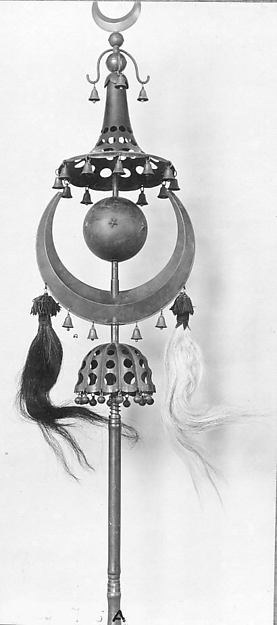
German Schellenbaum, early nineteenth century: upward-facing crescents and stars attached around a central ball, rather than a modern flag layout.
early 19th century · German · The Metropolitan Museum of Art · 89.4.846 · CC0
Frequently asked questions
Is the crescent and star the official symbol of Islam?
It is widely associated with Islam, especially through Ottoman and national histories, but it is not a universal required emblem for Muslims.
Is the crescent and star older than Islam?
Yes. Ancient objects show related celestial imagery. Similarity alone does not prove that every later use has the same meaning or a single direct origin.
Did the Ottomans first adopt the crescent in 1453?
That familiar story is misleading. Britannica records Ottoman use of the crescent on standards at least a century before the conquest of Constantinople.
What is the Unicode crescent and star?
☪ is U+262A, STAR AND CRESCENT. Its drawn appearance depends on the font, and it is not an exact national flag design.