Religion
Dharma Wheel Meaning and the Eightfold Path
The wheel of the Dharma represents the Buddha's teaching, often with eight spokes for the Noble Eightfold Path.
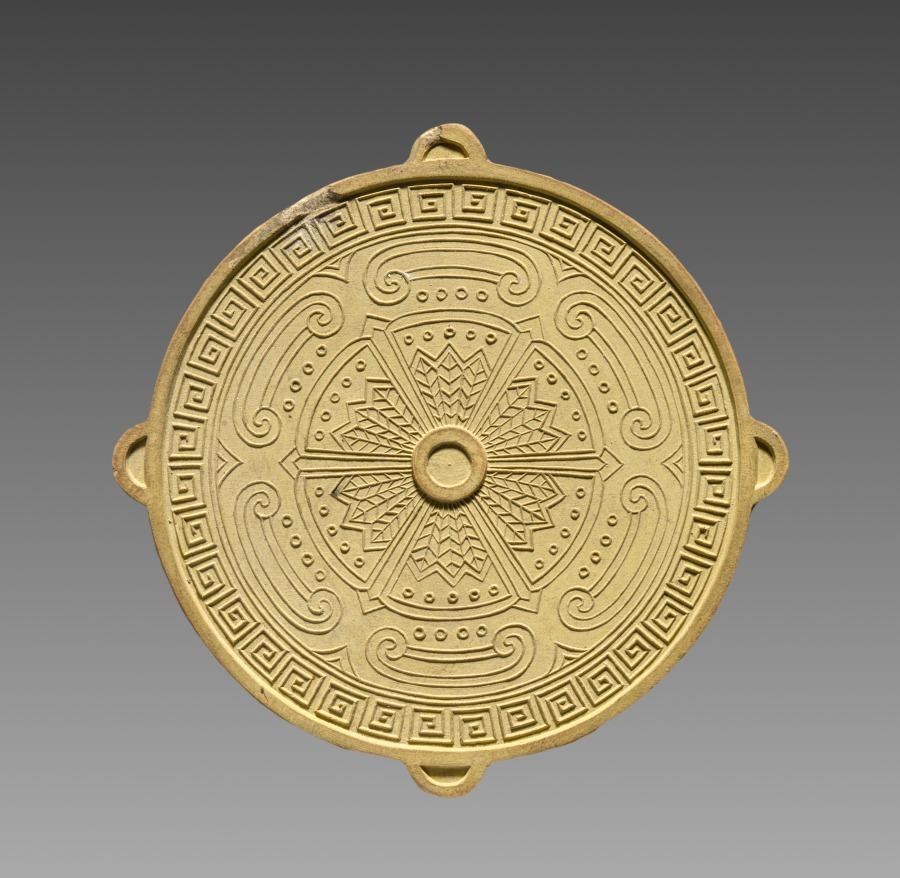
The dharma wheel is a Buddhist symbol of the Buddha's teaching, the Dharma. Called dharmacakra in Sanskrit and dhammacakka in Pali, it often has eight spokes associated with the Noble Eightfold Path. “Turning the wheel” means teaching the Dharma, not simply repeating the cycle of birth and death.
The wheel appears as a stand-alone emblem, a ritual object, and a detail in Buddhist art. Its form varies across regions and periods, so the familiar eight-spoked diagram should not be treated as the only authentic version. A dated museum object and a living Buddhist explanation together give a fuller picture than a list of supposedly universal meanings for every line.
What does the dharma wheel mean in Buddhism?
Its central reference is the Buddha's teaching and the teaching's movement into the world. The metaphor turns an everyday object into an image of religious instruction: the wheel is set in motion, and the Dharma is communicated. The Met uses this explanation for a Japanese ritual wheel, noting that the phrase “turning the wheel of the law” refers to teaching by Shakyamuni Buddha.
“Law” in older English museum titles means the Dharma in this religious sense. It does not mean a government statute or a command issued by a political ruler. “Wheel of the Dharma” and “Wheel of the Law” can therefore describe the same Buddhist symbol, although a particular object's language and tradition still matter.
The Buddhist Society of Australia describes the wheel as one of Buddhism's oldest and most widely used symbols. Its account connects the wheel with the first teaching after the Buddha's awakening and explains how its details can be interpreted differently. That range is part of the symbol's history, not a defect to be replaced by a single rigid decoding chart.
Why does it often have eight spokes?
Eight spokes commonly refer to the Noble Eightfold Path. The path is not eight unrelated promises or eight deities. It is a set of interdependent factors of practice. English translations vary slightly: “right resolve” and “right intention,” for example, can translate the same factor.
- Right view: understanding that guides practice.
- Right intention or resolve: the orientation of thought and purpose.
- Right speech: ethical communication.
- Right action: ethical conduct.
- Right livelihood: how one makes a living.
- Right effort: cultivating and sustaining appropriate mental qualities.
- Right mindfulness: attentive awareness in practice.
- Right concentration: collectedness of mind.
The list itself is grounded in Buddhist scripture, including the discourse traditionally understood as the Buddha's first sermon. The association between eight spokes and the eight factors is also explicitly identified in the Met's description of its late-thirteenth-century Japanese Wheel of the Buddhist Law. Not every historical wheel has eight spokes, however; counting them is a clue, not an automatic test of authenticity.
What does “turning the wheel” refer to?
The Dhammacakkappavattana Sutta, commonly translated as “Setting the Wheel of Dhamma in Motion,” places the Buddha near Varanasi at the Deer Park at Isipatana. He addresses five monks, rejects the extremes of indulgence and self-affliction, and teaches a middle way identified with the Noble Eightfold Path.
The discourse also presents the Four Noble Truths: suffering or stress, its origin, its cessation, and the path leading to its cessation. Translators differ in how they render key terms, but the connection between teaching and the wheel does not depend on one English wording. It is more precise to say the wheel evokes this teaching than to reduce it to a generic symbol of “positive energy.”
Two deer sometimes flank the wheel, recalling the location of that first teaching. They are part of a specific Buddhist visual reference, not merely decorative wildlife. When the deer are absent, the wheel can still carry its central meaning. Artists choose different ways to make the teaching visible.
What do the hub and rim mean?
Modern Buddhist explanations can connect the hub with ethical discipline or a settled center, the rim with concentration or mindfulness, and the circle with completeness. The Buddhist Society of Australia explicitly presents these as interpretations that vary. They should not be described as a fixed legend attached to every wheel from every period.
There is also a difference between a useful teaching analogy and a documented account of an object's manufacture. A teacher may use the hub, spokes, and rim to explain how practice holds together. An art historian still needs evidence before assigning that exact explanation to a particular carving. Both approaches can be valuable when their claims are kept distinct.
The wheel in surviving Buddhist art
The Met's limestone Dharma-wheel pilaster, dated to about the early third century CE, shows a wheel above a pillar capital, supported by two lions. Lotus petals frame its radiating spokes, and garlands hang beneath. The museum identifies it as an element of early Buddhist monastery imagery in Andhra Pradesh, possibly Ghantasala.
This is especially helpful evidence because the wheel is the actual subject of the relief, not an incidental circular object. It demonstrates that the Buddhist wheel did not always appear as a minimalist icon. Architectural setting, animals, flowers, and festive garlands could surround the central symbol.
A very different survival is Cleveland's yellow ink cake shaped as a Buddhist Wheel of the Law, dated 1795–1820. Its wheel shape and modeled spokes make the religious reference explicit. The museum explains that ink cakes were normally ground with water to prepare ink, although this precious set was never used. Buddhist imagery could therefore enter the world of fine writing materials as well as monumental sculpture and ritual metalwork.
These examples should not be flattened into one timeless design. Their materials, dates, places, and functions differ. The same care applies when comparing the wheel with a mandala or the lotus in Buddhist symbolism: related religious imagery is not necessarily the same type of object.
Is it the wheel of life or the wheel on India's flag?
The dharma wheel is not simply another name for the entire Buddhist wheel-of-life diagram. The latter depicts the condition of cyclic existence, often through a complex arrangement of figures and scenes. The dharma wheel primarily represents the teaching. Confusing them can reverse the point, turning a sign of the path into a generic sign of being trapped in a cycle.
India's national flag carries the Ashoka Chakra, a related wheel with twenty-four spokes, not the standard eight-spoked Buddhist icon. The Buddhist Society of Australia connects the flag's wheel with Ashokan pillars. Related history does not erase the flag's modern civic setting or make every twenty-four-spoked wheel interchangeable with every Buddhist ritual object.
Copying and describing the dharma wheel
The character ☸ is U+2638, named WHEEL OF DHARMA by Unicode. Its exact appearance depends on the font, so a text character will not reproduce every historical variation. It is also different from a ship's helm symbol, even though both can look like spoked wheels.
For a short caption, identify it as a Buddhist wheel of the Dharma and add the date or setting when known. For devotional use, follow the relevant community's explanation rather than treating the symbol as a context-free decorative charm. Browse our religious symbols for further comparisons rooted in specific traditions.
In the museum
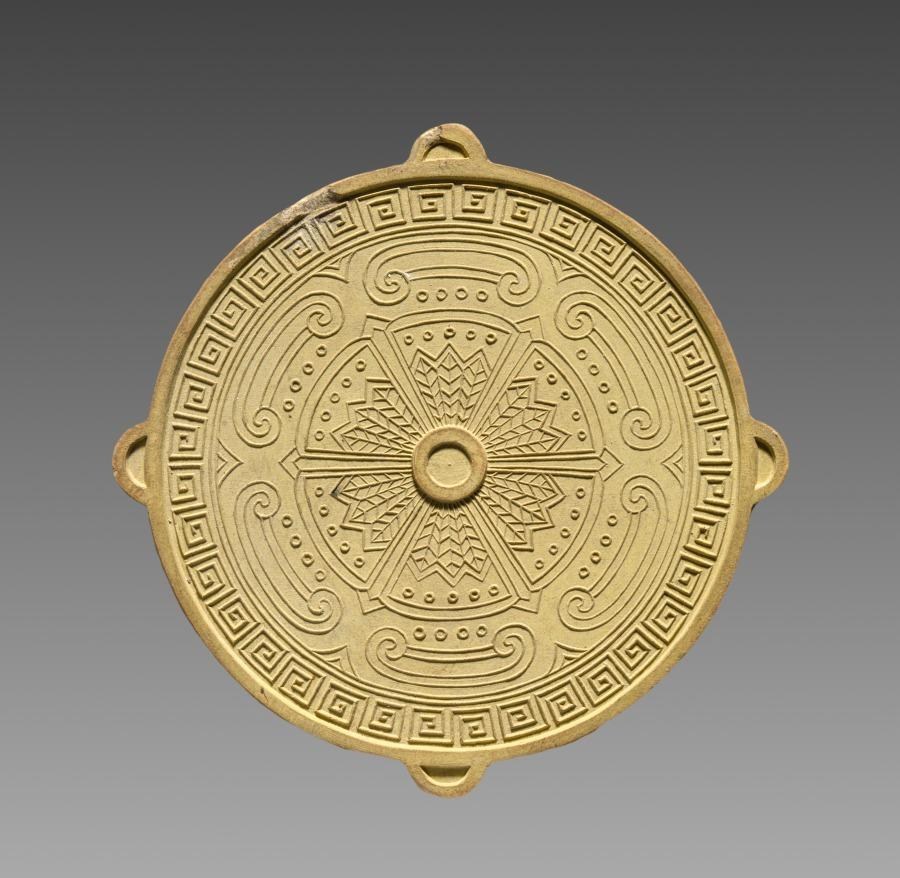
Yellow ink cake molded as a Buddhist Wheel of the Law, with a central hub and radiating spokes. Dated to the Jiaqing reign, 1795–1820.
1795–1820 · China, Qing dynasty (1644-1911), Jiaqing reign (1795-1820) · Cleveland Museum of Art · 1942.206.e · CC0
Frequently asked questions
What do the eight spokes of the dharma wheel represent?
They commonly represent the eight factors of the Noble Eightfold Path: right view, intention, speech, action, livelihood, effort, mindfulness, and concentration.
Does every dharma wheel have eight spokes?
No. Eight is a familiar and meaningful form, but historical and regional forms vary in their number of spokes.
Why are there deer beside a dharma wheel?
They can recall the Deer Park at Isipatana, the traditional setting of the Buddha's first teaching.
What is the Unicode dharma wheel?
☸ is U+2638, officially named WHEEL OF DHARMA.
Sources & further reading
- Buddhist Society of Australia: The Dharma wheel
- Dhammatalks: Setting the Wheel of Dhamma in Motion, SN 56:11
- The Met: Wheel of the Buddhist Law (Rinpō)
- The Met: Dharma-wheel pilaster
- Cleveland Museum of Art: Yellow ink cake in the shape of a Wheel of the Law
- Unicode: Miscellaneous Symbols, character names