Religion
Mandala Meaning in Buddhist and Hindu Traditions
A mandala is a sacred diagram, not simply a decorative circle. Museum paintings reveal ordered realms, divine figures, gates, and distinct religious purposes.
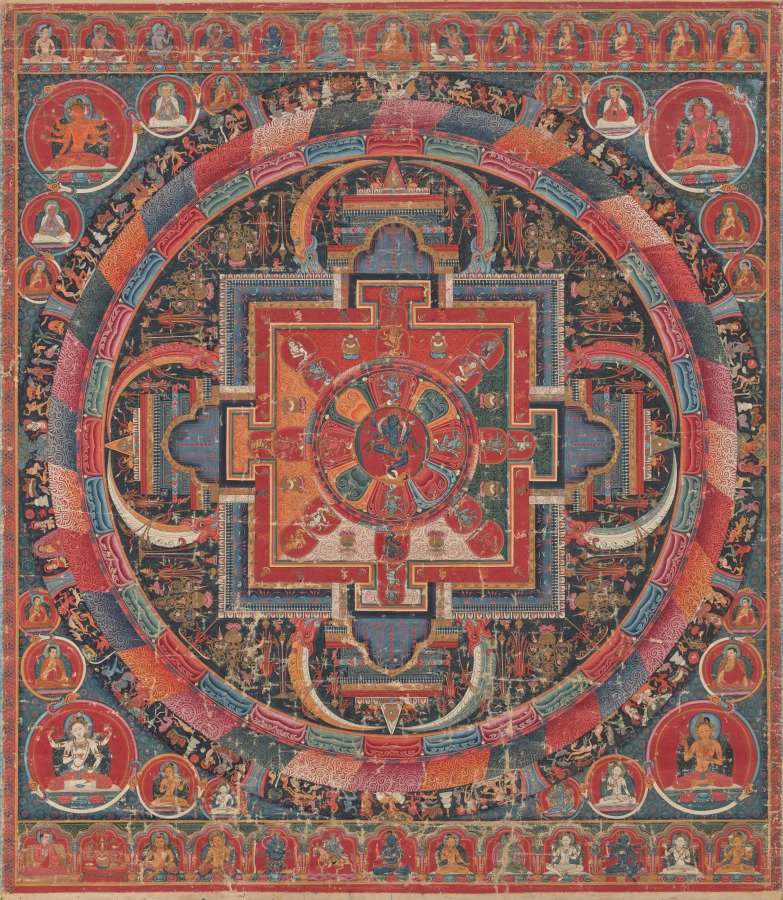
A mandala is a sacred diagram used in Hindu and Buddhist traditions to represent an ordered universe or a divine realm. The Sanskrit word means “circle,” but a mandala is not defined by circular decoration alone. Its figures, geometry, and religious use give it meaning.
In many Tantric Buddhist examples, a mandala presents the dwelling place of enlightened beings as a palace seen from above. Practitioners may visualize entering that realm under a teacher’s guidance. That is a more precise starting point than saying every mandala simply represents balance or relaxation.
What does a mandala represent?
“Mandala meaning” has more than one answer because the term belongs to several religious settings. A diagram may organize a cosmos, locate a central deity, or support ritual and meditation. Its meaning comes from a particular teaching and practice, not from a universal chart of colors and shapes.
The Smithsonian’s National Museum of Asian Art describes Buddhist mandalas as geometrically ordered palaces inhabited by buddhas, bodhisattvas, and other figures. The center and surrounding positions are deliberate. The image is a structured relationship among beings and spaces rather than a collection of interchangeable ornaments.
A viewer can appreciate the symmetry without knowing its complete ritual interpretation. But formal beauty and religious function are different kinds of information. An accurate caption should identify the named mandala, its tradition, and its central figures whenever those are known.
How to read a Buddhist mandala
A common arrangement places a square palace within surrounding rings. Gates establish directions and entry points. Rings of lotus petals, vajras, or fire can mark boundaries of sacred space. Not every mandala includes all these features, and the same visual element should not be assigned one meaning across every lineage.
Looking from outside toward the center can help a museum visitor understand the arrangement. Identify the outer boundary, then the gates or palace walls, and finally the main figure or group. This is a method of visual description, not a substitute for initiation or an instruction to perform a religious practice.
Some compositions include cremation grounds around the outer edge. These are not evidence that the painting celebrates harm. Cleveland’s explanations connect them with confronting death and loosening attachment to the body within guided Buddhist practice. Their presence complicates the modern assumption that a mandala must be a uniformly soothing floral pattern.
Two real mandalas in the museum
Cleveland’s Twenty-three Deity Nairatma Mandala, dated about 1375, shows Nairatma dancing in the center of an ordered realm. The museum identifies the central structure as her palace and the outermost ring as eight cremation grounds. Its account emphasizes the role of an accomplished teacher in guiding a practitioner through the image.
The second object, Mandala of Chakrasamvara and Vajravarahi, was made in Nepal in the late 1400s. Its central figures are Chakrasamvara and his consort Vajravarahi. The museum explains the diagram as a palace-like structure seen from above, with four gates and a surrounding ring of cremation grounds.
These paintings make a useful comparison. Both have ordered centers and boundaries, but their identities are not interchangeable. Their names identify different central beings, and their details belong to specific ritual systems. The CC0 images below reproduce actual paintings, not modern drawings given invented historical captions.
Why are some mandalas made from sand?
Sand is one possible medium, not part of the definition. The Smithsonian documents Tibetan Buddhist monks constructing a mandala with colored grains after preparing the space and establishing the design. The work involves trained, coordinated activity within a ritual setting.
The completed design is subsequently swept away. For a viewer, this makes impermanence unusually visible: careful work does not have to become a permanent possession. The Smithsonian’s documentation also shows sand being taken to water after the dismantling. Details and explanations should be tied to the specific ceremony rather than assumed for every community.
Our description concerns religious meaning and documented process. It makes no medical claims about viewing a mandala, using a coloring book, or keeping an image at home. A museum’s account of participants’ religious beliefs should not be mistaken for clinical evidence.
Hindu mandalas and related diagrams
Mandalas also belong to Hindu traditions. Britannica describes their use in sacred ritual and meditation and notes the role of a square-based mandala in Hindu temple planning. The translation “circle” therefore does not mean every example must be a round picture.
The related word yantra refers to an instrument or ritual diagram. The terms can overlap in particular contexts, but they are not a license to rename every diagram. The Sri Yantra, for example, deserves its own identification and explanation rather than being treated as a generic Buddhist mandala.
Our introduction to sacred geometry symbols considers how geometric forms acquire meaning in particular traditions. Geometry can organize a religious image without proving that all religions teach a single hidden mathematical system.
Are modern circular designs mandalas?
In everyday English, “mandala” is also used for radial drawings and coloring designs. That broader use is recognizable, but it should be labeled as modern decorative usage when no religious model is involved. Not every rosette, kaleidoscope pattern, or symmetric doodle is a historical sacred diagram.
There is no dependable universal key saying that a blue petal always means one thing or that a given number of rings diagnoses a person’s inner state. For a traditional image, consult the named tradition and object record. For a contemporary drawing, the artist’s explanation may be the most relevant source.
Respectful interpretation begins by keeping those settings distinct. A dharma wheel, a lotus, and a mandala may appear together in Buddhist art, but each has its own role. See lotus symbolism for another example of why context matters more than a one-word translation.
In the museum
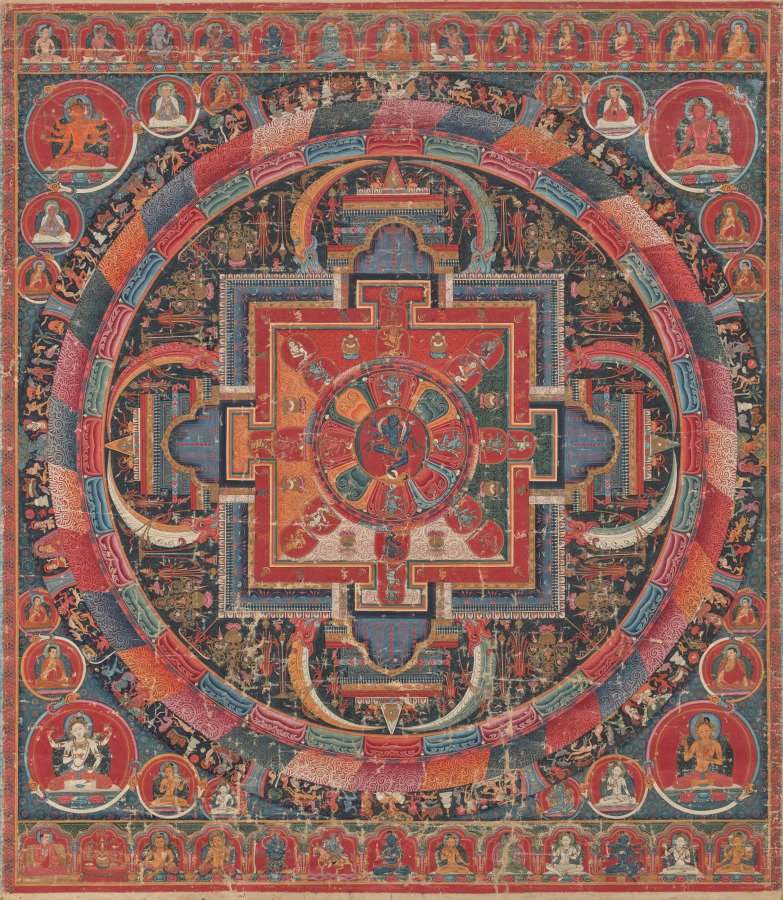
Twenty-three Deity Nairatma Mandala, c. 1375, Central Tibet. A central sacred realm enclosed by rings and attendant figures. The Cleveland Museum of Art, 1993.4; CC0.
c. 1375 · Central Tibet · The Cleveland Museum of Art · 1993.4 · CC0
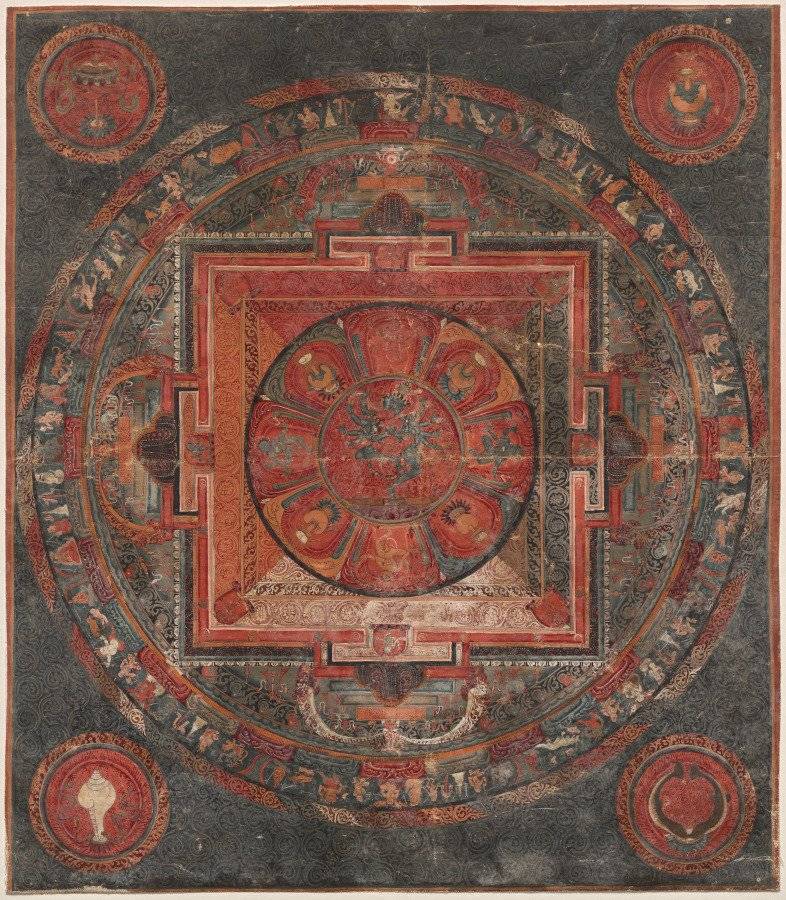
Mandala of Chakrasamvara and Vajravarahi, late 1400s, Nepal. A central sacred realm enclosed by rings and attendant figures. The Cleveland Museum of Art, 1960.211; CC0.
late 1400s · Nepal · The Cleveland Museum of Art · 1960.211 · CC0
Frequently asked questions
What does mandala mean in English?
The Sanskrit word means “circle.” In religious use it refers to a sacred diagram, which may include squares, palaces, figures, and other forms rather than only a circle.
Are all mandalas Buddhist?
No. Mandalas are used in Hindu and Buddhist traditions. Their forms and purposes differ by religious setting, region, and practice.
Why is a sand mandala destroyed?
In documented Tibetan Buddhist ceremonies, the completed sand image is dismantled as part of the ritual. Its temporary existence makes impermanence visible; consult the particular community for the ceremony’s fuller meaning.
Is every circular pattern a mandala?
No. The word has a broad modern decorative use, but a circle or radial pattern alone does not establish a traditional sacred identity.