Religion
Khanda Meaning and the History of the Sikh Emblem
The Sikh emblem joins a double-edged sword, circle, and curved swords. Sikh sources connect them with truth, divine oneness, and spiritual and worldly responsibility.
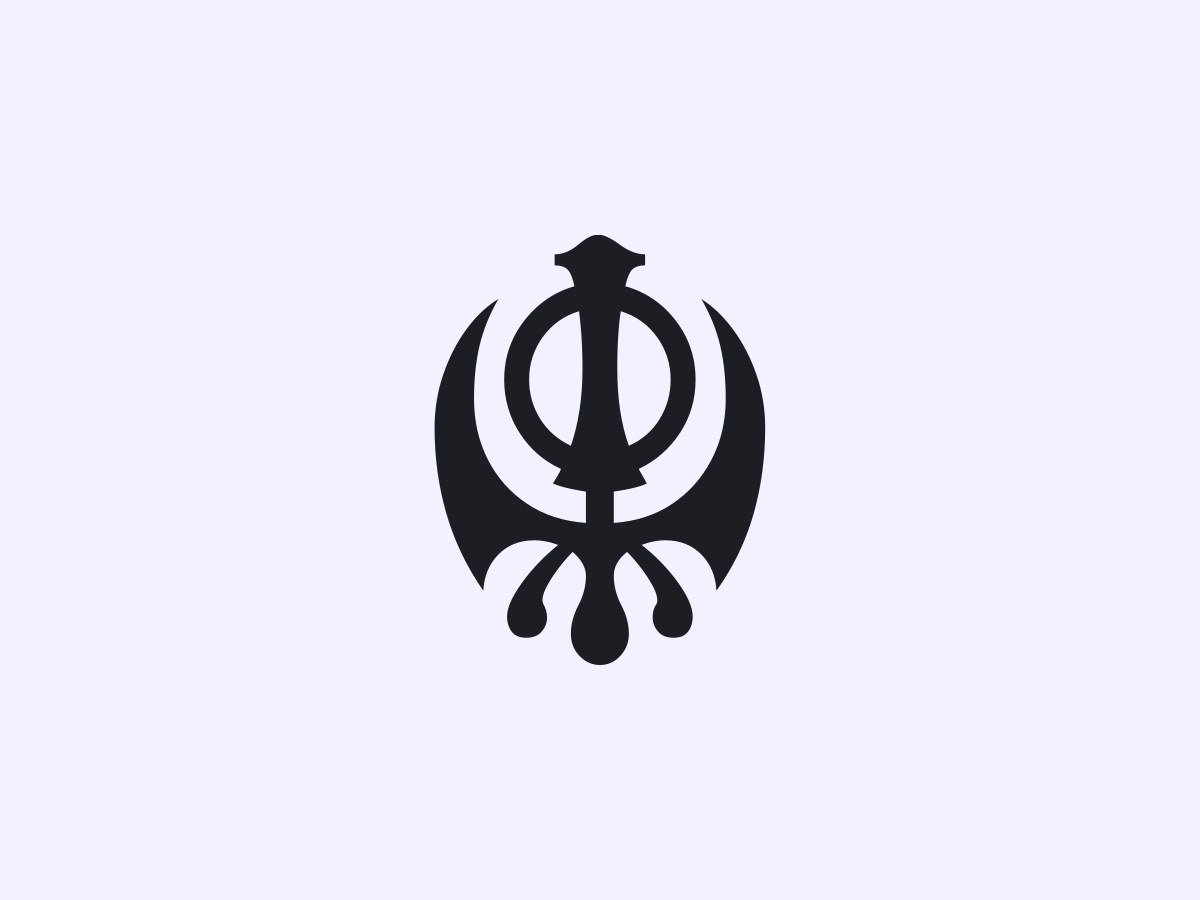
The khanda is a Sikh emblem combining a central double-edged sword, a circular weapon called a chakkar, and two curved swords. Its familiar form expresses religious understanding together with responsibility in the world. The same word also names the central sword itself, so a museum object titled “khanda” is not necessarily an example of the complete emblem.
The symbol is closely associated with Sikh identity and appears on the Nishan Sahib, the flag marking a gurdwara. Understanding it requires more than identifying weapons: Sikh explanations connect those forms with truth, the divine, spiritual commitment, and obligations to society.
What does the khanda mean?
The Sikh Coalition and Australian Sikh Civil Rights explain the emblem through the relationship among its parts. These are interpretations offered by Sikh organizations, not a speculative code imposed from outside the tradition. Although wording varies, the central theme is the integration of spiritual understanding and worldly duty.
It would be misleading to describe the khanda simply as a sign of warfare. Its weapons carry ethical and religious meanings, including discernment and the responsibility to protect. Equally, stripping away the weapons' identity to call it a generic “balance symbol” loses the particular Sikh history that gives the emblem its force.
The central double-edged sword
The straight sword in the center is the khanda from which the emblem takes its name. The Sikh Coalition describes its sharp edges as a metaphor for divine knowledge distinguishing truth from falsehood. Australian Sikh Civil Rights gives a similar explanation.
This is a religious interpretation of a recognizable weapon, not a claim that the physical blade grants knowledge. In an image, the central blade provides the vertical axis. Its relationship with the surrounding circle and curved swords distinguishes the whole emblem from an isolated sword illustration.
The circular chakkar
The circle is a chakkar, also spelled chakar. As a form without an obvious beginning or end, it is explained in Sikh educational sources through God's eternity, perfection, or oneness. Its circular shape should be read within that account rather than treated as evidence for every meaning ever assigned to a ring.
A chakkar can also be a historical weapon in a collection. That is a related object, but it is not by itself the complete khanda emblem. Clear captions should preserve the difference between a symbol's components and an actual representation of the assembled sign.
The two curved swords
The two curved swords are connected with miri-piri, the integration of temporal and spiritual authority associated with Guru Hargobind. Sikh sources describe these as complementary commitments: spiritual life does not cancel responsibility toward other people, and worldly action should not be severed from spiritual principle.
This relationship is more precise than a loose comparison with “opposites” or with the yin-yang symbol. The two traditions have distinct concepts and histories. A resemblance in the idea of relationship is not evidence that their emblems share an origin.
Khanda and the Nishan Sahib
The Nishan Sahib is the Sikh flag seen at gurdwaras. Australian Sikh Civil Rights describes it as a sign of refuge, food, shelter, protection, and dignity for all. The khanda commonly displayed on it therefore belongs to a public religious setting, not merely to a decorative vocabulary.
Sandeep Singh Brar's SikhMuseum study treats the flag as a marker of Sikh identity and spiritual sovereignty. It is not simply a national flag for everyone of Punjabi ancestry. Sikh religious identity cannot be equated with a single nationality or with every person from a geographical region.
The emblem is also not the flag itself. “Khanda” identifies the composite sign; “Nishan Sahib” names the sacred banner. A photograph may show both, but the terms answer different questions about what is pictured.
How old is the modern khanda emblem?
This question requires separating older weapons and religious principles from the exact modern arrangement. Historical swords, circular weapons, and Sikh banners are older than some surviving examples of the standardized composite emblem. Their existence alone cannot date the whole design.
Sources do not give a single uncontested origin story. The Sikh Coalition's FAQ reports an eighteenth-century appearance, attributing that account to scholar Kapur Singh. Brar's detailed SikhMuseum exhibition instead places the emergence of the modern form around the first decade of the twentieth century, after tracing earlier banner and weapon-emblem designs.
One especially useful piece of Brar's evidence is a photograph dated approximately January 24, 1906. It shows a Nihang wearing a turban ornament identified in the exhibition as an early modern khanda. The exhibition points out physical connections between the components, explaining why this is considered a single designed emblem rather than a chance arrangement of separate weapons.
Accordingly, this entry does not assign the finished emblem a certain inventor or claim that today's standardized design was unchanged during the Gurus' lifetimes. Its component meanings and the development of its graphic form are connected histories, but they need not have identical dates.
Khanda is not Ik Oankar
Ik Oankar, often written ੴ, is another foundational Sikh sign. The Sikh Coalition identifies it with the opening of the Guru Granth Sahib and the affirmation of one God, the Creator. It is distinct from the khanda, both visually and in its textual relationship to scripture.
Calling the khanda “the Sikh version of Om” is therefore inaccurate. Sikh identity includes its own language, scripture, institutions, and concepts. A comparison with Om should clarify differences rather than suggest that one religious sign is a substitute for another.
Copying and displaying the symbol
Unicode encodes ☬ as U+262C ADI SHAKTI. The character's official name differs from the common name used for the Sikh emblem. Font designs can vary in the thickness and arrangement of its elements. The code point identifies a text character; it does not date the religious design.
Australian Sikh Civil Rights specifically advises treating the khanda with care and notes that disrespectful placement, such as on a floor or near shoes, can cause distress. Educational use should identify it accurately and avoid contexts that trivialize a living sacred emblem. It is not Gurbani itself, but that does not make it a neutral ornament.
Museum evidence and an honest image gap
The permitted museum searches did not yield a verified CC0 photograph of the complete composite emblem. The Met search returned candidates under “khanda,” but its object-detail endpoints were inaccessible during verification. Cleveland's matching result was unrelated. An isolated sword or a loosely associated Sikh object would not satisfy the requirement for visible-symbol evidence.
For that reason, the featured image is a clean rendering of the encoded character, clearly labeled as an illustration. The historical photograph discussed above remains a source for the emblem's development, not an image reproduced here. No permission or public-domain status is assumed merely because an object is old.
Frequently asked questions
What are the parts of the khanda?
The emblem combines a central double-edged sword called a khanda, a circular chakkar, and two curved swords associated with miri-piri.
What does khanda mean in Sikhism?
Sikh organizations explain it through divine knowledge, God's eternity or oneness, and the integration of spiritual commitment with worldly responsibility.
How old is the modern khanda emblem?
Sources differ. SikhMuseum's study identifies an early modern form in a photograph dated about January 24, 1906; the Sikh Coalition reports an earlier origin. The exact inventor and a single uncontested date are not established here.
Is khanda the same as Ik Oankar?
No. Ik Oankar is a distinct sign associated with the opening of the Guru Granth Sahib and the affirmation of one Creator. The khanda is a composite weapon emblem.