Religion
The Om Symbol: Meaning, Sound, and Sacred Traditions
Om is a sacred syllable before it is a graphic sign. Explore its Hindu philosophical meanings and its distinct Buddhist and Jain settings.
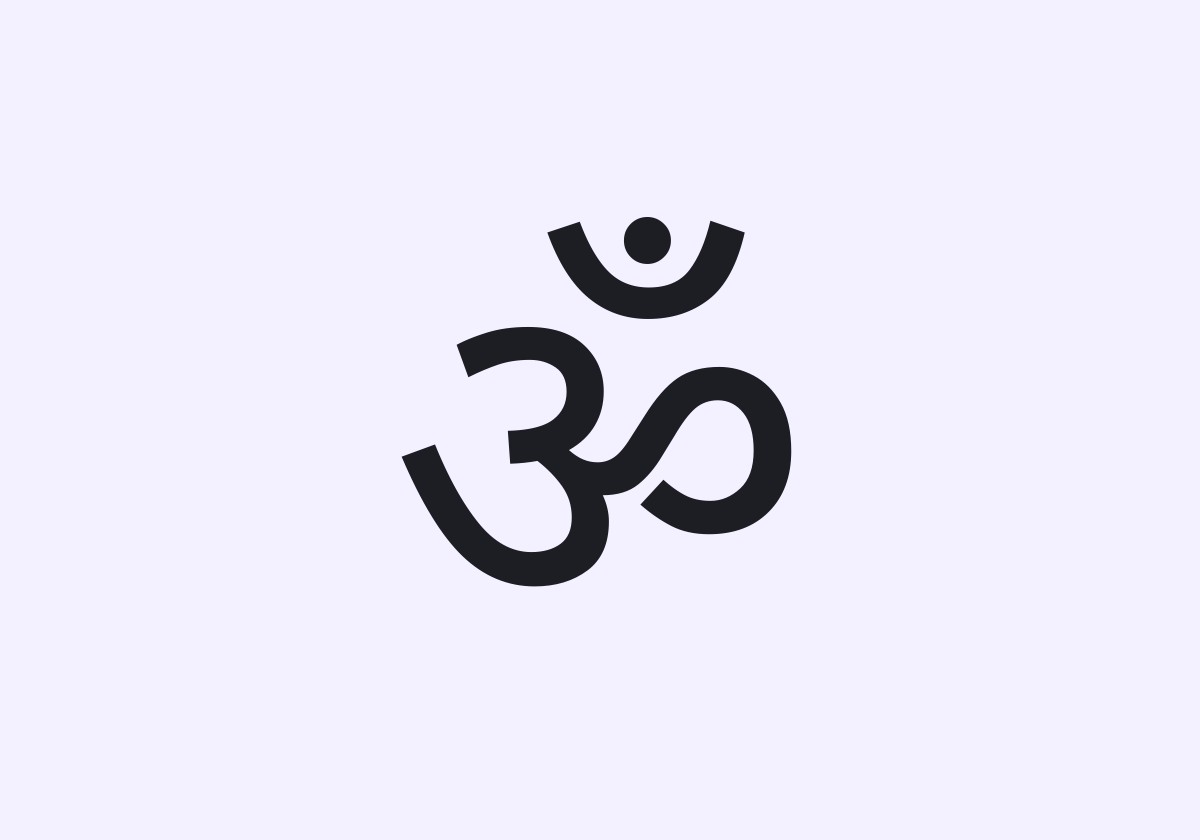
The Om symbol represents a sacred syllable, usually written Om or Aum, with a central place in Hindu prayer, scripture, and reflection on ultimate reality. The familiar sign ॐ is a written form of that sound, not its origin. Om also occurs in Buddhist and Jain traditions, where its meaning must be understood within the particular prayer, text, or community using it.
A useful starting distinction is between a sound, a written character, and an interpretation. These belong together, but they are not interchangeable. A manuscript can spell the syllable in a script that looks nothing like the familiar Devanagari sign while still referring to Om.
What does the Om symbol mean?
In Hindu traditions, Om can express the totality of existence and the relationship between the self and ultimate reality. The opening of the Mandukya Upanishad identifies Om with all that exists across past, present, and future, including what lies beyond those divisions. It connects this totality with Brahman and the self, or Atman. These are philosophical and religious teachings, not claims that a particular audible frequency has been scientifically identified as the universe's sound.
The syllable also has a practical ritual role. It opens or closes prayers, recitations, and meditation in many Hindu settings. Describing it only as a symbol of “peace” misses this textual and devotional depth. Peace may be an association for a particular person, but it is not a complete translation.
Om is often called the pranava. “Sacred syllable” is a helpful general description, while “mantra” identifies its use as a sacred utterance. Neither word means that all communities explain Om in precisely the same way.
Why is Om also written Aum?
Aum makes visible the traditional analysis of the syllable into A, U, and M. In Sanskrit, A and U combine to form O. The spellings therefore need not identify two different symbols or competing religions. They emphasize different ways of representing and explaining the same sacred syllable in Roman letters.
The Mandukya Upanishad relates these elements to modes of consciousness. Its scheme is more specific than the popular slogan that Om simply means “mind, body, and spirit.” The text considers waking experience, dreaming, deep sleep, and a fourth condition that cannot be reduced to the other three.
- A: associated with the waking condition.
- U: associated with the dreaming condition.
- M: associated with deep sleep.
- The fourth: the text's account moves beyond the three sound elements toward a nondual understanding of the self.
Modern explanations often use the silence following a chant to introduce that fourth condition. This can be a useful teaching approach, but the philosophical argument concerns more than a pause between sounds. It is also important not to turn these religious categories into a medical account of sleep.
How old is Om?
Om belongs to the Vedic textual and ritual world of South Asia. Finnian M. M. Gerety's Harvard dissertation traces its development through Vedic sources over the period from approximately 1000 BCE to the beginning of the Common Era. His research emphasizes variation: the syllable had multiple forms and functions within recitation and ritual, rather than a single unchanging use.
This is the history of the sacred sound. It does not date every curve of the modern printed ॐ to that early period. Writing systems, handwriting, and printing changed over time. Britannica distinguishes the syllable's religious history from evidence for the written sign marking the start of manuscripts or inscriptions from the sixth century onward.
For that reason, claims that a particular modern logo is thousands of years old need more evidence than the age of a text about Om. A reference work should separate the history of a teaching from the history of a graphic design.
Reading the written form without inventing a code
The widely recognized ॐ belongs to the Devanagari writing tradition. Online diagrams sometimes assign a precise cosmic meaning to each curve, the upper crescent, and the dot. Such diagrams can communicate a particular teacher's interpretation, but they should not be presented as a universal ancient key shared by every Hindu, Buddhist, and Jain community.
The strongest first explanation comes from texts that discuss the syllable and from objects whose inscriptions can be identified. A symbol's shape alone cannot establish the meaning of every line. Compare the distinct visual and ritual functions of a mandala or Sri Yantra, rather than treating all South Asian sacred designs as versions of one diagram.
Om in Buddhist and Jain objects
Om appears in Buddhist mantras, including om mani padme hum, associated with Avalokiteshvara. Cleveland's thirteenth-century Stele with Shadakshari-Lokeshvara carries that mantra in two scripts beside the figure's head. The letters are evidence for a particular devotional setting, not a reason to identify Buddhist teachings wholesale with Hindu accounts of Brahman.
A Yuan-dynasty Chinese bronze mirror in Cleveland bears the same mantra within its lotus design. The museum notes that its Sanskrit is slightly incorrect, possibly because the maker was unfamiliar with the language. That detail is valuable: sacred inscriptions traveled through real workshops, and their material histories include translation, adaptation, and mistakes.
A late-fifteenth-century Jain Kalpa-sutra folio offers another distinct setting. Among Mahavira's principal disciples is a stylized combination identified by the museum as om-hrim, invoking the essence of Jain teaching. It is a composite sacred sign, not a stand-alone example of the modern Devanagari Om glyph. The caption preserves that distinction.
Copying and identifying Om
Unicode encodes ॐ as U+0950 DEVANAGARI OM. It also encodes 🕉 as U+1F549 OM SYMBOL. Depending on the font and device, the latter may display as a pictorial emoji rather than a plain monochrome character. They are separate characters, so substituting one for the other can change appearance and text handling.
A character can be copied through the Symbol Finder, but copying is not the same as translating a mantra. Preserve surrounding text accurately when quoting a religious source. A single decorative character cannot stand in for a complete inscription.
Using the symbol respectfully
Om remains a living sacred sign, not simply a yoga-themed ornament. In editorial, educational, or design use, identify the tradition and context instead of marketing it as a universal good-luck mark. Do not promise healing, protection from illness, or measurable “energy” on the basis of the character.
The sound's shared presence in several religions is a reason for greater specificity, not less. A useful explanation asks who is using Om, in which language and script, and as part of which practice. Those questions reveal far more than an unsupported list of mystical meanings.
In the museum
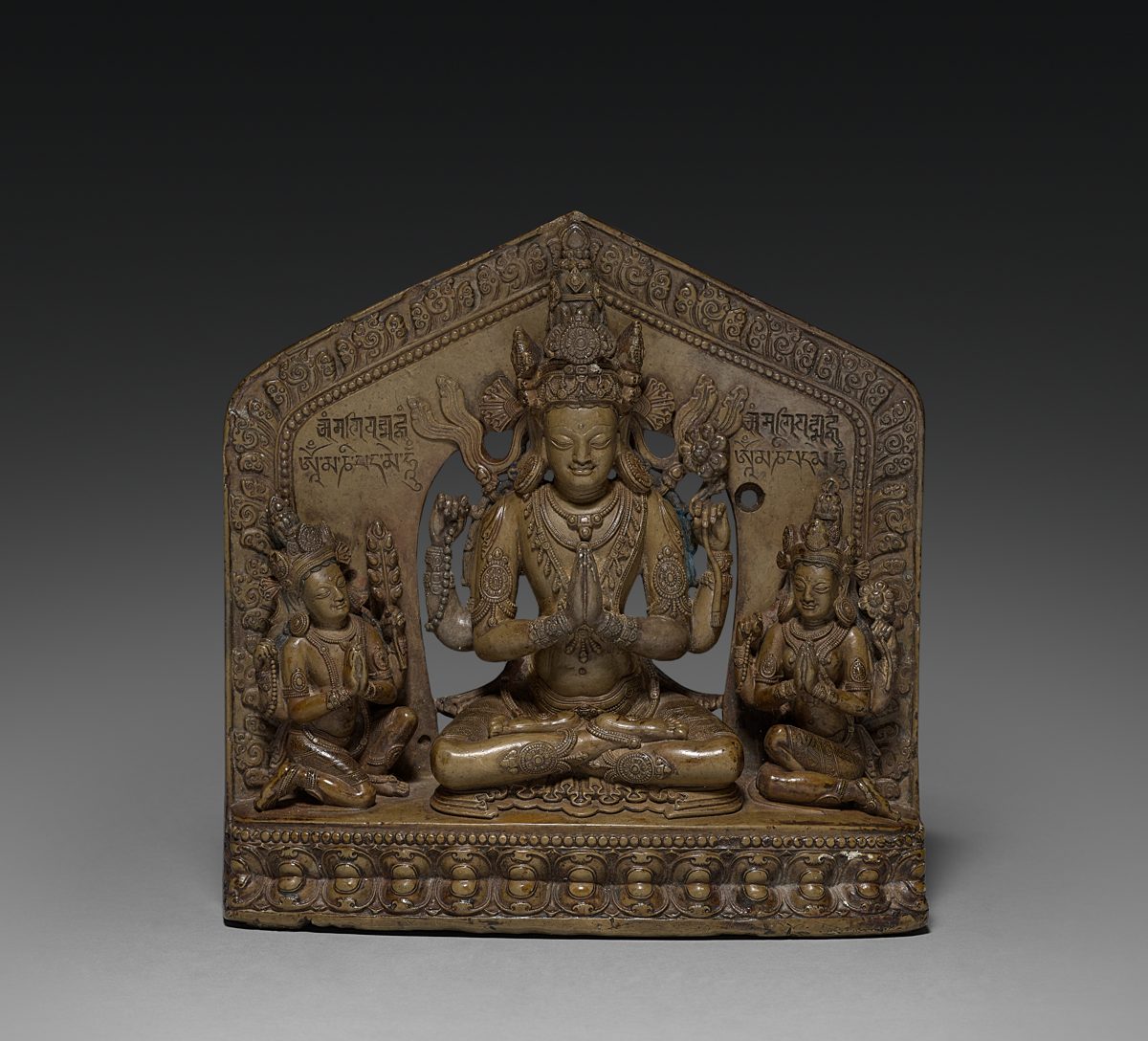
The mantra om mani padme hum is inscribed in two scripts beside the deity's head; this is not a stand-alone Devanagari Om sign.
c. 1200s · Tibet · Cleveland Museum of Art · 1989.4 · CC0
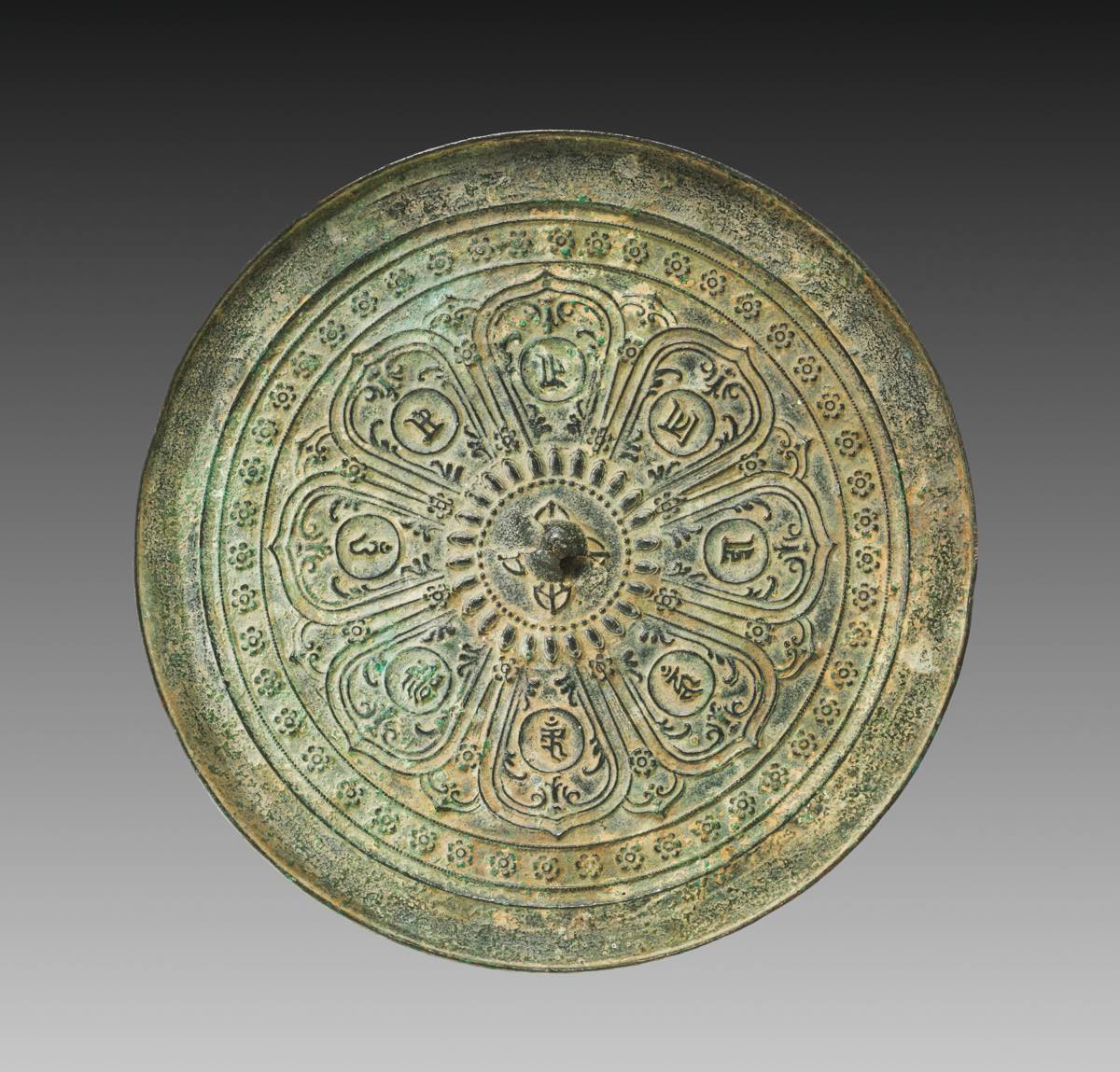
Lotus petals enclose the mantra om mani padme hum in the mirror's cast design; the museum notes irregular Sanskrit.
1271–1368 · China, Yuan dynasty (1271–1368) · Cleveland Museum of Art · 1999.221 · CC0
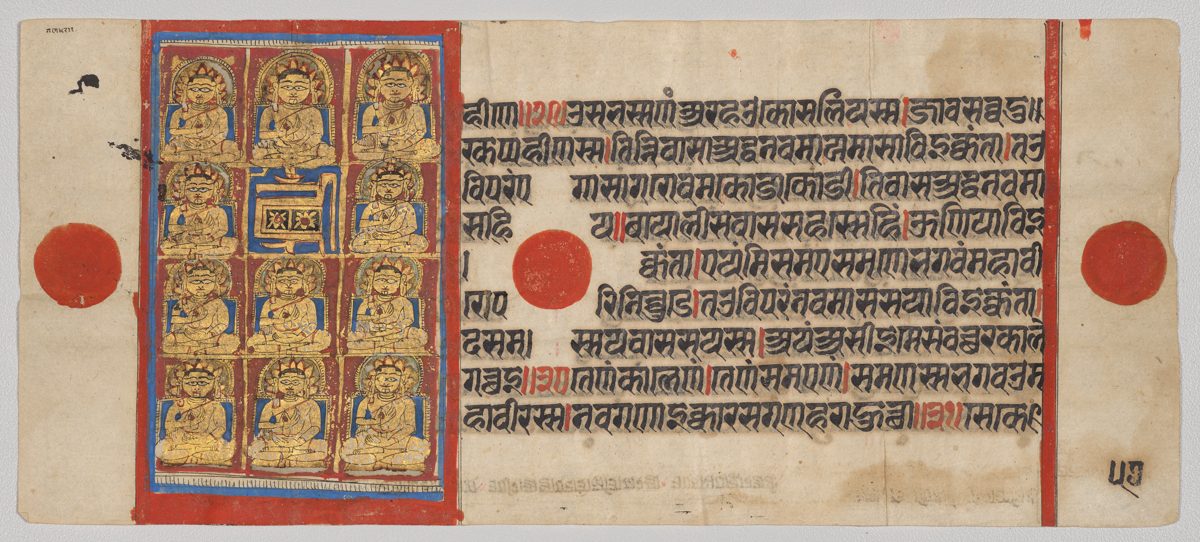
Within the upper central grid among the eleven disciples is the composite om-hrim sign; it is not an isolated Om glyph.
c. 1475–1500 · Western India, Gujarat · Cleveland Museum of Art · 1932.119.57.b · CC0
Frequently asked questions
What does the Om symbol mean?
In Hindu traditions, Om is a sacred syllable associated with ultimate reality and the totality of existence. Its written forms represent the sound; Buddhist and Jain uses require their own religious context.
Are Om and Aum different?
Usually not. Aum emphasizes the traditional analysis into A, U, and M; Sanskrit A and U combine as O. The spellings represent the same sacred syllable in different explanatory ways.
Is the Om symbol only Hindu?
Om has a central Hindu history and also appears in Buddhist and Jain ritual and art. Those traditions do not necessarily give it the same philosophical interpretation.
What is the Unicode for Om?
ॐ is U+0950 DEVANAGARI OM. 🕉 is the separate character U+1F549 OM SYMBOL and can display as an emoji depending on the device.
Sources & further reading
- Britannica: om
- Finnian M. M. Gerety, This Whole World Is OM, Harvard University (2015)
- Hinduism Today: Our Daily Modes of Consciousness, by Satguru Bodhinatha Veylanswami
- Mandukya Upanishad: twelve verses and translation
- Unicode: Devanagari chart
- Unicode: Miscellaneous Symbols and Pictographs
- Stele with Shadakshari-Lokeshvara
- Mirror with Lotus and Mantra
- The Eleven Principal Disciples (Ganadharas) of Mahavira, Folio 57 (verso), from a Kalpa-sutra