Religion
Sri Yantra Meaning and the Geometry of Shri Chakra
The Sri Yantra is a Hindu sacred diagram centered on the goddess. Its nine interlocking triangles organize a movement from the enclosing world toward a central point.
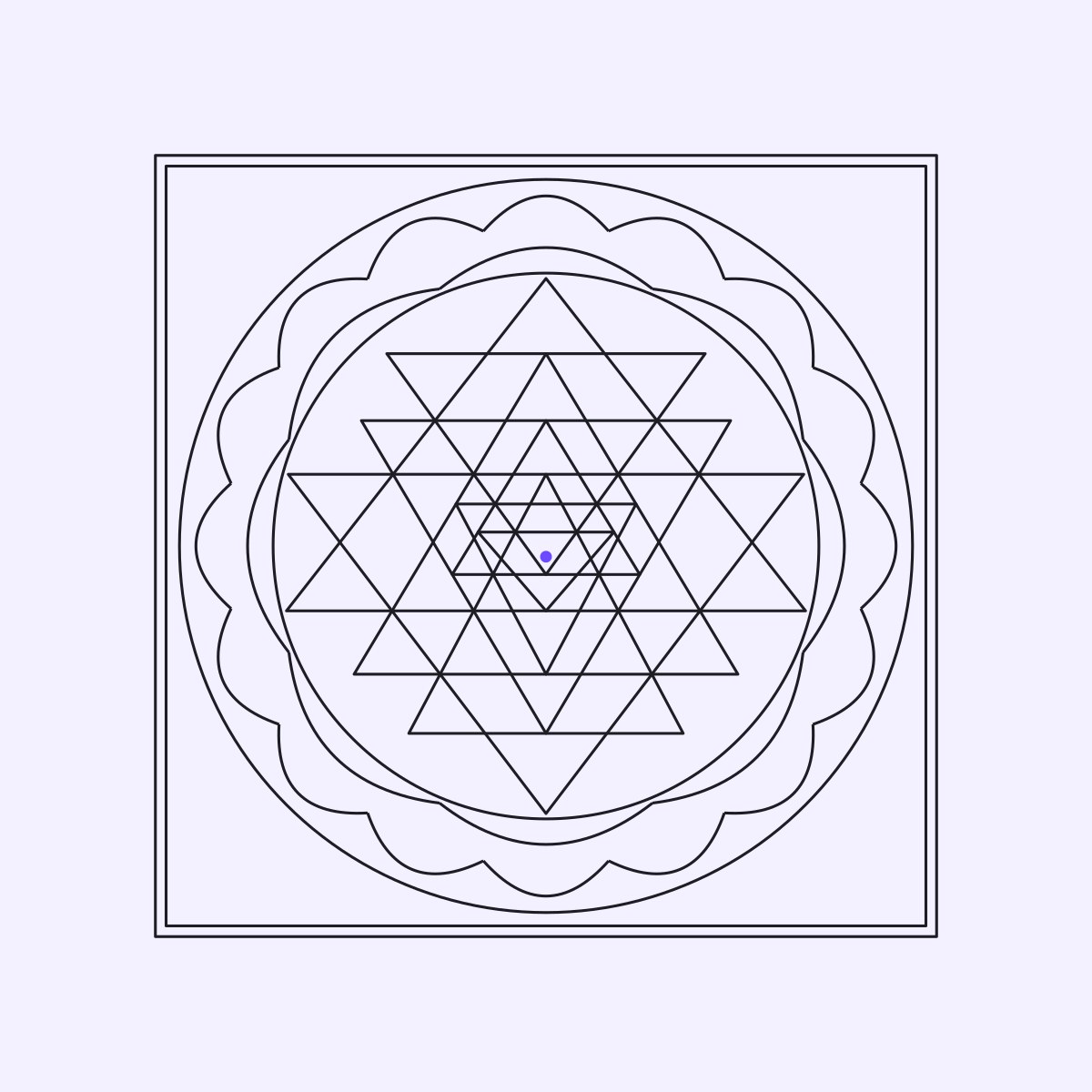
The Sri Yantra, also written Shri Yantra and called Shri Chakra, is a sacred diagram used in Hindu goddess worship, especially the Shri Vidya tradition. Sri Yantra meaning is rooted in the relationship of the goddess, the cosmos, and the worshipper. Nine interlocking triangles surround a central point, or bindu, within lotus rings and an enclosing boundary.
It is not simply a generic badge for good luck. In its religious setting, the diagram belongs to systems of worship, recitation, visualization, and teaching. Its precision matters, but counting its shapes is only one part of understanding it.
What does the Sri Yantra mean?
The diagram presents multiplicity and unity together. Numerous small compartments unfold from a tightly organized center. A worshipper can approach it as an ordered sacred space, moving inward through successive enclosures toward the goddess at the bindu. That movement is a religious interpretation, not a claim that the picture emits a measurable physical force.
The University of Pennsylvania's account of Hindu tantric diagrams identifies the nine interlocking triangles with the goddess Shri. A scholarly discussion published by the University of Hawaiʻi Press treats the Shriyantra as a diagram of Tripurasundari and a way of organizing a Shakta understanding of the world. These sources place the figure in a specific theological setting, rather than presenting it as a universal secret behind every religion.
Why are there nine triangles?
Four principal triangles point upward and five point downward. In a common interpretation, the upward triangles represent Shiva and the downward triangles represent Shakti. Their interpenetration expresses a relationship between consciousness and creative power. These associations belong to a religious vocabulary; they are not instructions for dividing actual people into fixed categories.
The nine large triangles intersect to make a pattern conventionally described as forty-three smaller triangles. This is why nine isolated triangles, or a decorative star with roughly similar proportions, is not automatically an accurate Sri Yantra. The placements of the intersections are part of the diagram's recognizable structure.
The central point is not another large triangle. It is the bindu, a focus associated with the presiding goddess and with the unity toward which the surrounding structure directs attention. A drawing may make the point visually prominent without turning it into a literal picture of a person or deity.
How to read the surrounding shapes
The triangular core is only the innermost, most immediately recognizable portion. Full versions commonly include a ring of eight lotus petals, another of sixteen, circles, and an outer square boundary with openings or gates. These enclosing forms establish the figure as an organized sacred precinct rather than a free-floating star.
- Bindu: the central point and focus of the diagram.
- Interlocking triangles: the central pattern associated with the goddess and the relationship of Shiva and Shakti.
- Lotus rings: surrounding enclosures that give the center an ordered setting.
- Outer boundary: a framed precinct often represented with four gates.
Specific deity names, ritual sequences, and interpretations of the enclosures are matters of lineage and instruction. A short reference page should not imply that one numbered key supplies the complete practice for every community. The same caution applies to color: a modern monochrome drawing can show the structure, but it does not replace a tradition's full ritual description.
Sri Yantra, Shri Chakra, and other yantras
The spellings Sri and Shri represent the same Sanskrit term in different English transliterations. Shri Chakra is another widely used name for this diagram. Not every yantra is a Sri Yantra, however. The broader category includes diagrams connected with other deities and purposes, with different arrangements inside their boundaries.
A mandala is also an organized sacred diagram in several Asian religious settings, but the terms should not be treated as interchangeable labels for any circular art. Likewise, the Om symbol is a written sacred syllable, not a simplified version of the nine-triangle figure. Comparing their forms can be helpful as long as their distinct uses remain visible.
What can be said about its history?
The Sri Yantra belongs to Hindu tantric traditions, not to an undifferentiated prehistoric civilization. The sources cited here explain its religious setting and construction, but they do not establish a securely dated first drawing. We therefore do not assign it a single invention year or claim that a particular modern image reproduces the earliest version.
Museum cataloging can help establish that an individual object existed at a particular time. The British Museum, for example, records a rock-crystal yantra with an interlocking star pattern and four T-shaped gates, tentatively dated to the eighteenth century. That is evidence about a cataloged object, not proof that all similar diagrams originated in that century.
Historical diagrams require careful identification. A goddess painting, a Buddhist mandala, and an object sold under the name Yantra do not automatically depict the Sri Yantra. The illustration on this page shows its recognizable triangular pattern and surrounding lotus rings, with a simplified outer border; it is not a photograph of a ritual object.
Modern sacred geometry claims need context
Online descriptions often connect the Sri Yantra with prosperity, manifestation, or sweeping claims about the structure of the universe. Religious associations with abundance can be discussed as beliefs. They should not become promises that buying a plate, wearing a pendant, or looking at a screen will produce wealth, medical benefits, or a guaranteed change in circumstances.
The broader label sacred geometry can help people compare meaningful geometric forms. It can also hide differences between documented worship and recent interpretation. The Sri Yantra has a particular name, religious setting, and intricate construction. Respect begins by retaining those particulars instead of reducing it to a fashionable pattern with a single universal meaning.
Frequently asked questions
What is the meaning of Sri Yantra?
In Shri Vidya and related Hindu goddess traditions it represents the goddess and an ordered sacred cosmos, with a central bindu approached through surrounding enclosures.
How many triangles are in the Sri Yantra?
Nine principal triangles, four upward and five downward, intersect in the conventional forty-three-triangle inner pattern.
Is Shri Chakra the same as Sri Yantra?
These are commonly used names for the same sacred diagram. Sri and Shri are alternative English transliterations.
Does a Sri Yantra guarantee wealth?
No. Devotional associations and religious practices should not be represented as a guarantee of financial or medical results.