Cultures
Shamrock Meaning and Its Irish Symbolism
Ireland’s three-leaflet emblem connects Saint Patrick, Christian tradition, and Irish identity. The four-leaf clover is a different symbol.
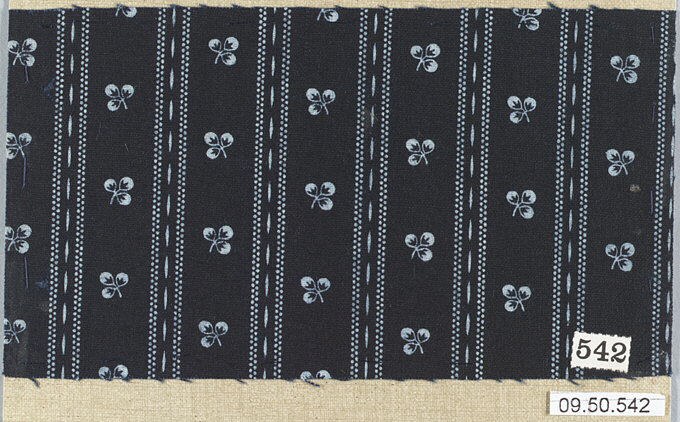
The shamrock is a three-leaflet plant emblem associated with Ireland and Saint Patrick. Its best-known religious meaning comes from the tradition that Patrick used its three parts to explain the Christian Trinity. Today the shamrock meaning also includes Irish identity, heritage, and Saint Patrick's Day celebration. It is not the same symbol as a lucky four-leaf clover, even though shops and emoji keyboards often place them side by side.
The plant and the emblem need slightly different explanations. Botanists use precise species names; “shamrock” is a traditional common name applied to more than one plant. Artists simplify the three leaflets into a recognizable graphic. Neither a stylized drawing nor a pot labeled “shamrock” settles which living species a person in a historical account had in mind.
What does a shamrock symbolize?
Context supplies the strongest answer. On a Saint Patrick's Day badge, the shamrock points to the holiday and Irish association. In a Christian explanation of the Trinity, the three leaflets illustrate a religious idea. In a family keepsake, it may express ancestry or affection for Ireland. Those uses can coexist, but not every person wearing one is making a theological statement.
A shamrock is therefore not a universal sign for “good luck.” Luck may be part of a modern greeting or commercial design, but three leaflets primarily identify the Irish emblem. If the design has four, it usually belongs to the separate four-leaf-clover convention. Counting the leaflets is the quickest way to avoid conflating them.
Why is the shamrock linked with Saint Patrick?
The traditional story says Patrick used one plant with three leaflets to explain the Father, Son, and Holy Spirit. It is an analogy: three distinguishable parts belong to one visible plant. Religious analogies have limits, and the leaf is not a complete statement of Christian teaching. Its visual simplicity helps explain why the story remains memorable.
The National Museum of Ireland cautions that this explanation is a relatively late tradition. We should not retell it as an eyewitness record of Patrick's missionary work. A story can be an important part of a saint's later reception without being securely documented during that saint's lifetime.
Dublin City Council's library account points to Caleb Threlkeld's botanical publication of 1726. Threlkeld recorded the custom of wearing shamrock on March 17 and reported the Patrick story as a current tradition. That gives us a dated written witness to the association. It does not show that Threlkeld invented it, nor does it tell us exactly when the story first circulated orally.
Is the shamrock a real species of plant?
There is no single botanical species named simply “shamrock.” Kew identifies white clover, Trifolium repens, and lesser or yellow clover, Trifolium dubium, among the plants associated with the name. Cornell Botanic Gardens likewise explains the uncertainty surrounding the “real” shamrock. The common name belongs to cultural use as much as to plant identification.
Strictly speaking, the familiar three green parts are leaflets of one compound leaf. “Three-leaved” is normal everyday language, but “three-leaflet” is more botanically precise. This is why a stylized shamrock can look like three separate hearts joined at their tips while still standing for a single plant leaf.
Plants sold as indoor shamrocks may instead belong to Oxalis. Iowa State University Extension notes that both Trifolium and Oxalis are commonly given shamrock names. A decorative houseplant label is not a guarantee that the plant is one of the clovers commonly used for the Irish emblem. The label also cannot establish the species in the Patrick legend.
Shamrock versus four-leaf clover
A shamrock has three leaflets in the emblem's standard form. A four-leaf clover has four and carries its own familiar association with good fortune. Adding a fourth leaflet is not merely a flourish: it changes the symbol the viewer is likely to recognize. It also removes the three-part structure central to the Trinity story.
The difference is preserved in digital text. Unicode names ☘ SHAMROCK at U+2618 and 🍀 FOUR LEAF CLOVER at U+1F340. Depending on the device and presentation settings, a shamrock may appear as a monochrome glyph or a colored emoji. Font style can change its appearance, but the character names remain distinct.
If you want the Irish three-part emblem in a message, copy ☘. In HTML, the numeric reference is ☘. For a broader selection, the Symbol Finder offers copy-and-paste characters. A font's drawing is a modern rendering, not evidence of how medieval Irish artists depicted the plant.
Is it an ancient Celtic symbol?
Calling the shamrock “Celtic” can be a loose way of referring to Irish identity. It becomes misleading when the label is used to claim an unbroken, precisely documented pagan emblem with a fixed meaning. The evidence cited here establishes later Irish custom and the Patrick association, not a standardized prehistoric symbol chart.
For related designs, compare the triquetra and the Celtic cross. A three-loop knot, a ringed cross, and a three-leaflet plant are different forms with different evidence. Their appearance together on contemporary gifts does not make their origins interchangeable. Our guide to Celtic symbols keeps those distinctions visible.
What museum evidence can show
Two CC0 objects at the Met make the three-part form visible without requiring a legendary origin story. An American metal-and-enamel pin dated 1891 combines three green, heart-shaped leaflets with a horseshoe. The combined motifs are clear, but the catalog does not identify a particular wearer's beliefs or occasion. It would be a step too far to call it a documented Saint Patrick's Day badge.
A nineteenth-century cotton fragment, cataloged simply as Piece, repeats small stemmed shamrocks between stripes. Its graphic simplicity makes the three leaflets easy to recognize. The API record does not supply a culture, and we have not guessed one from the motif. The featured photograph shows this real textile, not a digital reconstruction.
These examples demonstrate the plant form's use in jewelry and textile pattern. They do not prove that all three-part ornament represents the Trinity. To interpret a historical design, check both what is visible and what its catalog actually says. For a current design, the number of leaflets, the occasion, and the accompanying words usually tell you more than a list of mystical meanings.
In the museum

An American metal-and-enamel pin dated 1891 displays three green heart-shaped leaflets around a central setting, beside a horseshoe. The two motifs are visibly combined; the catalog does not document a specific wearer’s intention.
1891 · American · The Metropolitan Museum of Art · C.I.43.40.113 · CC0
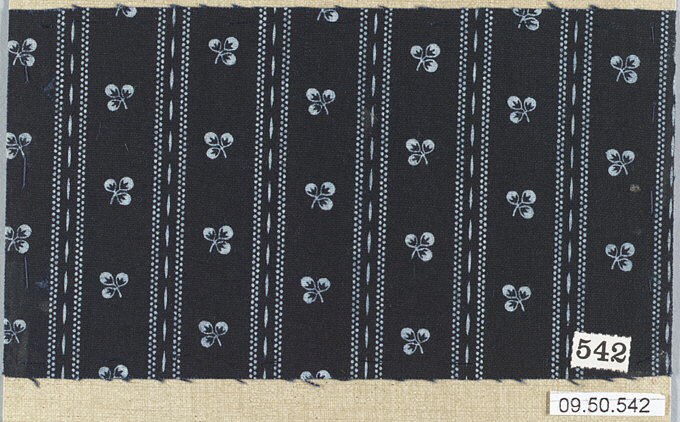
A nineteenth-century cotton fragment repeats small three-leaflet, stemmed shamrock motifs between vertical stripes. The Met titles it “Piece” and does not assign a culture in its API record.
19th century · Not specified in the museum API record · The Metropolitan Museum of Art · 09.50.542 · CC0
Frequently asked questions
Does a shamrock have three or four leaves?
The standard shamrock emblem has three leaflets. The lucky four-leaf clover is a different image and a separate Unicode character.
Did Saint Patrick really use a shamrock?
The story is a longstanding tradition, but it is not securely documented from Patrick’s lifetime. The National Museum of Ireland describes the Trinity explanation as relatively late.
What is the real shamrock plant?
The name is applied to several plants. White clover and lesser clover are frequent identifications; some indoor plants sold as shamrocks are Oxalis rather than true clovers.
What does the shamrock emoji mean?
The character ☘ is Unicode U+2618, SHAMROCK. It commonly signals Ireland or Saint Patrick’s Day. It is not the same character as 🍀, FOUR LEAF CLOVER.
Sources & further reading
- National Museum of Ireland: A history of St Patrick’s Day traditions and customs
- Dublin City Council: The Shamrock – An Seamróg
- Kew: How plants help us celebrate
- Cornell Botanic Gardens: Which plant is the real shamrock?
- Iowa State University Extension: Growing Shamrocks Indoors
- Unicode: U+2618 SHAMROCK
- Unicode: Miscellaneous Symbols names list
- The Met: Pin (C.I.43.40.113)
- The Met: Piece (09.50.542)