Cultures
Seed of Life Meaning and Its Seven-Circle Geometry
Seven overlapping circles suggest beginnings and growth in modern sacred geometry. The pattern's history is older than its present-day name.
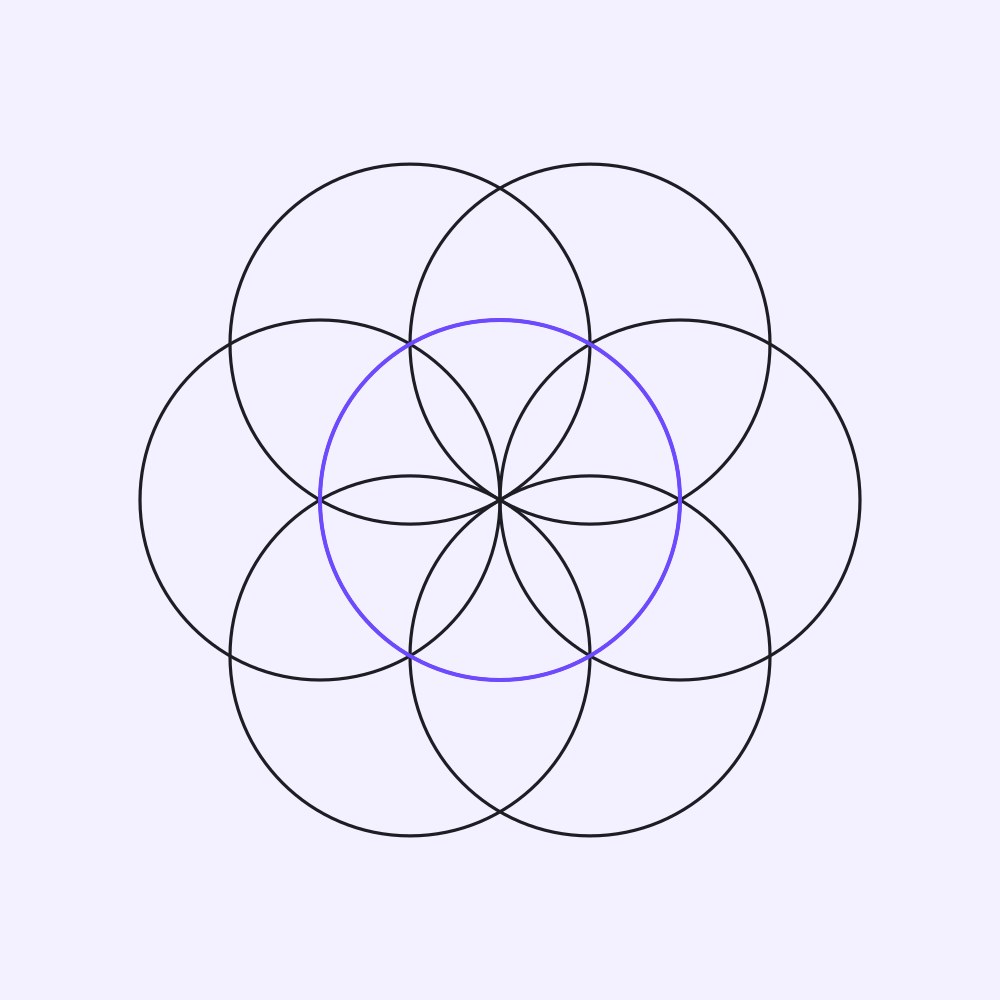
The Seed of Life is a design of seven equal, overlapping circles: one in the center and six arranged around it. In modern sacred geometry, its meaning is usually beginnings, creation, growth, and the emergence of complexity from a simple source. The circle arrangement is older than this modern name. Historical examples of similar geometry do not, by themselves, document the spiritual system associated with it today.
The Seed is the smaller configuration within the Flower of Life. Understanding that relationship is more useful than treating the two names as interchangeable. The Seed has seven circles; the usual Flower has nineteen. Both belong to a repeating grid, not to botanical diagrams of a literal seed or flower.
What does the Seed of Life mean?
The modern reading starts with the contrast between a single circle and a connected group. One shape generates an organized structure through repetition, so the diagram lends itself to ideas about potential, relationships, and a beginning that contains possibilities for further development. Its central flower-like form also encourages the language of unfolding and growth.
These meanings explain why the design appears in contemporary jewelry, prints, and contemplative art. They are not a universal dictionary inherited unchanged from antiquity. A designer may intend harmony; a wearer may choose it as a reminder of a new beginning; another person may simply enjoy its symmetry. An interpretation is strongest when it is tied to an identified person, community, or text.
Seven circles, six petals
MathWorld defines the Seed as a seven-circle patch of a triangular overlapping-circles grid. Six circle centers lie at equal intervals on the circumference of a central circle. Every circle has the same radius, and each surrounding circle passes through the middle of the design. This gives the figure sixfold rotational symmetry: it repeats after a turn of sixty degrees.
At the center are six equal lens-shaped areas that resemble petals. That is why descriptions can mention seven circles and six petals without contradicting one another. They are counting different things. An extra outer frame is optional and is not an eighth component circle. The full Seed includes the complete intersecting circles, not only the central petal outlines.
How old is the Seed of Life?
There is no securely established single inventor for the circle construction. MathWorld identifies the name “Seed of Life” as modern while noting earlier seven-circle arrangements, including a first-century BCE mosaic from a bathhouse in Herod's palace. It also points to related patterns in thirteenth-century Italian art. These examples establish historical use of geometry, not the ancient use of the modern English name.
The same reference places the Seed within the vocabulary used by Drunvalo Melchizedek in his 1999 book, The Ancient Secret of the Flower of Life, volume one. That supplies a dated modern reference for the name and construction sequence. It should not be converted into a claim that the author invented overlapping circles, or that every earlier artist understood the motif as he did.
Is it the same as a daisy wheel?
The patterns are closely related, but the labels are not perfect synonyms. A daisy wheel, or hexafoil, commonly shows a six-lobed flower inside a circle. The Seed of Life shows seven full circles, whose intersections generate that central flower. A historical object may preserve only the rosette, so identifying it as the full seven-circle symbol can hide a real difference.
Historic England documents hexafoils on buildings and explains that many have been interpreted as ritual protection marks. It also acknowledges disagreement: decoration and geometric practice are possible readings in some contexts. A daisy wheel near an old doorway therefore deserves a site-specific explanation, not an automatic caption saying “ancient Seed of Life.” Similar geometry need not mean identical belief.
Does it represent the seven days of creation?
A modern interpretation connects the seven circles with the creation week in Genesis: six days of creative work followed by the seventh day of rest. The biblical passage itself describes that sequence; it does not instruct readers to draw seven circles. The correspondence is an interpretive analogy, not a diagram supplied by the text.
That distinction matters for cultural accuracy. Calling the Seed an official Jewish or Christian creation emblem would require evidence from a specific tradition or historical source. It is more precise to say that some contemporary spiritual explanations compare its seven circles with the creation week. Number symbolism can be meaningful without proving that a geometric figure originated within the tradition being invoked.
How to draw the Seed of Life
- Draw a circle and choose a point anywhere on its circumference.
- Keeping the compass opening fixed, draw a second circle centered on that point.
- Use an intersection of the two circles as the next center, and draw another circle at the same radius.
- Continue stepping around the original circle until six surrounding circles have been drawn.
- Count the original circle plus its six neighbors. The finished group contains seven.
You do not need to measure the angles separately. The unchanged radius steps around the original circumference in six equal intervals. If the final step fails to close neatly, check whether the compass opening slipped or the point moved away from an intersection. The construction is an accessible exercise in precision as well as a recognizable symbol.
How it relates to other sacred-geometry designs
Two suitably spaced circles produce a vesica piscis, the lens that recurs through the Seed. Extending the circle grid produces the Flower of Life. A thirteen-circle selection from a further extension is called the Fruit of Life in modern teaching; joining its centers produces Metatron's Cube. Thirteen is not the number of circles in the Seed.
Our sacred geometry guide compares these diagrams with other shapes and symbolic systems. A shared compass technique is a mathematical relationship. A shared religious history is a separate claim that needs its own evidence.
What the museum evidence can and cannot show
A museum object with a seven-circle design can demonstrate that somebody used that geometry at a particular place and time. Its date, material, findspot, and accompanying imagery may help explain its function. Unless the catalog or other evidence supports it, however, the modern name and meaning should not be projected backward onto the maker.
No matching CC0 object from the Met or Cleveland was visually verified for this edition, so we use an original illustration rather than an unrelated antique flower. The historical mosaic mentioned above is a research reference, not an object reproduced here. The distinction keeps the entry's modern symbolism separate from its limited, specific historical evidence.
Frequently asked questions
What is the Seed of Life meaning?
In modern sacred geometry it usually represents beginnings, creation, growth, or potential. These interpretations should be distinguished from the historical use of similar circle patterns.
Why does the Seed of Life have seven circles but six petals?
There is one central circle and six surrounding circles. Their overlaps generate six lens-shaped petals at the center, so the two numbers describe different features.
Is the Seed of Life in the Bible?
Genesis describes six days of creation and a seventh day of rest, but does not prescribe this circle drawing. Connecting the circles with the creation week is an interpretation, not a biblical diagram.
Is a daisy wheel a Seed of Life?
They share related geometry, but a daisy wheel often shows only a six-lobed rosette inside a circle. The full Seed includes seven complete circles, and the modern name should not automatically be applied to historical hexafoils.