Cultures
Metatron's Cube Meaning, Geometry, and Modern History
A thirteen-point geometric network used to represent connection and order. Its modern symbolism is distinct from the Jewish literary history of Metatron.
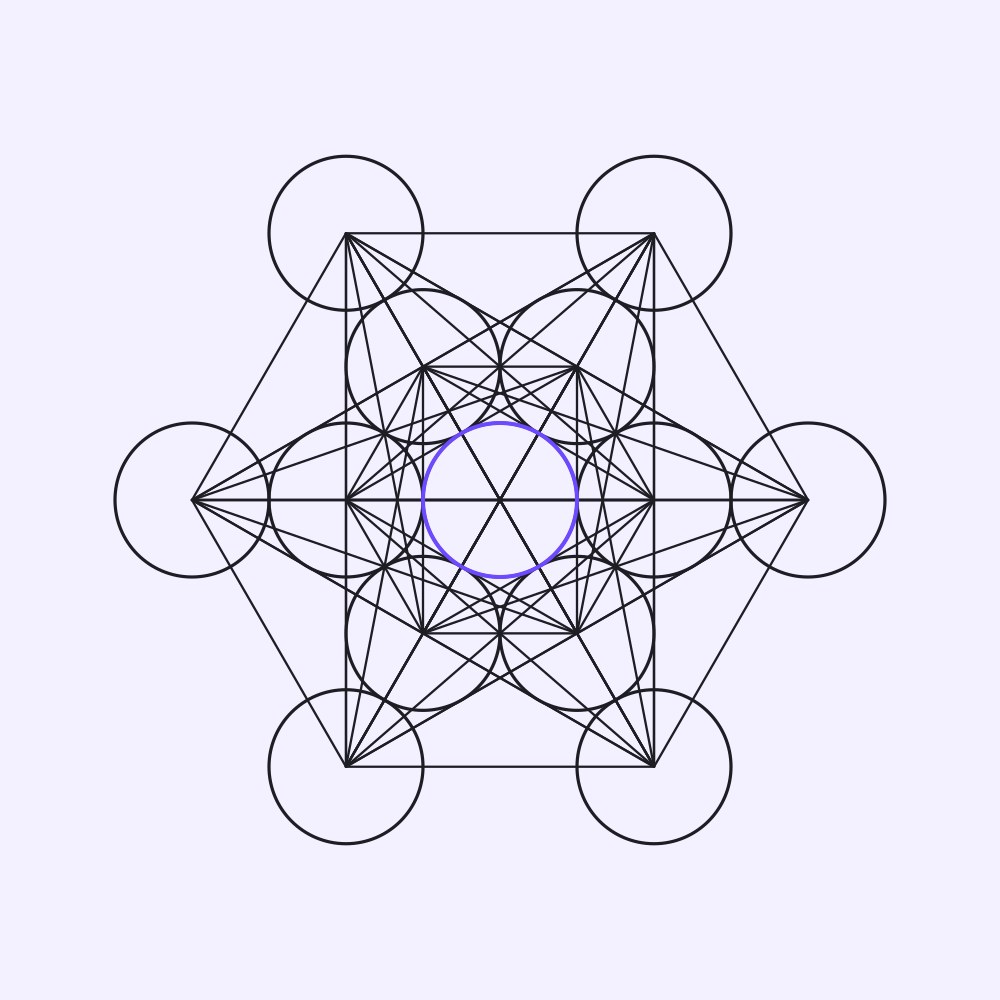
Metatron's Cube is a geometric line drawing built by joining thirteen specially arranged points, often shown as the centers of thirteen circles. Its modern symbolic meanings include interconnectedness, order, creation, and protection. The name refers to Metatron, an angel in Jewish literature, but the familiar diagram should not be presented as an established ancient Jewish emblem. The history of the angel and the history of the drawing are different subjects.
For the surrounding family of shapes, see our guide to sacred geometry symbols. Metatron's Cube combines a circle arrangement with straight connections, which is why it looks more angular and architectural than the Flower of Life from which its modern construction sequence develops.
What does Metatron's Cube mean?
In contemporary sacred-geometry teaching, the connected network is read as an image of relationships holding the universe together. Because every point connects to every other point, the drawing offers an especially direct metaphor for interdependence. Its regular structure also supports ideas about balance and order. Some users give it a protective meaning in personal spiritual practice.
These are modern symbolic readings, not powers demonstrated by the geometry. A pendant or printed diagram may serve as a personal reminder of connection without having a measurable effect on events. It is useful to distinguish “this represents protection to me” from “this object guarantees protection.” The first describes a meaning; the second makes a claim requiring evidence beyond the drawing.
Why there are thirteen circles and seventy-eight connections
MathWorld describes thirteen points arranged as a center and two concentric regular hexagons, with every pair joined by a straight segment. The thirteen equal circles commonly drawn around those points belong to the related configuration called the Fruit of Life. The circles make the underlying arrangement easier to see, but the network of center-to-center lines is the defining feature.
With thirteen points, each point has twelve possible partners. Multiplying thirteen by twelve counts every connection twice, once from each end, so dividing by two gives seventy-eight pairs. This is the complete graph on thirteen vertices in a particular planar arrangement. Some drawn segments overlap, so seventy-eight is not necessarily the number of separate strokes or visible pieces you can count in a finished image.
Who is Metatron?
Metatron appears in Jewish rabbinic and mystical literature, not as a named figure in the Hebrew Bible. In the Babylonian Talmud, Chagigah 15a describes him as permitted to sit and record the merits of Israel. The passage concerns the danger of mistaking an angel's status for a second divine authority. It is not a set of instructions for drawing a geometric cube.
The Jewish Encyclopedia discusses Metatron's role as a heavenly scribe and his identification with Enoch in some traditions. These literary associations help explain why later spiritual systems might borrow his name. They do not establish a historical chain from those texts to the thirteen-circle design. Describing the modern symbol as “the ancient Jewish symbol of Metatron” would blur that distinction and misrepresent the tradition.
Is Metatron's Cube ancient?
The sources used here establish the diagram's modern sacred-geometry context, not an ancient origin. MathWorld connects the terminology of the Fruit of Life and Metatron's Cube with Drunvalo Melchizedek's The Ancient Secret of the Flower of Life, volume one, published in 1999. This is a dated reference for the modern system, not proof that nobody had ever drawn a similar combination of lines before it.
It is equally important not to date the whole diagram by the age of one component. Circles, hexagons, and drawings of cubes have long histories. Their existence in an older artwork does not establish the full thirteen-point network, its modern name, or its modern meanings. An origin claim needs the actual configuration and a reliable historical context, not a vague resemblance.
Does it contain all five Platonic solids?
This is one of the most repeated claims about the symbol. The five Platonic solids are the tetrahedron, cube, octahedron, dodecahedron, and icosahedron. They are three-dimensional solids. Metatron's Cube is a flat drawing, so any solid “inside” it is being represented by a selected set of projected edges, not physically contained in the paper.
MathWorld notes that selected segments form familiar projections of the cube, octahedron, and tetrahedron. It cautions that claims about exact projections of all five depend on the chosen segments and projections and are not part of the definition. If a diagram highlights a supposed solid, ask which points and edges it uses and whether extra lines have been introduced. A persuasive-looking overlay is not itself a mathematical proof.
Seed, Flower, Fruit, and Cube are different stages
The Seed of Life has seven overlapping circles. Extending that grid gives the nineteen-circle Flower of Life. The Fruit of Life selects thirteen circles from a further extension of the pattern. Joining the Fruit's centers creates the network called Metatron's Cube. This modern sequence explains the family resemblance without making the names synonyms.
The Cube is also not simply a Star of David. Six-pointed star forms can be picked out of its lines, but a shared hexagram does not make two symbols historically or religiously equivalent. The Star of David has a distinct Jewish history and communal significance. Treating any six-pointed geometry as interchangeable loses both visual precision and cultural context.
How to examine a drawing of Metatron's Cube
First locate the thirteen centers rather than counting small triangles in the linework. Check for a central point, an inner group of six, and an outer group of six arranged symmetrically. Then follow the center-to-center connections. Illustrations vary in whether they emphasize the circles, highlight particular solids, or omit some lines for clarity. A decorative simplification may no longer show the complete network.
The word cube can make newcomers expect an ordinary wireframe box. Here it is the name of the larger symbolic drawing. A projected cube is only one form that may be emphasized within it. Recognizing this prevents confusion when comparing a simple geometry textbook cube with a dense thirteen-circle emblem.
Museum evidence and responsible use
No Met or Cleveland CC0 object showing this complete symbol was visually verified for this edition. An antique angel, an unrelated hexagram, or a carving of a cube would not fill that gap. Our featured image is an original geometric illustration, not a reconstruction of a museum artifact.
The symbol can be discussed respectfully as modern spiritual art while acknowledging that its name draws on Jewish literature. Give the textual tradition its own context, label present-day interpretations as such, and avoid promising supernatural results. Its real geometric interest does not require an invented ancient pedigree.
Frequently asked questions
What does Metatron's Cube symbolize?
Modern users commonly associate it with interconnectedness, creation, balance, and sometimes protection. Those symbolic readings are not proof of supernatural effects.
How many circles are in Metatron's Cube?
It is commonly drawn with thirteen equal circles whose centers are joined. Joining every pair of thirteen centers gives seventy-eight connections before overlapping portions are combined visually.
Is Metatron's Cube an ancient Jewish symbol?
Metatron is an angel in Jewish literature, but that does not establish the thirteen-point drawing as an ancient Jewish emblem. The sources cited here document the diagram in modern sacred geometry.
Does Metatron's Cube contain all five Platonic solids?
Selected lines show familiar projections of some solids, including the cube, octahedron, and tetrahedron. Claims about exact projections of all five depend on the edges and projections chosen, and are not the definition of the figure.