Cultures
Flower of Life Meaning and the History of Its Geometry
A nineteen-circle pattern associated with connection and creation. Its historical geometry and modern spiritual interpretations need separate explanations.
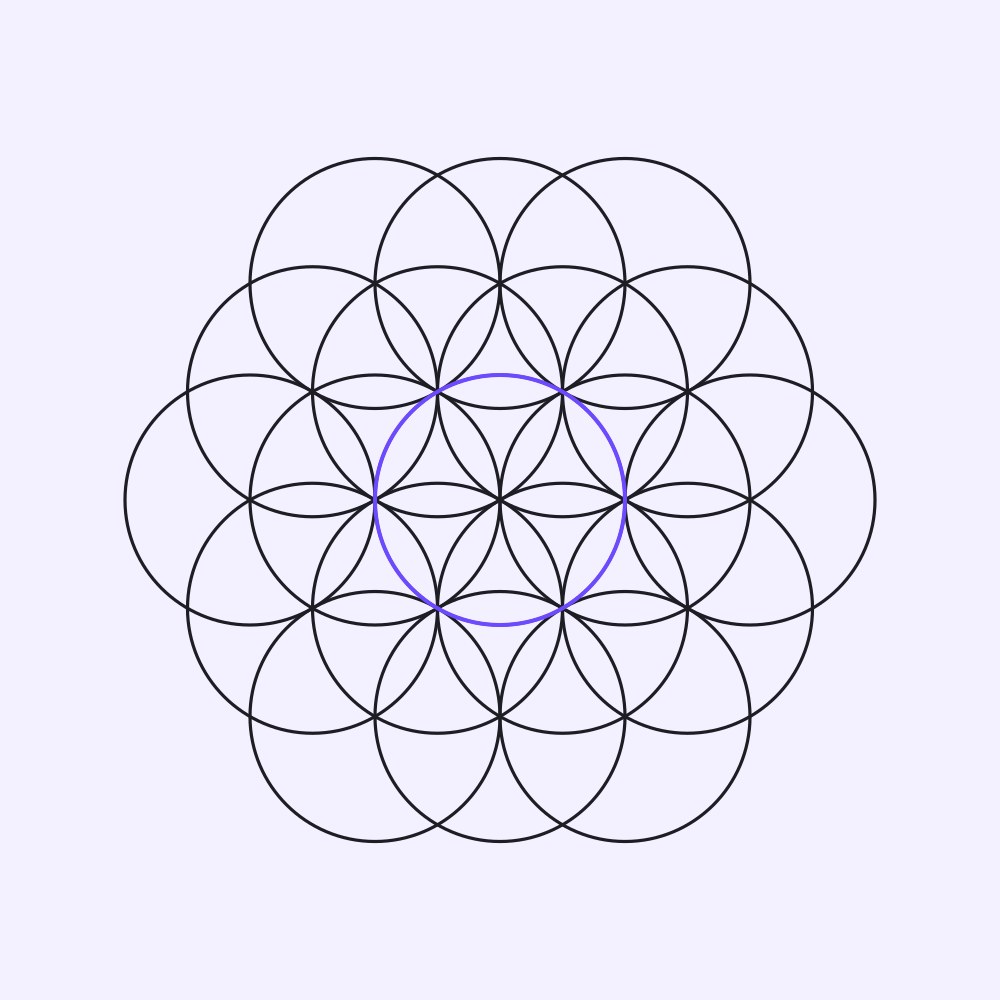
The Flower of Life is an overlapping-circle pattern associated today with interconnectedness, creation, and the order of the universe. Its familiar form has nineteen equal circles arranged with sixfold symmetry. The geometry has historical precedents, but the name and many spiritual explanations circulating today belong to modern sacred-geometry teaching. An old pattern is not automatically evidence for an equally old interpretation.
For the wider family of diagrams, start with our guide to sacred geometry symbols. The Flower of Life is especially useful for understanding how a simple construction can acquire new names and meanings as it moves between mathematical illustration, ornament, and personal spirituality.
What does the Flower of Life mean?
In contemporary spiritual use, the pattern commonly represents life emerging from a shared source. Each circle intersects several others, making relationships visible rather than leaving individual circles isolated. People read that connected structure as a metaphor for unity, mutual dependence, or the relationship between a person and the wider world. These are interpretations of the drawing, not measurable properties hidden inside it.
The word flower fits its repeating petal-like lenses; life gives the design a generative meaning. Someone may use it on jewelry, in an artwork, or as a focus for reflection without accepting every teaching associated with sacred geometry. There is no single religious authority that fixes what the symbol must mean for every wearer or viewer.
How the nineteen-circle pattern works
MathWorld defines the Flower of Life as a nineteen-circle patch of a triangular overlapping-circles grid. All circles have the same radius. Neighboring centers are one radius apart, so each circle passes through the centers of its immediate neighbors. The arrangement consists of a center circle, a first ring of six centers, and a second ring of twelve centers.
Rotate the finished pattern by sixty degrees and it matches itself. The familiar petal shapes are intersections between circles, not separate flowers inserted into the drawing. A large enclosing circle, or a pair of borders, may frame a finished illustration, but those frames should not be counted among the nineteen component circles. Decorative versions sometimes add further arcs beyond the central patch.
Old geometry and a modern name
MathWorld explicitly identifies “Flower of Life” as a modern name. It cites historical overlapping-circle designs and a related construction in Leonardo da Vinci's Codex Atlanticus. It also discusses the modern terminology used in Drunvalo Melchizedek's The Ancient Secret of the Flower of Life, volume one, published in 1999. That book is a source for a modern teaching system, not proof of the system's claimed antiquity.
Three questions need separate answers: When was a particular object made? When was its circle pattern added? What did its maker call or mean by that pattern? A resemblance can help answer the second question only with supporting evidence, and rarely answers the third. We do not assign a universal prehistoric origin or an earliest inventor to this symbol.
What about the drawings at Abydos?
Overlapping-circle drawings at the Osireion at Abydos, Egypt, are frequently presented online as decisive proof of a pharaonic Flower of Life doctrine. MathWorld records an Abydos example, but the existence of the drawing does not establish its date or original meaning. A mark on an ancient monument need not be as old as the monument: buildings accumulate visitors' marks, repairs, and later additions.
The responsible distinction is between a recognizable geometric resemblance and a securely dated religious emblem. Without a reliable date for the particular marks and evidence explaining their use, it is not justified to call them a blueprint of Egyptian religion. Nor does a photograph establish claims that the design was burned into the stone or encodes advanced lost technology. Those claims need independent evidence.
Flower, Seed, Fruit, and Cube
The Seed of Life is the smaller seven-circle configuration at the center of the same grid. Adding the next twelve circles produces the usual nineteen-circle Flower. The “Fruit of Life” is a different selection of thirteen circles from an extension of the grid, not simply another name for the nineteen-circle pattern.
Connecting the centers of the Fruit's circles gives the straight-line network called Metatron's Cube. These names form a useful modern diagram vocabulary. They should not be treated as the successive chapters of a recovered ancient scripture. The vesica piscis, the lens formed by two equal circles with the appropriate spacing, is a simpler geometric relative.
Is every historic rosette a Flower of Life?
No. A six-petal rosette can resemble the center of this design without showing nineteen complete circles. Historic England discusses six-lobed hexafoils, often called daisy wheels, on historic buildings. Their interpretation depends on setting; protection is a widely accepted explanation for many examples, but geometry practice and decoration also enter the discussion. Their resemblance does not establish a shared modern name or doctrine.
Likewise, the Metropolitan Museum explains circles and interlaced circles as foundations of geometric ornament in Islamic art. That is valuable context for construction and repetition, not a license to relabel every Islamic geometric design a Flower of Life. Count the circles, examine the actual layout, and consult the object's catalog before giving it a symbolic identity.
How to draw and recognize it
- Draw one circle and keep the compass opening unchanged.
- Place a second center on its circumference, then step that same distance around the first circle to mark six equally spaced centers.
- Draw the six surrounding circles to produce the seven-circle Seed.
- Extend the same triangular grid by another ring of twelve centers and draw their circles.
- Keep the nineteen-circle patch, then add an optional enclosing border.
A common drawing error is to change the compass width between rings. Another is to confuse the curved petal shapes with the complete circles that generate them. Counting centers rather than visually crowded arcs makes identification easier.
Reading the symbol without overstating it
The design can be meaningful as a visual metaphor for connection without being a scientific model of everything. Its symmetry is demonstrable; assertions that it changes water, repairs the body, or produces protective energy are not established by that symmetry. Religious meaning, personal response, historical evidence, and mathematics are different kinds of claim.
Our featured image is a newly drawn geometric illustration. We have not attached unrelated museum rosettes to this entry as evidence: no matching, visually verified CC0 object from the Met or Cleveland was established for this edition. That gap is preferable to showing a beautiful artifact under an unsupported name.
Frequently asked questions
What does the Flower of Life symbolize?
Today it commonly symbolizes interconnectedness, creation, and order. These are modern spiritual interpretations of the pattern, not a universal meaning documented for every historical circle design.
How many circles are in the Flower of Life?
The standard configuration has nineteen equal circles: one central circle, six in the first ring, and twelve in the second. Optional enclosing borders are not included in that count.
Is the Flower of Life an ancient Egyptian symbol?
Abydos has historical overlapping-circle drawings, but their presence on an Egyptian monument does not establish their date or a pharaonic doctrine behind them. The modern name should not be projected backward without evidence.
Is the Seed of Life the same as the Flower of Life?
No. The Seed is a seven-circle configuration. Adding another ring of twelve circles gives the standard nineteen-circle Flower of Life.