Learn
Vesica Piscis Meaning, Geometry, and Art
The vesica piscis is a pointed oval formed by two equal circles. Its geometry is precise; the meanings attached to similar shapes depend on their artistic and religious setting.
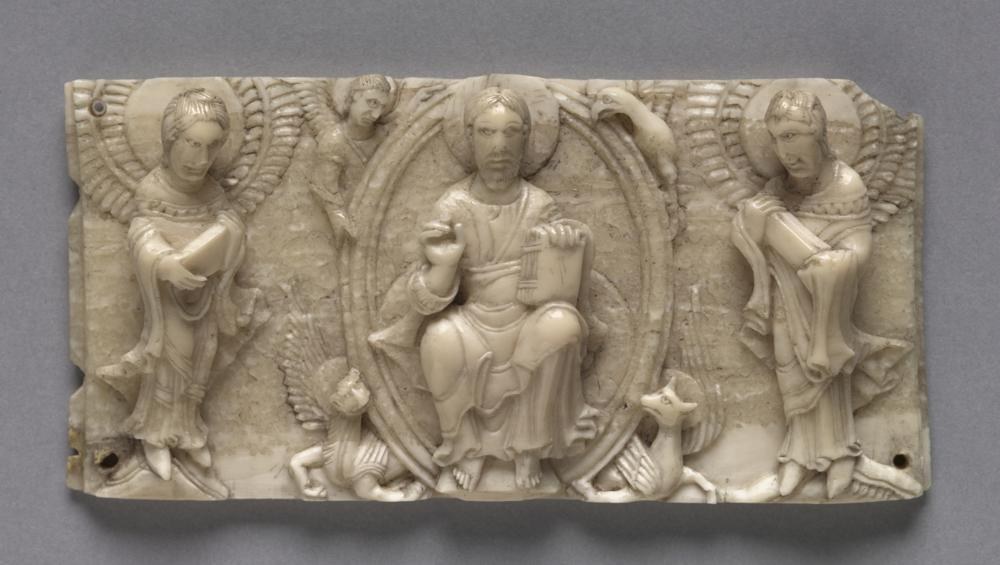
The vesica piscis is the pointed, lens-shaped overlap of two equal circles when the center of each circle lies on the circumference of the other. Vesica piscis meaning changes with context: in geometry it names a specific construction, while in art it is often discussed alongside the almond-shaped mandorla surrounding a sacred figure.
The outline alone does not establish one universal religious message. A compass drawing, a medieval image of Christ, and a contemporary “sacred geometry” print may share a shape while making very different claims. Identifying the setting is the first step toward interpreting it accurately.
How do you construct a vesica piscis?
Draw a circle, then place the compass point on its circumference without changing the radius. Draw a second circle. Because the distance between the centers equals the common radius, each circle passes through the other's center. Their shared interior is the vesica piscis.
The circles meet at two points. Joining either intersection to both centers produces an equilateral triangle: all three sides are radii of the same length. This is the elementary geometry behind the construction, and it can be checked directly rather than accepted as a symbolic assertion.
Place the centers side by side and the lens points upward and downward. Turn the arrangement and the lens turns too. Orientation affects its appearance in a composition, but not the underlying relationship of the two circles.
Not every overlap of circles is the same exact construction. Move the centers closer or farther apart and the lens changes proportions. In careful geometric writing, specify the equal radii and center-to-circumference placement instead of applying the name to any vaguely pointed oval.
What does the name mean?
Vesica piscis is Latin for “fish bladder.” The expression describes a form; it does not mean that every object using the outline depicts a fish. In art and architecture, terms can be named after an everyday resemblance without importing the whole object into the work's subject.
Mandorla, by comparison, is the Italian word for almond. In art history it usually describes a full-body field of glory or aureole around a sacred figure. The names overlap in descriptions of pointed oval forms, but they emphasize different things: geometric outline and iconographic function.
An almond-shaped border does not have to be laid out as two mathematically exact equal-circle arcs. Artists worked in varied materials and conventions. It is better to call a sacred frame a mandorla when that is the museum's identification than to imply a measured geometric construction that nobody has demonstrated.
The mandorla in Christian art
In Christian imagery, a mandorla often surrounds Christ in glory. The enclosed field sets the figure apart and gives visible form to divine radiance or majesty. The subject, gestures, inscriptions, surrounding figures, and original devotional use all contribute to the interpretation.
The Cleveland Museum of Art's Christ in a Mandorla, with the instruments of the Passion, with St. Stephen and St. Lawrence below, dated about the 1230s, names the feature explicitly. It belongs to a small folding altarpiece associated with Berlinghiero's workshop, rather than to a free-standing collection of abstract symbols.
Cleveland also preserves an eleventh-century portable-altar plaque showing Christ and apostles. The museum specifically discusses the figure of Christ within a mandorla. These are strong examples because the identification rests on the museum's description and the visible sacred frame, not on our search for circles hidden in a composition.
For related Christian visual language, see Christian symbols and the Chi Rho. A radiant enclosure, a monogram, and a cross can appear within one tradition while functioning in different ways.
Is the shape only Christian?
No. Almond-shaped aureoles also occur in Buddhist art. Cleveland's stele with Shakyamuni and bodhisattvas, dated 537, has a flame-edged mandorla described by the museum as an almond-shaped halo. Its meaning belongs to that Buddhist image and its specific devotional context.
The existence of similar outlines in different traditions does not prove that they all teach the same doctrine. Nor does it establish a single inventor or one continuous chain of borrowing. Similar shapes can serve related visual purposes without becoming identical symbols.
That distinction matters when a modern chart puts every pointed oval under one explanation such as “the portal of creation.” Such a phrase may describe a contemporary interpretation, but it is not a substitute for the historical meanings of a Christian altar panel or a Chinese Buddhist stele.
Vesica piscis and the Christian fish
The ichthys, or Christian fish emblem, is a different design and interpretive topic. A fish can be drawn from intersecting arcs, but its body and tail make it a recognizable creature. The vesica piscis is the enclosed lens itself.
Similarity of construction does not make the two names interchangeable. A diagram can use overlapping circles to demonstrate how a fish-like outline is made without proving that all historical fish emblems were constructed that way.
Likewise, stories about secret recognition gestures need their own evidence. They cannot be established merely by observing that a fish and an almond-shaped halo can both be drawn with arcs. Separate a plausible drawing exercise from a documented historical practice.
Modern sacred geometry interpretations
Contemporary sacred geometry often reads the overlap as relationship, shared space, emergence, or the meeting of two principles. Those are interpretive metaphors, not mathematical theorems. Geometry can establish a length or angle; it cannot by itself establish a spiritual doctrine.
The same two-circle construction can be extended into repeating patterns discussed as the Seed of Life and Flower of Life. These connections explain why the vesica appears so often in modern geometric artwork. Claims about the age and original names of each pattern still need independent historical sources.
No reliable geometric argument shows that looking at the shape heals a condition or creates a measurable protective field. It can be meaningful as art, a devotional association, or an aid to reflection without making a medical claim.
How to describe an example precisely
For a diagram, say “two equal intersecting circles, with centers one radius apart.” For a sacred painting, identify the figure and use the collection's term for the surrounding glory. For contemporary jewelry, distinguish the seller's or wearer's explanation from established art history.
This approach keeps the geometry clear and the cultural meanings specific. The shared outline is a useful starting point, but the object, maker, audience, and setting determine what can responsibly be said beyond it.
In the museum
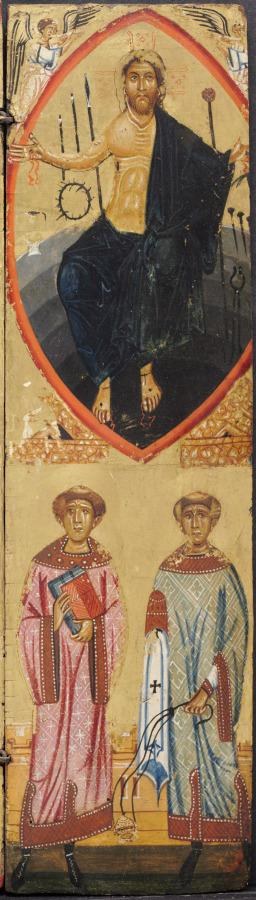
Christ appears inside an almond-shaped mandorla. This is related sacred-frame imagery, not proof of an exact compass construction.
c. 1230s · Italy · Cleveland Museum of Art · 1966.237.c · CC0
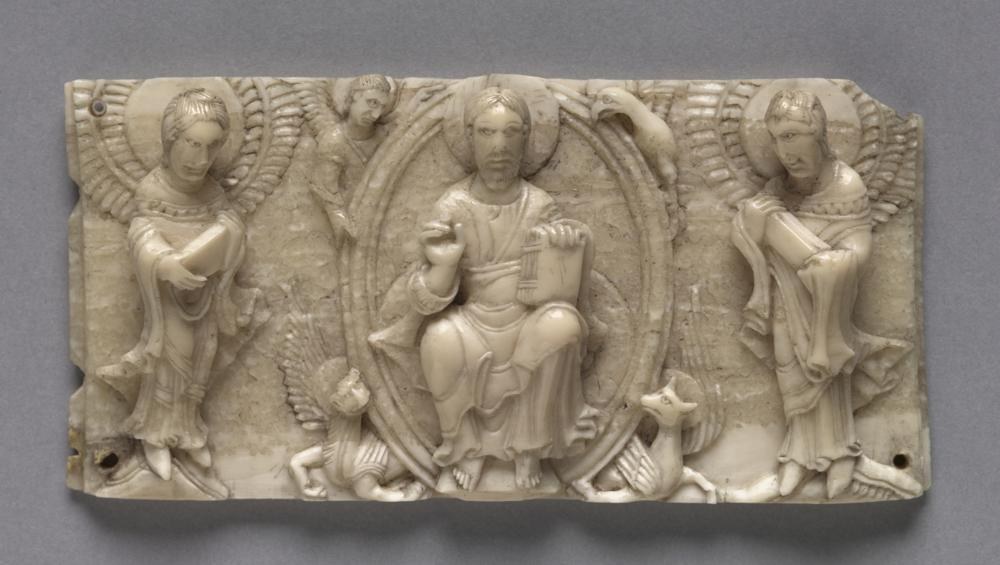
Christ sits within a mandorla on an ivory portable-altar plaque. The museum identifies the frame explicitly.
1050–1100 · Germany, Lower Rhine Valley, Romanesque period, 11th century · Cleveland Museum of Art · 1922.307.b · CC0
Frequently asked questions
Is every pointed oval a vesica piscis?
Not in the strict geometric sense. The standard construction requires two equal circles with centers one radius apart.
Is a mandorla the same thing?
A mandorla is a sacred full-body aureole, often almond-shaped. Its artistic outline need not be an exact two-circle geometric construction.
Does the vesica piscis have one spiritual meaning?
No. Modern geometric metaphors and historical religious uses should be interpreted within their own contexts.