Cultures
Vegvisir Meaning: Icelandic Stave, Not Viking Compass
Vegvísir is an Icelandic magical sign associated with finding one’s way. The documented manuscript tradition is much later than the Viking Age.
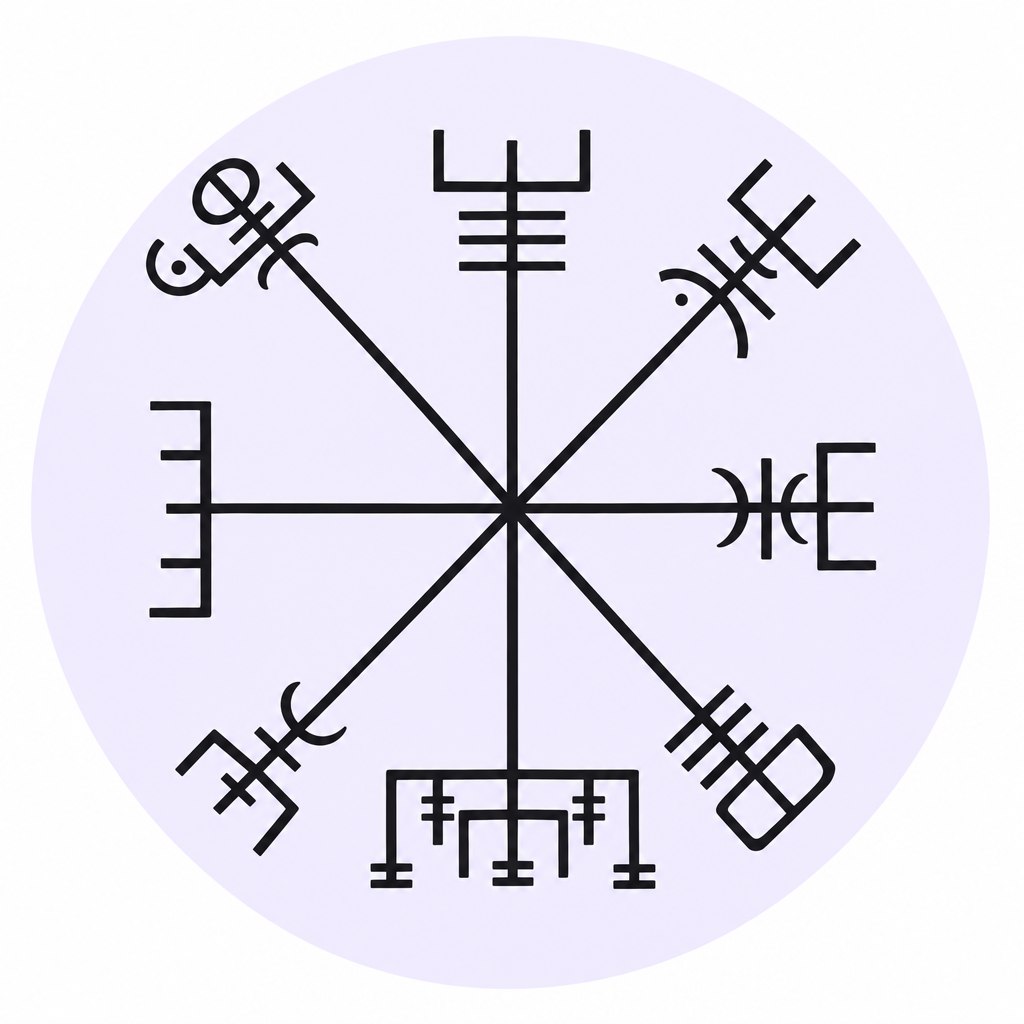

Vegvisir, more precisely written Vegvísir, is an Icelandic magical stave associated with not losing one's way in difficult weather. Vegvisir meaning is often summarized as guidance or wayfinding. The familiar label “Viking compass,” however, goes beyond the surviving evidence and confuses a magical sign with a navigational instrument.
The key evidence comes from Icelandic manuscript culture long after the Viking Age. A responsible explanation starts with the named drawing, the text beside it, and the age of its source. It does not assume that a striking radial design must have been carried by medieval seafarers.
What does Vegvísir mean?
The name is commonly translated as “wayfinder” or “way-shower.” More important than a loose English gloss is the instruction attached to the drawing in the Huld manuscript. It says, in essence, that a person carrying the sign will not lose the way in storms or bad weather, even in unfamiliar surroundings.
That is a historical claim made by the manuscript, not a practical guarantee this site endorses. It describes how the sign was meant to function within a magical tradition. It is not evidence that the design measures direction, responds to magnetism, or makes travel safe.
Modern people can reinterpret that promise metaphorically as perseverance, orientation during uncertainty, or remembering a chosen path. Those personal readings are understandable extensions of the guidance theme. They should be labeled modern interpretations rather than quoted as Viking beliefs.
The Huld manuscript evidence
The National and University Library of Iceland holds the Huld manuscript under shelfmark ÍB 383 4to. A cataloged reproduction identifies a portion of its page 60 with two Vegvísir signs, their title, and an accompanying Icelandic instruction. The compiler was Geir Vigfússon.
The manuscript is generally associated with the nineteenth century, commonly dated around 1860 in reproductions of this particular page. Secondary descriptions do not always give the same compilation date. For that reason, “nineteenth-century Huld manuscript” is a more secure short description than treating a single year as proof of the symbol's invention.
A manuscript date tells us that a sign was recorded by that time. It does not, by itself, tell us when the sign was first devised, how widely it circulated, or whether an earlier source once existed. Those are separate historical questions requiring separate evidence.
The NorseMap catalog is especially helpful because it identifies the actual manuscript and page rather than presenting a context-free modern vector. Museum and library records make it possible to connect an often-reproduced image with a particular surviving source.
Why “Viking compass” is misleading
The Viking Age ended many centuries before the Huld manuscript was compiled. Calling Vegvísir a Viking compass collapses that gap without supplying earlier evidence. Icelandic origin, Norse-language associations, and a radial appearance do not independently establish Viking-Age use.
A compass is also an instrument, while this is a magical stave. An instrument supplies directional information through a physical mechanism or observed reference. The manuscript's instruction concerns carrying a sign, not following a magnetic needle or reading a calibrated bearing.
This distinction does not make the stave uninteresting. On the contrary, Icelandic magical manuscripts have their own history, including learned writing, collections of signs, and later copying. Relabeling them as Viking artifacts can obscure the people and periods that actually preserved them.
For a better comparison with an explicitly Norse mythological subject, see Yggdrasil. For an artifact-centered discussion of another recognizable emblem, see Mjölnir. Their evidence should not be transferred wholesale to Vegvísir.
How to recognize the design
The widely circulated form has arms radiating from a central crossing. Different terminals carry combinations of short bars, forks, and curves. Those details help distinguish it from a generic starburst, a compass rose, or another Icelandic magical stave.
Modern merchandise often adds an outer ring of runes, an animal border, or decorative knotwork. Such additions are not automatically part of the manuscript drawing. A modern designer may combine several northern-looking elements even when they come from different periods or traditions.
It is therefore useful to describe a design in layers: the central stave, any added alphabet, and any surrounding ornament. A rune ring may spell something, repeat characters decoratively, or be inaccurate. Its presence does not authenticate the central symbol.
The featured image here is a modern schematic illustration, not a photograph of Huld or a claim to reproduce every manuscript stroke. For close historical comparison, use the cited manuscript reproduction and its catalog identification.
Is Vegvísir the same as the Helm of Awe?
No. Modern pictures can make Icelandic staves look similar because both may use a central point and radiating arms. The name, arm endings, accompanying text, and specific manuscript source matter. An outline that “looks Norse” is not enough to identify it.
Nor is every angular mark a rune. Runes are characters in writing systems. A composite magical stave is not necessarily a single alphabetic character and should not be given a made-up pronunciation as if it were one letter.
Our broader symbol dictionary separates names and histories instead of treating all magical, religious, and geometric designs as interchangeable. That approach is particularly important when commercial artwork mixes several recognizable motifs.
Using the name and meaning accurately today
“Icelandic magical stave associated with guidance” is a concise, defensible description. “Nineteenth-century manuscript witness” adds the key historical qualification. “Ancient Viking navigational technology” is not supported by the evidence cited here.
If the design appears on a pendant or personal artwork, it may mean finding one's way emotionally or staying grounded in a difficult period. Only the person choosing it can confirm that intention. Personal resonance and a careful historical label can coexist.
The most interesting question is not whether the symbol can be made older, but what the surviving record actually says. Huld preserves an instruction, a named sign, and a material witness to a distinctive Icelandic manuscript tradition. Those are worth understanding on their own terms.
Frequently asked questions
Is Vegvisir a Viking symbol?
A Viking-Age origin is not established by the surviving sources cited here. The familiar named sign is documented in much later Icelandic magical manuscripts.
Was it used as a real compass?
The manuscript describes carrying a magical sign. It does not describe a magnetic instrument or a navigational measurement system.
What does Vegvisir represent today?
It often represents guidance or finding one’s way, including metaphorical personal meanings. These modern uses should be distinguished from the manuscript instruction.