Cultures
Yggdrasil Meaning and the Norse World Tree
The Norse world tree connects the cosmos, but its stories are also about damage, fate, and the care that sustains life.
Yggdrasil is the immense world tree of Norse mythology, usually described as an ash. It connects and sustains the mythic cosmos while creatures feed on it, wells lie beneath its roots, and the gods meet beside it. The central Yggdrasil meaning is cosmic connection, but the stories also concern vulnerability, wisdom, and the work of keeping a world alive. It is a named tree with a narrative, not an all-purpose Viking good-luck sign.
The familiar modern picture of a tree inside a circle is only one way to illustrate it. Medieval descriptions give Yggdrasil recognizable features without prescribing one official logo. A necklace can be inspired by those descriptions, but its symmetrical branches and decorative border need not reproduce a surviving Viking-age emblem.
What does Yggdrasil mean?
As a name, Yggdrasill is generally interpreted as “the horse of Yggr.” Yggr, often translated as the Terrible One, is a name of Odin. The “horse” is commonly understood in connection with hanging: the tree bears the hanged god. Britannica presents the interpretation cautiously, and it is better to retain that caution than to turn a traditional explanation into an uncontested literal definition.
As a symbol, the tree makes relationships visible. Roots go downward, branches spread outward and upward, and living things occupy different parts of the same structure. Modern readers often describe that as interconnectedness. The old stories make the idea less comfortable than a slogan: the beings sharing the tree do not always cooperate, and the tree itself suffers damage.
Where do the Yggdrasil stories come from?
Major sources include the Poetic Edda and the Prose Edda, preserved in medieval Icelandic literary traditions. The latter is associated with Snorri Sturluson and the early thirteenth century. The written witnesses are not straightforward transcripts of a single, unchanging Viking religion. They preserve and organize material whose relationship to earlier oral traditions requires interpretation.
In Gylfaginning, part of the Prose Edda, a question-and-answer narrative describes the ash and its surroundings. Chapters 15–16 are especially useful because they provide concrete details: the gods' meeting place, three roots, wells, and the creatures living in or around the tree. The older English translation hosted by Britannica is freely readable, although its spellings and language differ from modern translations.
The roots, wells, and Norns
Snorri describes three great roots extending into different regions. Wells beneath them connect the tree with fate, wisdom, and dangerous depths. One is associated with Mimir and wisdom; another is Urðr's well, linked with the Norns. These features make the tree more than scenery. It stands at the meeting point of powers that shape the lives of gods and people.
The Norns are associated with determining lives and tending the tree. The account describes water and clay from the well being applied to the ash to preserve it. Symbolically, that is a striking combination: even the structure supporting the cosmos needs care. Reading Yggdrasil only as invincibility misses the repeated attention to damage and maintenance.
Lists of realms and the relationships between them are often simplified in contemporary illustrations. The sources do not provide one universally agreed, scale-drawn plan of nine worlds arranged along a trunk. A diagram can help introduce the stories, but its exact placement of each realm should not be mistaken for a surviving medieval map.
Animals in the world tree
The tree is full of movement. An eagle sits above, with a hawk between its eyes. The squirrel Ratatoskr travels up and down, carrying hostile words between the eagle and the serpent or dragon Níðhöggr below. Deer feed among the branches, and serpents threaten the roots. Different translations anglicize these names differently.
These details resist a neat modern code in which every animal stands for a single virtue. The squirrel is not simply “communication” in a neutral sense: its messages provoke hostility. The animals feeding on the tree are part of a story about pressure on the world's supporting structure. A thoughtful illustration can show both life within the tree and the forces wearing it down.
Odin, sacrifice, and Ragnarök
The Eddic poem Hávamál tells of Odin hanging on a wind-swept tree for nine nights in an ordeal associated with gaining the runes. The tree in that passage is commonly identified with Yggdrasil, although the passage does not simply introduce it by that name. This is the background to readings of the world tree as an image of costly knowledge or self-sacrifice.
Yggdrasil also trembles in accounts of Ragnarök, the catastrophic crisis of the gods' world. That makes “eternal peace” a poor summary of its meaning. The tree belongs to a cosmos in which fate, danger, and renewal coexist. Its force comes partly from holding those tensions together rather than promising that nothing can change.
Is Yggdrasil the same as the tree of life?
Yggdrasil is often called a tree of life or world tree in comparative writing. The broader tree of life category also includes images with very different histories. The tree in Genesis, a Kabbalistic diagram, and an Ottoman flowering-tree textile are not all representations of Yggdrasil. A shared outline does not make their meanings identical.
It is also not specifically a Celtic symbol. Contemporary designers may combine the Norse tree with Celtic-style interlace. That is a modern visual combination, not proof of one ancient pan-European emblem. For another clearly named Norse object with its own stories, compare Mjölnir, Thor's hammer.
Museum evidence and modern representations
Relevant museum works do exist, but the ones verified for this entry are not eligible for our CC0 image strip. The Met's two works titled Yggdrasil by Anselm Kiefer are modern copyrighted art. Cleveland's Saga – Blue textile explicitly alludes to the tree, but its collection record also marks it copyrighted. We have not reproduced those images or substituted an unrelated Viking object.
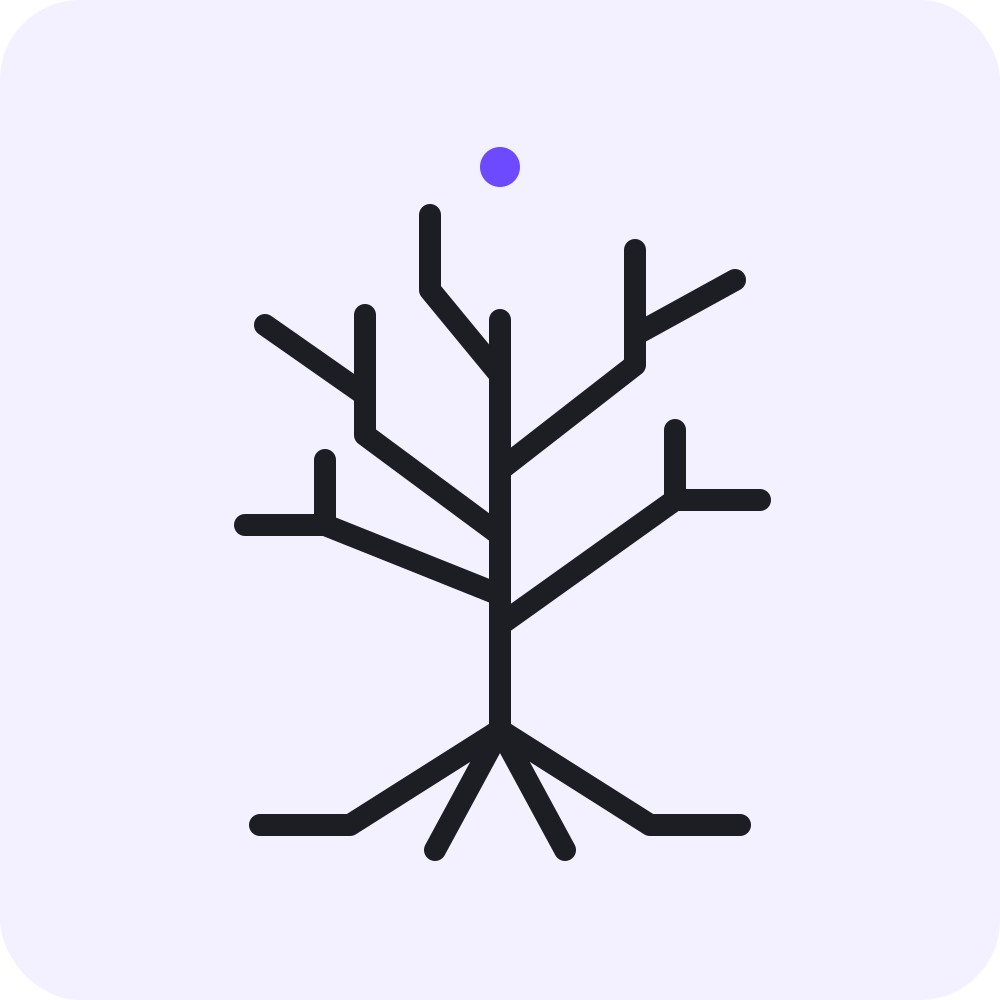
Our featured graphic is therefore an original geometric illustration. Its branching crown and visible roots evoke a world tree; it is not presented as an archaeological reconstruction. If you are identifying a historic object, look for an explicit museum attribution or a combination of narrative details. A lone tree is not enough. The wider tree symbolism guide can help distinguish natural, genealogical, and religious readings without forcing them into Norse mythology.
Frequently asked questions
Is Yggdrasil an ash or a yew?
The Prose Edda calls it an ash, and ash is the standard description in reference works. Claims that it must instead be a yew should not replace that textual evidence without explanation.
What are the nine worlds on Yggdrasil?
Norse sources speak of nine worlds, but popular charts organize the material in different ways. They should not be treated as one surviving, authoritative medieval map.
Is every tree in a circle Yggdrasil?
No. A circular tree can be a family emblem, a generic tree of life, or a modern decorative design. A Norse identification needs a name, narrative details, or reliable contextual evidence.
Can I copy a Yggdrasil Unicode symbol?
There is no dedicated Unicode character for the complete Yggdrasil motif. Generic tree emoji do not reproduce its particular mythological features.
Sources & further reading
- Britannica: Yggdrasil
- Britannica: Edda
- The Prose Edda, English translation hosted by Britannica
- Britannica: Germanic religion and mythology
- Britannica: Norns
- The Met: Anselm Kiefer, Yggdrasil, ca. 1980 (copyrighted; not reproduced)
- The Met: Anselm Kiefer, Yggdrasil, 1985 (copyrighted; not reproduced)
- Cleveland: Saga – Blue (copyrighted; not reproduced)