Religion
Ichthys Meaning and the History of the Jesus Fish
The Greek word for fish became a compact Christian profession of faith. Early texts and a surviving crystal fish reveal more than the modern outline alone.
Ichthys is the Greek word for “fish” and the name commonly given to the Christian fish symbol. Its letters form the initials of a Greek profession of faith meaning “Jesus Christ, Son of God, Savior.” The simple outline now called the “Jesus fish” is one recognizable modern form of a much wider early Christian use of fish imagery.
The strongest explanation brings together language, early Christian writing, and surviving objects. It does not require assuming that every ancient fish was Christian or that every story about secret recognition has been proved.
What does ichthys mean?
The Greek noun is written ΙΧΘΥΣ in capitals. Transliteration produces spellings including ichthys, ichthus, and ikhthys. Differences in rendering Greek letters into the Roman alphabet do not automatically signal different religious symbols.
In its Christian interpretation, the five letters serve as initials for five words. Cleveland Museum of Art and the Byzantine and Christian Museum both explain this connection in their discussions of fish-shaped objects.
| Letter | Greek word | Meaning |
|---|---|---|
| Ι | Ἰησοῦς, Iēsous | Jesus |
| Χ | Χριστός, Christos | Christ |
| Θ | Θεοῦ, Theou | Of God |
| Υ | Υἱός, Huios | Son |
| Σ | Σωτήρ, Sōtēr | Savior |
Greek word order differs from idiomatic English, so the complete phrase is normally translated “Jesus Christ, Son of God, Savior.” Some museum transliterations write the fourth word as Yios rather than Huios. The letter is Greek upsilon in either case.
The fish is therefore more than a general emblem of friendliness, water, or good fortune in this setting. It can serve as a compact statement about who Jesus is. That religious meaning depends on the Christian context and the wordplay, not simply on the outline of an animal.
Why fish mattered to early Christians
Fish recur in the Gospel narratives. Jesus calls fishermen as disciples; stories of feeding crowds feature loaves and fish; John 21 describes a meal of fish and bread beside the Sea of Galilee after the Resurrection. These texts offered Christians several ways to connect an everyday animal with discipleship and sacred meals.
The fish also acquired a relationship with baptism. At the beginning of On Baptism, Tertullian describes Christians as little fish after the likeness of their fish, Jesus Christ, born in water. The passage is direct evidence for the image's theological use. It does not depend on a modern reconstruction of what a carved symbol might have meant.
Clement of Alexandria offers another valuable witness. In Book III, chapter 11 of The Paedagogus, he recommends appropriate images for Christians' seals, including a fish. The reference places the motif in the world of personal objects and everyday identification, not only on church walls or tombs.
These writers belong to the late-second- and early-third-century Christian world. Their discussions establish early use, but neither text identifies the first person who drew the now-familiar two-arc outline. A history of fish symbolism is not necessarily a history of one standardized logo.
Was the Jesus fish a secret sign?
Fish imagery could communicate Christian meaning without spelling out an entire confession. Cleveland's interpretation of its Fish Gem explicitly describes fish images as a code referring to Christ in circumstances where Christians could face punishment. That is a museum's interpretation of the symbol's historical role.
A more specific popular story says that one stranger drew an arc in the dust and another completed the fish to prove shared faith. The sources consulted here do not document that exact exchange as an established ancient practice. It should not be repeated as a witnessed event simply because it gives an appealing explanation of the shape.
Nor should early Christianity be described as a single unbroken period of identical persecution everywhere. A symbol might express belief, refer to a biblical story, decorate an object, or carry several meanings at once. Context matters more than a universal “secret password” narrative.
A real early Christian fish in the museum
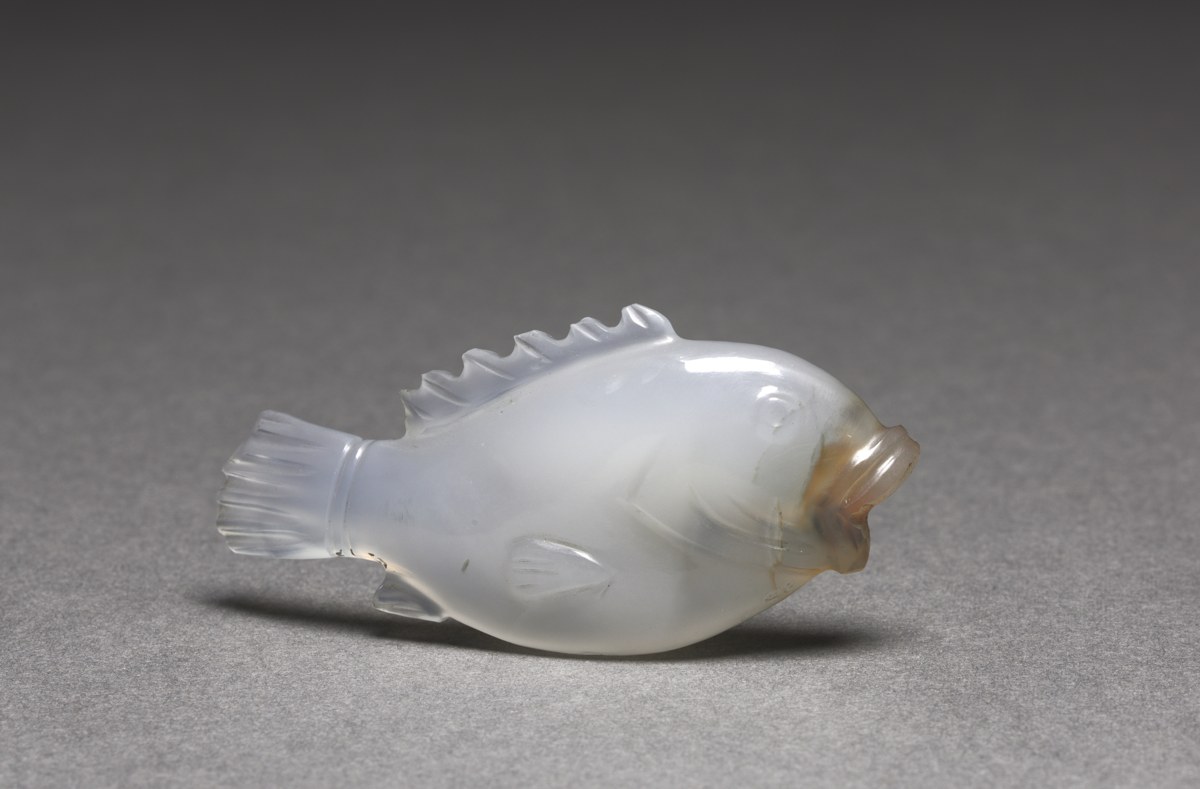
Cleveland's rock-crystal Fish Gem, dated approximately 250–350 CE, is a small object with a fish form. The museum cautiously locates it in Syria or Anatolia and identifies it as early Christian. Its accession number is 1954.592. The photograph shows an actual carved object, not a modern rendering of a catacomb motif.
It is a useful comparison with today's two-line decal precisely because the forms differ. Christian fish imagery could be materially elaborate and three-dimensional. A crystal fish and a minimalist outline can participate in the same religious vocabulary without looking identical.
Only one qualifying CC0 object was verified in the permitted collections for this entry. Other fish-related results were rejected when they depicted ordinary fishing, different religious traditions, or uncertain imagery. Met object records could not be fully checked because the detail API was blocked during this research. No second artifact has been added just to create an appearance of abundance.
Not every ancient fish is an ichthys
The University of Michigan's Kelsey Museum warns that fish images on late-antique Egyptian bread stamps raise difficult questions about identifying belief from archaeological remains. Fish belonged to the visual worlds of Christians and non-Christians alike. A fish on an object is evidence for a fish image; the step to identifying a Christian owner needs additional support.
Relevant clues may include a Christological inscription, a documented Christian setting, associated images, or a well-supported museum attribution. An object's date alone is insufficient. Even a date within the Roman Empire's Christian centuries cannot determine every maker's or user's religion.
This is a useful principle for the wider study of Christian symbols: meanings are not always exclusive, and objects can travel between settings. Comparison should sharpen an interpretation, not erase uncertainty.
Ichthys, Chi Rho, and the fish outline
The Chi Rho combines letters from the Greek word for Christ. Ichthys instead uses a whole Greek word whose letters can be read as the initials of a religious statement. Both involve Greek language, but they are not alternative spellings of the same monogram.
The fish outline also resembles a pointed oval extended into a tail. That does not make it identical to a vesica piscis, the lens-shaped overlap of two circles. A geometrical resemblance does not prove that the Christian fish was invented from that construction.
Reading the symbol today
On a vehicle, pendant, sign, or contemporary church publication, the ichthys usually declares Christian affiliation. In a historical collection, its interpretation requires slower attention to date, material, inscription, and provenance. The same short name can refer to a Greek word, a theological wordplay, or an image.
There is no single dedicated Unicode character for the familiar two-arc Christian fish outline. An ordinary fish emoji represents an animal and is not a precise textual substitute for this emblem. Where exact form matters, use a labeled image and preserve the distinction between illustration and historical evidence.
In the museum
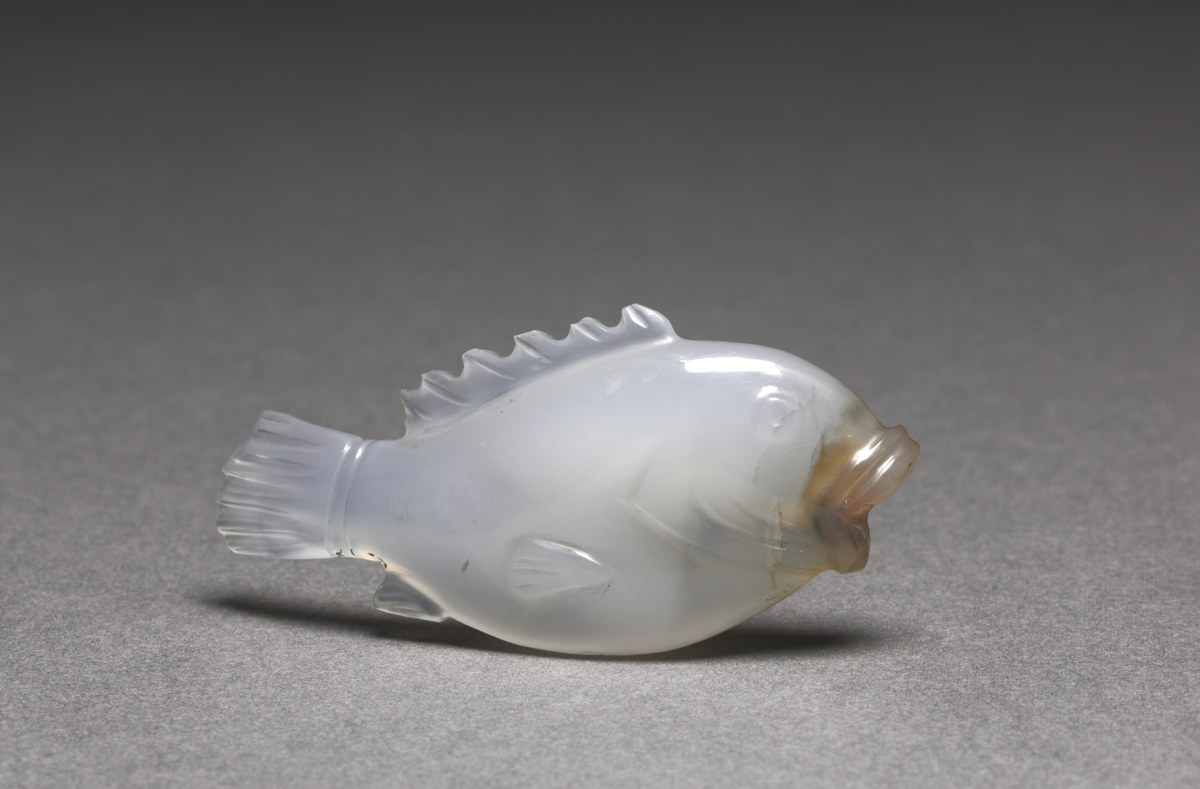
An actual rock-crystal fish, identified by the museum as early Christian, rather than a modern two-arc fish outline.
c. 250–350 CE · Syria(?) or Anatolia, early Christian · Cleveland Museum of Art · 1954.592 · CC0
Frequently asked questions
What does ichthys stand for?
ΙΧΘΥΣ is Greek for fish. Christians read its letters as the initials of a Greek phrase translated 'Jesus Christ, Son of God, Savior.'
Is the secret fish-drawing story proven?
Fish imagery did communicate Christian identity, but the sources used here do not establish the specific story of strangers completing each other's arcs in the dust as a documented ancient practice.
Is every ancient fish image Christian?
No. Fish also appear in non-Christian art and daily-life scenes. An inscription, setting, associated imagery, or a well-supported attribution is needed before identifying an object as Christian.
Is ichthys the same as Chi Rho?
No. Chi Rho combines letters from the Greek word for Christ. Ichthys is a Greek word for fish interpreted as the initials of a longer profession of faith.