Religion
Anchor Symbol Meaning in Hope, Faith, and Seafaring
An anchor holds a vessel in place, making it a powerful image of steadiness. Christian scripture gives it a specific connection with hope, while maritime and personal uses remain broader.
The anchor symbol usually means hope, stability, or steadfastness: something holds firm when circumstances change. In Christianity, its connection with hope is explicit in Hebrews 6:19, which describes hope as an anchor for the soul. In maritime imagery, an anchor may instead identify seafaring, a harbor, or a life connected with ships. The surrounding details determine which meaning fits.
The anchor is a useful example of an ordinary tool becoming a metaphor without losing its practical identity. Before interpreting an anchor as faith, love, or resilience, ask whether the image is simply showing how a vessel is secured.
Why does an anchor symbolize stability?
An anchor works by engaging the seabed and resisting a vessel's movement. Its symbolic force comes from that holding action. “Grounded” and “anchored” are familiar metaphors because they make an abstract condition, such as emotional steadiness, imaginable as a physical relationship.
The familiar pictorial anchor has a vertical shank, a ring at the top, a crosspiece, and two curved arms ending in pointed flukes. It is not a diagram of every anchor type ever used. Its clear silhouette makes it especially effective in badges, jewelry, signs, and small printed marks.
Stability does not necessarily mean never traveling. A ship uses an anchor during a pause in its journey. In a personal design, that can make the image less about being stuck and more about having a dependable point of return. This is an interpretive possibility, not a fixed historical definition for every wearer.
The anchor's Christian meaning of hope
Hebrews 6:19 supplies the clearest textual foundation: “This we have as an anchor of the soul, sure and firm,” in the translation published by the United States Conference of Catholic Bishops. The surrounding passage concerns God's promise, encouragement, and the hope held by believers.
That context is more specific than a general instruction to stay positive. The passage connects security with divine faithfulness and Jesus' entry into the heavenly sanctuary. A Christian anchor therefore can express trust in a promise, not just an individual's ability to withstand difficulty.
The United Methodist Church explains the anchor cross through this same scriptural association and discusses its appearance in Christian funerary art. A cross-shaped shank can make the connection to Christianity especially apparent. Still, the shape alone is not sufficient to identify every anchor as a disguised cross.
For related early Christian imagery, compare the ichthys and the Chi Rho. They can appear in the same broad religious setting, but their forms and textual associations are different. Our guide to Christian symbols places them alongside other images of faith and hope.
Was the anchor a secret Christian sign?
Anchors occur in early Christian funerary imagery, including Roman catacomb contexts. Older reference works often describe them as symbols of hope and sometimes emphasize their resemblance to a cross. Those are relevant observations, but they do not justify a universal story about a secret recognition code.
The anchor also existed outside Christianity. A symbol's presence in a tomb must be read with the inscription, neighboring images, archaeological setting, and date. It is possible to identify a Christian use without claiming that every ancient anchor carried a hidden Christian message.
There is also a distinction between a biblical metaphor and a surviving pictured object. Hebrews supplies evidence for a metaphor of hope. Establishing the date and interpretation of a particular carving requires separate object evidence. A careful history keeps those two kinds of evidence in conversation rather than treating one as a substitute for the other.
Anchors in museum art
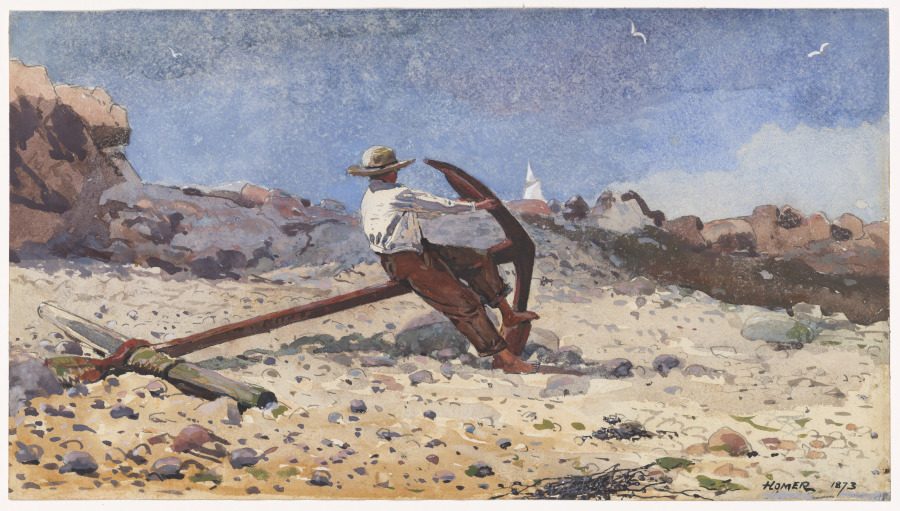
Winslow Homer's Boy with Anchor, dated 1873 by the Cleveland Museum of Art, places an actual anchor in a shore scene. The anchor's presence makes the maritime connection concrete. It does not, by itself, prove that Homer intended a Christian allegory of hope.
In Pieter Bruegel's Hope, dated 1559 by Cleveland, the central personification stands amid dangerous water and scenes of distress. A large anchor extends diagonally beside her. Here an anchor belongs within an explicitly named allegory, rather than simply appearing as equipment on a beach.
These two objects answer different questions. Homer's watercolor shows an anchor in a human coastal setting; Bruegel's engraving places one beside a personification of Hope. Their different settings demonstrate why a recognizable shape is only the start of interpretation, not a complete explanation of an artist's intention.
The museum examples below are included because anchors are genuinely visible, not because every object with “hope” in its title must contain one. That distinction is especially important in allegorical art, where Hope may have different attributes and the title alone cannot verify the design.
What does an anchor mean in love or friendship?
In contemporary personal imagery, an anchor can stand for a dependable relationship or someone who provides a sense of security. A gift may use the metaphor “you keep me grounded.” Names, dates, initials, or accompanying words usually clarify that personal intention.
Such uses belong beside, not in place of, the maritime and Christian histories. An anchor with a heart does not establish an ancient code for romantic commitment. It is a readable combination of familiar images whose exact significance depends on the maker and recipient.
For comparison, the Claddagh has a more specific arrangement of hands, heart, and crown. Our guide to symbols of love considers how personal affection is expressed through different forms without treating them as interchangeable.
Ropes, crosses, and other details
A rope wound around an anchor can emphasize its nautical identity. A clearly added cross, scriptural quotation, or church setting strengthens a religious interpretation. A uniform badge, naval setting, or shipping sign points toward professional or institutional use.
A broken anchor can suggest the loss of security in a particular artwork, but that interpretation should be checked against the scene. An upside-down or angled anchor likewise has no single meaning that applies across all jewelry, monuments, and logos. Composition and function may explain its orientation.
Copying the anchor character
The anchor character is ⚓, Unicode U+2693, officially named ANCHOR. It is a real encoded character rather than a picture that must be downloaded. Depending on the device and font, it may appear as a monochrome sign or an emoji-style image.
A digital anchor carries no automatic religious statement. Someone might use it to mark a port, describe a sailing trip, or express steadiness. As with the historical objects, meaning comes from context. The most useful first question remains simple: what is the anchor holding steady here?
In the museum
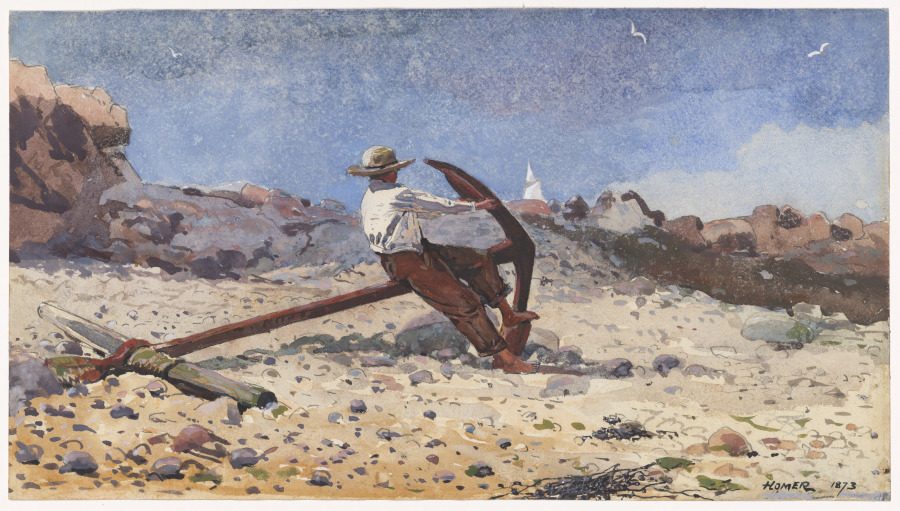
An anchor lies beside the boy in Winslow Homer’s 1873 coastal watercolor; the scene documents maritime imagery, not a proven Christian allegory.
1873 · America · The Cleveland Museum of Art · 1954.128 · CC0
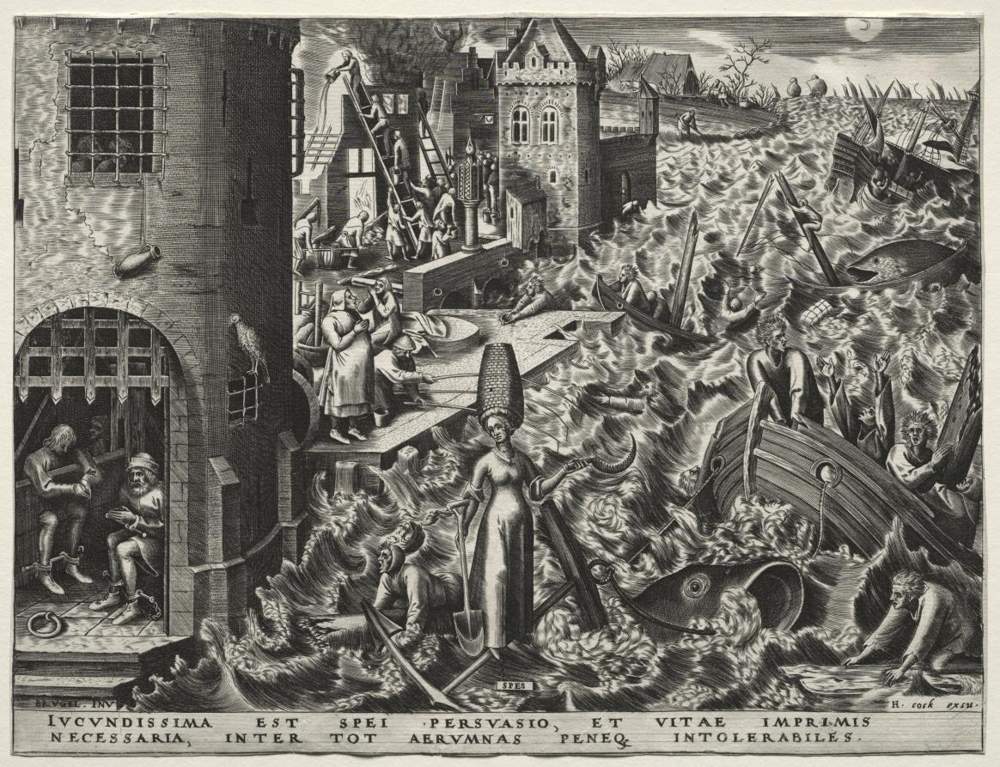
A large anchor extends diagonally beside the central figure in Pieter Bruegel’s Hope, an engraving dated 1559.
1559 · Flanders · The Cleveland Museum of Art · 1964.447 · CC0
Frequently asked questions
What does an anchor symbolize?
It commonly symbolizes hope, steadfastness, stability, or security. It can also identify seafaring without any additional allegorical meaning.
Why is the anchor a Christian symbol?
Hebrews 6:19 describes hope as an anchor for the soul. Christian art and teaching draw on that explicit comparison, particularly in imagery concerned with hope and salvation.
Does an anchor always mean Christianity?
No. Anchors are practical maritime objects and appear in nautical, decorative, institutional, and personal designs outside Christian contexts.
What is the anchor Unicode character?
The character ⚓ is U+2693, officially named ANCHOR. Its appearance varies across fonts and devices.