Religion
Christian Symbols and Their Meanings
The cross, fish, dove, lamb, and Christograms explained through scripture, church traditions, and real museum objects.


Christ's crucifixion, salvation, and resurrection.
The joined Greek initials of Christ's name.
 Ichthys
The fish as a confession of faith in Jesus Christ.
Original illustration · Symbolism.co editors; original code-rendered illustration · CC0-1.0 · Source record · License
Hope and steadfastness, with a direct reference in Hebrews 6:19.
A cross form with a title board, crossbeam, and footrest.
Christian symbols express beliefs about Jesus Christ, salvation, the Holy Spirit, and the life of the Church. The cross is the most widely recognized Christian faith symbol, but the fish, Chi-Rho, dove, lamb, and anchor each communicate a different part of that faith. Their meanings come from scripture, worship, and particular Christian communities, not from a single universal symbol chart.
A small fish on a car and an elaborate processional cross belong to the same broad tradition, yet they do different work. One identifies a believer; another accompanies public worship. To read either well, notice its setting, date, inscriptions, and denomination. Our religious symbols collection offers a starting point for comparisons without treating different faiths as interchangeable.
Christian symbols and their meanings at a glance
| Symbol | Usual Christian meaning | Useful detail |
|---|---|---|
| Cross | Christ's death and resurrection; salvation | Its form varies across churches. |
| Fish, or ichthys | A confession of faith in Jesus Christ | The Greek word can function as an acrostic. |
| Chi-Rho | Christ's name | It joins the Greek letters chi and rho. |
| Dove | The Holy Spirit, especially at Christ's baptism | An olive branch may introduce a different biblical story. |
| Lamb | Christ as the Lamb of God | A cross or victory banner helps identify the reference. |
| Anchor | Hope and steadfast faith | Hebrews describes hope as an anchor of the soul. |
The cross and crucifix: the central Christian faith symbols
The cross refers first to the crucifixion of Jesus. In Christian belief, his death and resurrection bring salvation, so the cross can express suffering, self-giving love, victory over death, and hope together. A decorative cross is not simply a general-purpose symbol of good fortune: its central reference is a specific person and event.
A crucifix includes a representation of Christ's body. An empty cross does not. Catholic churches commonly display crucifixes, and many Protestant churches favor an empty cross, but that contrast is not an absolute rule. Lutheran and Anglican settings, for example, complicate any tidy division. Orthodox crosses can also bear an image of the crucified Christ.
The Latin cross has a longer lower arm. A Greek cross has four arms of roughly equal length. These names describe shapes rather than dividing all Christians into two camps. Placement, material, and accompanying figures can reveal more than geometry alone. A cross carried in a procession also has a practical role that a cross carved on a grave does not.
The fish: ichthys as a symbol of Jesus
The ichthys, often called the Jesus fish, is usually drawn as two curved lines that meet at the head and cross at the tail. Its Christian reading is associated with the Greek word for fish, ichthys. The letters can stand for the Greek words translated as “Jesus Christ, Son of God, Savior.”
The fish therefore makes a compact confession about Jesus rather than representing fishing in general. Gospel accounts of fishermen and meals involving fish add further associations. A familiar modern story says Christians always recognized one another by completing half a fish scratched in the ground. It is better not to present that charming story as a securely documented universal practice. The established symbolism does not depend on it.
Chi-Rho, IHS, and the letters of Christ's name
The Chi-Rho combines Χ and Ρ, the first two Greek letters of Christos, “Christ.” Although an English reader may see an X and P, those are not the letters' values here. The joined sign is a Christogram: a monogram representing Christ's name.
The Vatican Museums describe its importance in Christian funerary art and its association with Constantine and victory over death. A Chi-Rho on a sarcophagus can therefore carry a hope of resurrection, not simply label a Christian owner. Claims about Constantine's vision should be distinguished from the surviving objects that demonstrate the monogram's use.
IHS is another Christogram, derived from the beginning of Jesus' name in Greek. It is frequently encountered on church furnishings and devotional objects. Later explanatory phrases have been attached to its letters, but reading it as a name-monogram is a sound starting point. Neither IHS nor Chi-Rho is a separate deity or an unrelated magical sign.
Alpha and Omega: beginning and end
Alpha and omega are the first and last letters of the Greek alphabet. In the Book of Revelation, the paired letters express divine beginning and end. Christian art often places Α and Ω beside a cross or Chi-Rho, emphasizing Christ's relation to all time and to creation's fulfillment.
The letters work as a pair. An isolated decorative A is not enough to identify the same meaning. On the Vatican Museums' Christological monogram relief, their funerary setting helps connect the image to resurrection and final judgment. Lettering can be as important as a picture when identifying symbols representing Jesus.
The dove and the Holy Spirit
The dove is associated with the Holy Spirit because the Gospels describe the Spirit descending like a dove at Jesus' baptism. Matthew 3:16–17 places that descent alongside the voice identifying Jesus as the beloved Son. In an image of the baptism, the bird belongs to that scriptural narrative.
A dove carrying an olive leaf or branch can instead recall Noah and the end of the flood, and in other settings may express peace. A bird beside a saint can have still another meaning. These are connected visual traditions, not proof that every white bird means the same thing. Our guide to dove symbolism separates the biblical stories from wider cultural uses.
The lamb, vine, bread, and cup
John 1:29 calls Jesus the “Lamb of God.” Christian images of a lamb may develop this identification through a halo, a cross, or a banner of victory. A lamb with a victory banner can bring sacrifice and resurrection into one image. Sheep around a central shepherd or lamb, however, may represent followers rather than additional images of Christ.
The vine has an especially direct textual source: in John 15:5 Jesus identifies himself as the vine and his followers as branches. A church vine can therefore speak of dependence on Christ and the community joined to him. Yet a vine on an older Roman object is not automatically Christian. The plant existed in other artistic traditions too.
Bread and a cup, or wheat and grapes, can refer to the Eucharist or Holy Communion. Christians differ substantially in their theological explanations of this sacrament and in its celebration. Identifying the visual reference does not settle those differences. The same objects may also appear in a painting of the Last Supper as elements of the narrated meal.
The anchor and images of the Trinity
The anchor as a Christian symbol expresses hope. Hebrews 6:19 describes hope as an anchor of the soul, sure and firm. The ordinary function of an anchor makes the metaphor accessible: faith remains secure when circumstances are unstable. On an object, a cross-shaped shaft may strengthen the Christian association, but an anchor can also simply identify a sailor.
Triangles and groups of three can refer to the Trinity: Father, Son, and Holy Spirit. Such images offer ways of pointing toward a doctrine, not diagrams that fully explain it. The Orthodox Church in America includes the triangle among graphic Christian symbols. A three-part design elsewhere is not necessarily Trinitarian, and mathematical resemblance alone cannot establish its religious meaning.
Orthodox Christian symbols and Protestant differences
The three-bar cross familiar in Russian Orthodox settings includes an upper title board, a longer central crossbeam, and a lower footrest. The Orthodox Church in America cautions that explanations of the footrest's slant are later pious interpretations; earlier Byzantine depictions often show it horizontal. That distinction matters when someone presents a devotional explanation as the cross's proven historical origin.
No single cross shape represents every Orthodox church. The same care applies to the question “What is the symbol of Protestant Christianity?” There is no one emblem used by every Protestant denomination. An empty cross is widespread, while particular churches have their own identifiers. The United Methodist cross and flame, for instance, belongs to that denomination rather than to Protestantism as a whole.
Nor should every star in a church be labeled a Christian version of the Star of David. The six-pointed star has its own Jewish history and contemporary identity. Where it occurs in Christian art, the specific work needs to be examined on its own terms.
Two museum objects that make the meanings tangible
Cleveland's Ceremonial Cross of Countess Gertrude, dated 1038 or shortly afterward, shows how a simple recognizable outline could become an elaborate object of devotion. Its gold surface, stones, and figural details ask to be read together. It is evidence for a particular medieval Christian object, not a model of how all crosses must look.
The museum's Byzantine Fragment of a Processional Cross, about 1050, presents Christ flanked by the Virgin and John the Baptist. Cleveland identifies this grouping as the Deesis, an image of intercession. The surviving fragment also reminds us that museum objects may be incomplete: what is displayed today is not necessarily the full silhouette worshippers once saw.
How to identify a Christian symbol responsibly
Start with what is visible, then check the surrounding evidence. Is a bird descending toward Jesus? Are Greek letters placed around a cross? Does the museum record identify the object as a reliquary, a processional cross, or a tomb monument? Those details turn a loose association into a supported interpretation.
Finally, distinguish historical description from belief. A reference can explain what Christians mean by an image without asking every reader to share that faith. It can also respect living worshippers while acknowledging variation, uncertainty, and change. Religious symbols communicate through communities and practices, not through a secret code that stays identical everywhere.
In the museum
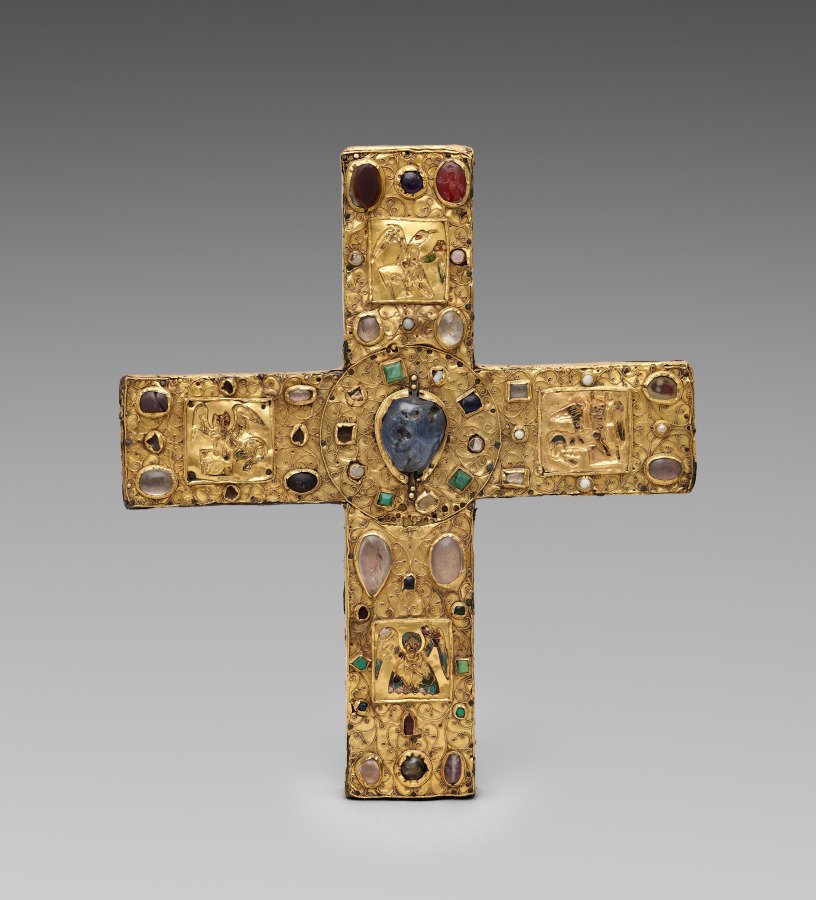
Gold and gem-set Ceremonial Cross of Countess Gertrude, 1038 or shortly after; Germany, Lower Saxony?, Cleveland Museum of Art, 1931.55.
1038 or shortly after · Germany, Lower Saxony?, 11th century · Cleveland Museum of Art · 1931.55 · CC0
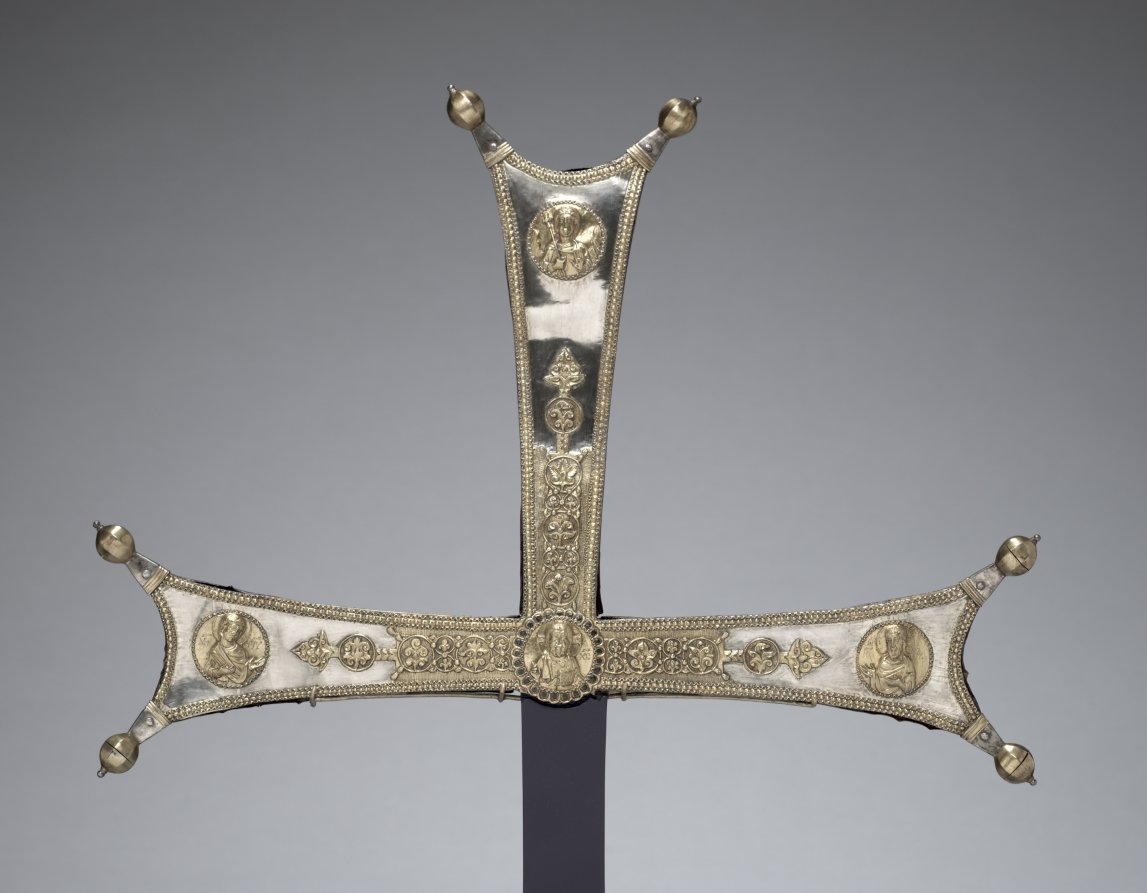
Surviving Byzantine processional cross fragment with medallions of Christ, the Virgin, and John the Baptist, about 1050; Cleveland Museum of Art, 1970.36.
c. 1050 · Byzantium, Constantinople, Byzantine period · Cleveland Museum of Art · 1970.36 · CC0
Frequently asked questions
What is the main symbol of Christianity?
The cross is Christianity's most widely recognized symbol. It refers to Jesus' crucifixion and, in Christian belief, to salvation and victory over death through his resurrection.
What does the Christian fish mean?
The ichthys represents Jesus Christ. The letters of the Greek word for fish can stand for a confession translated as Jesus Christ, Son of God, Savior.
What is the difference between a cross and a crucifix?
A crucifix includes an image of Christ's body; an empty cross does not. Preferences vary across denominations and local churches.
Why does an Orthodox cross have a slanted bar?
The lower bar represents a footrest. The Orthodox Church in America distinguishes its later devotional interpretations from earlier Byzantine examples in which the bar was often horizontal.
Is there one symbol for all Protestants?
No. The cross is widely used, but Protestant denominations have distinct traditions and emblems. An empty cross is not exclusive to Protestant churches.
Sources & further reading
- Orthodox Church in America: Christian Symbols
- Vatican Museums: Christological monogram
- United Methodist Church: Christian Symbols and Chrismons
- Society of Jesus: On the Holy Name of Jesus
- United Methodist Church: What do the letters IHS stand for?
- United Methodist Church: History of the Cross and Flame insignia
- Orthodox Church in America: The Russian Orthodox Cross
- USCCB Bible: John 1, Lamb of God and dove
- USCCB Bible: Matthew 3, baptism of Jesus
- USCCB Bible: Hebrews 6, anchor of the soul
- Cleveland Museum of Art: Ceremonial Cross of Countess Gertrude
- Cleveland Museum of Art: Fragment of a Processional Cross