Religion
Chi Rho Meaning and Early Christian History
A monogram of Christ formed from Greek letters, seen on imperial standards, Christian textiles, and tombs.
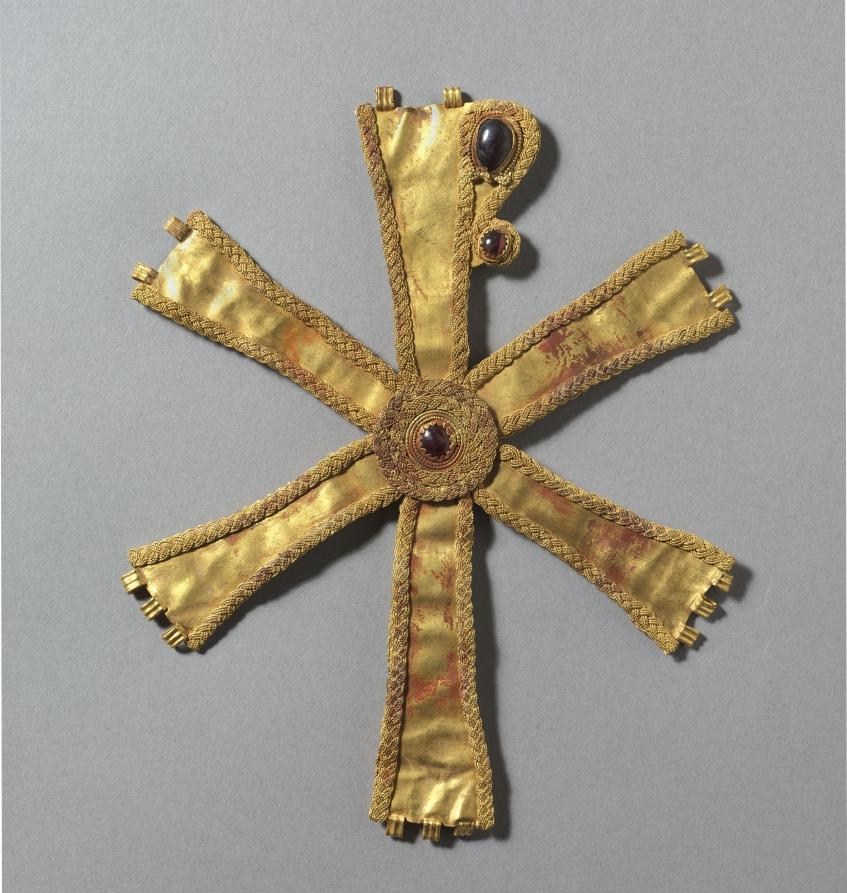
The chi rho is a Christian symbol made by placing the Greek letters chi (Χ) and rho (Ρ) over one another. They are the first two letters of Christos, the Greek title meaning Christ. Its central meaning is therefore Christ himself; in early Christian art it also expresses Christian identity, resurrection, and victory over death. The shape that looks like an English P is a Greek rho, not the letter P.
Also written chi-rho and called a Christogram, the monogram belongs to a family of signs that abbreviate Christ's name. Its close association with the Roman emperor Constantine helped make it prominent, but surviving objects show that it was not just a military emblem. Christians placed it on jewelry, textiles, and tombs. Those settings are essential to understanding what a particular example means.
How to recognize the chi rho
Look for an X crossed by an upright stem with a curved loop at the top. The X supplies chi; the upright and loop supply rho. Some versions have a wreath or circle around the letters. Others place alpha and omega beside them. The proportions vary because artists worked in different materials: a cast or assembled metal ornament cannot look exactly like woven wool or a mark pressed into clay.
The two Greek letters can be shown separately as ΧΡ, but the familiar symbol combines them. The rho's loop is particularly useful for distinguishing it from an ordinary six-armed cross. A damaged object can lose that loop, so identification should rely on the museum's catalog as well as its silhouette. Not every intersecting group of lines is a Christogram.
What does the chi rho mean in Christianity?
At its simplest, it names Christ without spelling out the whole title. That makes it different from a sign whose meaning has to be reconstructed only from its appearance. The letters are the starting point. Further meanings come from Christian beliefs about the person they identify and from the circumstances in which the sign appears.
On a tomb, the monogram can express hope in Christ's victory over death. On an object associated with imperial power, the same sign can connect victory and authority with Christ. In a church or domestic hanging, it can identify the subject of devotion and join other images of salvation. These are related uses, not a single message mechanically applied to every object.
For a broader comparison, see our guide to Christian symbols. The ichthys or Jesus fish is another way of expressing Christian identity, but its form and explanation are different. Recognizing that difference is more useful than treating all early Christian signs as interchangeable secret codes.
Constantine, the vision, and the labarum
Constantine's association with the sign is central to its history. Ancient Christian accounts connect his victory over Maxentius in 312 with divine assistance and a heavenly sign. However, the accounts do not describe the event in precisely the same way. Lactantius reports a dream and a sign marked on soldiers' shields; Eusebius gives a fuller account of a luminous sign and a subsequent dream.
It is therefore too neat to say that every detail of the familiar modern story is independently established. The narratives are evidence for how Constantine's victory was remembered and interpreted, as well as sources for the emperor's use of Christian imagery. A responsible history distinguishes their testimony from a photograph-like record of a vision.
In Eusebius's description, the imperial standard known as the labarum bore the monogram within a wreath. The standard and the monogram are not the same thing: the labarum was a physical military banner or standard, while the chi rho was the sign incorporated into it. Constantine's use gave the monogram a powerful public association with Christian triumph and imperial rule.
Why are alpha and omega added?
Alpha and omega are the first and last letters of the Greek alphabet. In Christian interpretation they refer to Christ as beginning and end, drawing on the Book of Revelation. Beside the chi rho, they expand the message rather than supply missing parts of its name. A plain chi rho is still a complete monogram.
The Vatican Museums' explanation of a Christological monogram connects these letters with its funerary setting and Christian hope in resurrection. Cleveland's terracotta tomb plaque makes the same association especially tangible. Letters, an enclosing arch, and the monogram work together on an object made for a burial niche, not for a battlefield.
Three surviving objects, three different settings
Cleveland's Monogram of Christ (Chrismon), dated to the 500s and cataloged as Byzantine Syrian, combines gold sheet, wire, and garnets. Its loop and crossed arms turn the written abbreviation into a freestanding precious object. The museum suggests that it may once have occupied the center of a golden wreath; that proposed original arrangement should not be mistaken for something that survives intact.
A Hanging with Christian Images from Byzantine Egypt, also dated to the 500s, places Christograms among birds, figures, and other Christian imagery. Here the sign participates in a larger composition. Its presence demonstrates how a concise monogram could sit alongside narrative or emblematic images rather than replace them.
The Columbarium Tomb Plaque with the Monogram of Christ, dated 400–800 and attributed to Spain, is terracotta rather than gold. It covered a burial niche. Taken together, these objects prevent a misleadingly narrow account: the symbol crossed materials, regions, and social settings, while retaining its reference to Christ.
Is the chi rho the same as a cross or IHS?
No. A cross represents the instrument of the Crucifixion through its shape. The chi rho is built from letters, even when its crossed strokes invite a visual connection with the cross. IHS is another Christogram with a different letter history. Similar religious purpose does not make their components identical.
The Celtic cross likewise has its own history and visual structure. When identifying a sign in a church, begin with what is actually visible: a rho loop, an X, a surrounding circle, or a conventional cross. Then use the object's date and setting to narrow the interpretation.
Copying the symbol accurately
The Unicode character is ☧, U+2627, officially named CHI RHO. A font may alter the shape of its strokes, but the encoded character remains the same. The plain text letters XP are not an exact substitute: they invite an English reading and do not reproduce the combined Greek monogram.
In present-day Christian use, the sign continues to identify Christ. In a historical description, the most accurate short caption is usually “chi-rho monogram of Christ,” followed by the object's date and context. That identifies the evidence without claiming that every use had an identical theological or political purpose.
In the museum
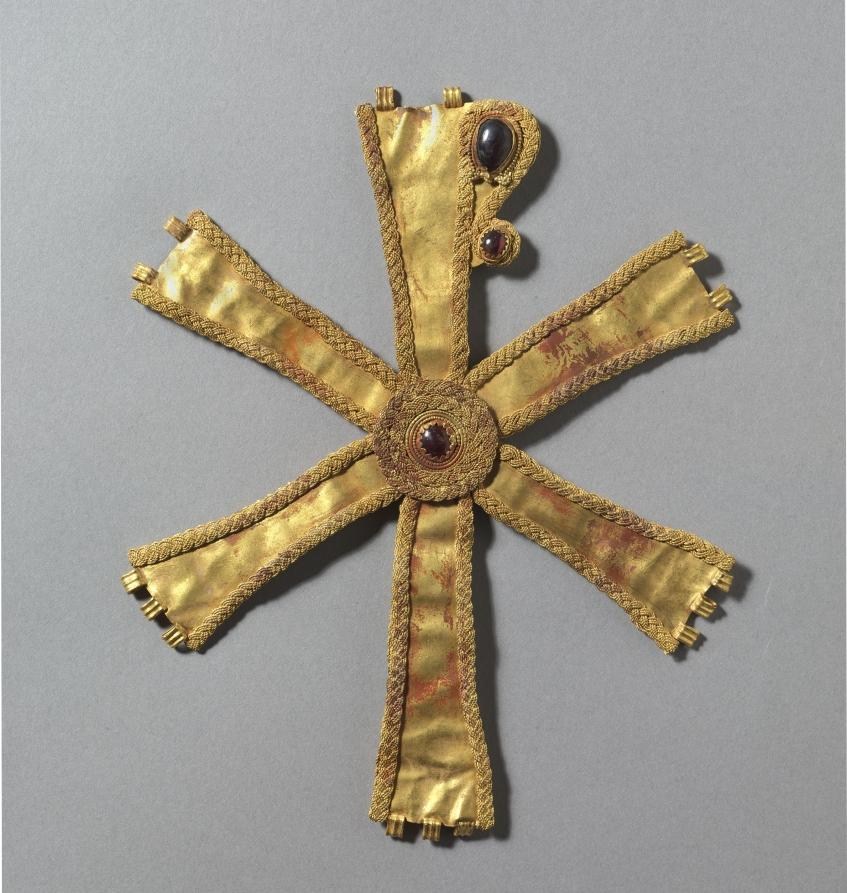
Gold-sheet chi-rho monogram set with garnets, dated to the 500s. The museum suggests it may once have formed the center of a wreath.
500s · Byzantium, Syria, early Byzantine period, 6th century · Cleveland Museum of Art · 1965.551 · CC0
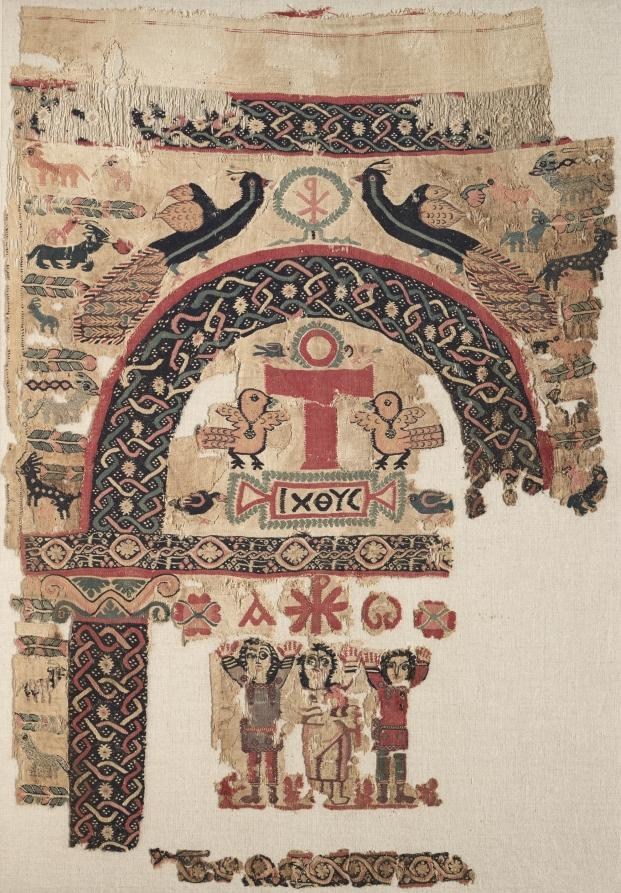
Byzantine Egyptian textile hanging with Christograms, alpha and omega, birds, and figures. The chi-rho signs are part of a larger Christian composition.
500s · Egypt, Byzantine period · Cleveland Museum of Art · 1982.73 · CC0
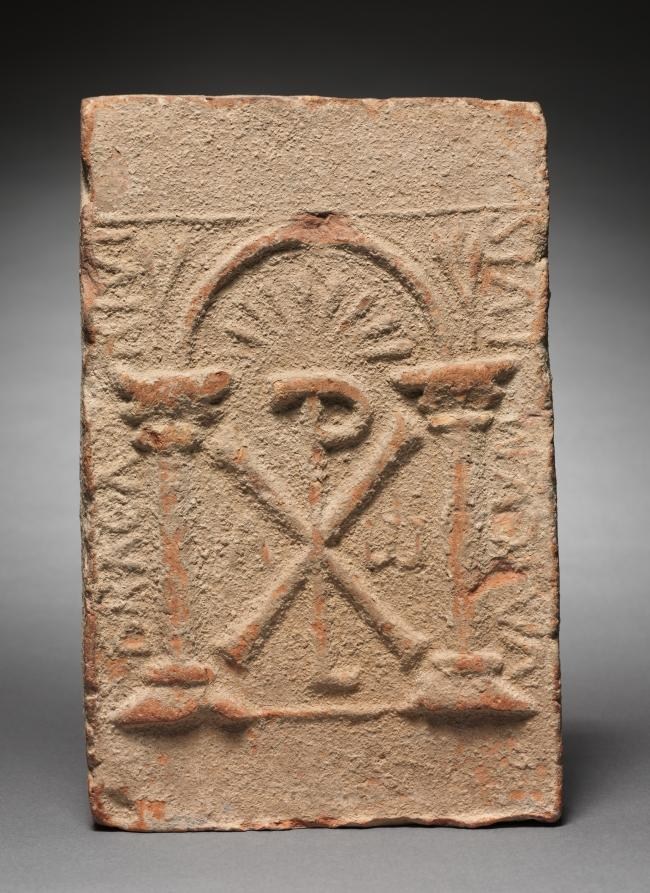
Terracotta burial-niche plaque with a chi-rho between alpha and omega, beneath an arch. The catalog dates the plaque broadly to 400–800.
400–800 · Spain (Visigothic or Byzantine) · Cleveland Museum of Art · 1938.160 · CC0
Frequently asked questions
What do the letters chi and rho stand for?
They are the first two Greek letters of Christos, the title Christ. Their combination forms a monogram of Christ.
Is the chi rho a Catholic symbol?
It is used in Catholic Christianity, but its early Christian history predates later denominational divisions. It is not exclusively Catholic.
Did Constantine invent the chi rho?
His use made it prominent. The evidence discussed here does not establish that he personally invented the letter combination.
What is the Unicode for chi rho?
The character ☧ is U+2627, officially named CHI RHO.
Sources & further reading
- Lactantius: Of the Manner in Which the Persecutors Died, chapter 44
- Eusebius: Life of Constantine, book I, chapters 28–31
- Cleveland Museum of Art: Monogram of Christ (Chrismon)
- Cleveland Museum of Art: Hanging with Christian Images
- Cleveland Museum of Art: Columbarium Tomb Plaque
- Vatican Museums: Christological monogram
- Studia Ceranea, University of Lodz: The Labarum
- Unicode: Miscellaneous Symbols, character names