Cultures
Celtic Cross Meaning, History, and Christian Symbolism
A ringed Christian cross with a rich life in Irish and Scottish art. Its medieval carvings tell us more than the familiar legends about its circle.
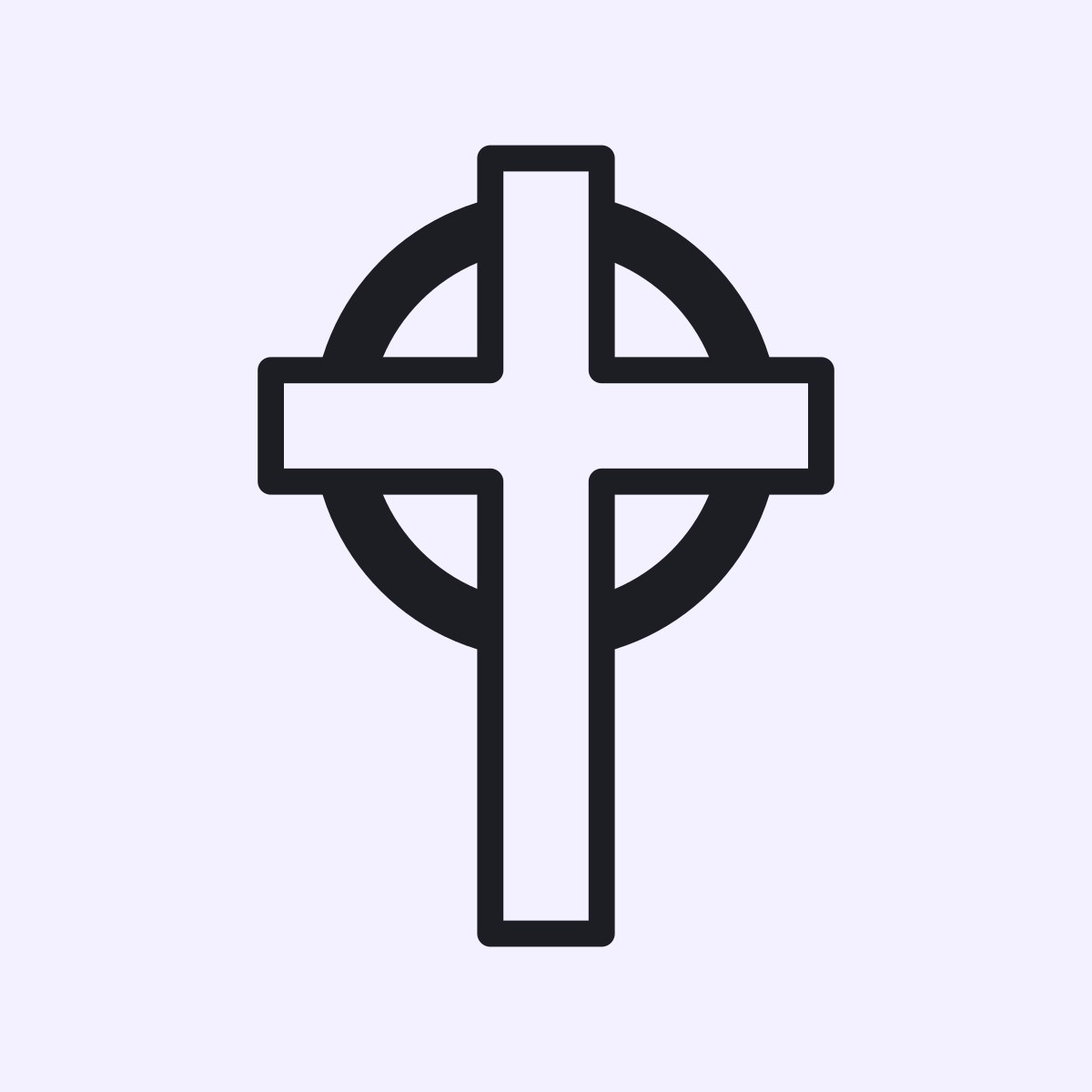
The Celtic cross is a Christian cross with a ring around the intersection of its arms. Its strongest historical meaning comes from the medieval churches and monasteries that commissioned ringed stone crosses in Ireland and Britain. Today it can also express Irish or Scottish heritage, family remembrance, and personal faith. Those meanings overlap, but they are not interchangeable with a single supposed message from pre-Christian antiquity.
To understand Celtic cross meaning, begin with a particular cross: where it stood, when it was made, and what was carved on it. A monument covered with biblical scenes provides firmer evidence than a modern explanation that assigns a secret meaning to every curve.
How to recognize a Celtic cross
The familiar outline combines a long lower shaft, two horizontal arms, an upper arm, and a circular ring. The ring usually joins the arms close to their intersection. Some examples are plain; others carry panels of interlace, animals, figures, or biblical narrative. A ringed cross does not need knotwork to qualify, and an ornamented Christian cross is not automatically a Celtic cross.
“Celtic cross” is a useful general name, while “high cross” describes a class of monumental stone crosses. The categories overlap rather than match perfectly. Medieval high crosses vary in their form and decoration. The small pendant worn today is not the same kind of object as a large freestanding monument, even when both share the ringed silhouette.
The medieval evidence: faith made visible
Heritage Ireland places the main Irish high-cross tradition around the ninth through twelfth centuries. Its account of Ahenny dates those particular crosses to the eighth century, a reminder that a broad historical range should not erase the dating of individual examples. Their setting is early medieval Christianity, not an undocumented prehistoric cross religion.
These monuments belonged to communities where art, learning, religious devotion, and patronage worked together. Heritage Ireland describes crosses as markers of important or sacred territory and expressions of political power, as well as religious monuments. A cross could announce the significance of a place while inviting prayer and reflection.
The carvings make that Christian setting explicit. Scenes identified on Irish high crosses include Adam and Eve, the Crucifixion, the Resurrection, and the Last Judgment. Interlace and animal ornament may occupy adjacent panels. These are not rival categories of “pagan decoration” and “Christian pictures”; they are components of the same medieval artwork.
What does the circle mean?
The ring is the feature most likely to attract an overly confident explanation. Eternity, the sun, a halo, and the union of different religious traditions are all proposed in popular accounts. A circle can certainly suggest continuity to a modern viewer. That visual association is not proof that every medieval patron or sculptor gave it exactly that meaning.
The sources cited here do not establish one universal explanation for the ring. The responsible answer is therefore narrower: the ring is a defining formal feature of many surviving Christian crosses, while its full significance may depend on the example. It is better to leave an origin question open than to turn a plausible-looking interpretation into a documented event.
The familiar story that Saint Patrick drew a Christian cross over a sun symbol should likewise be treated as a legend, not a verified account of invention. The existence of circles in pre-Christian art does not establish that specific story. A claim about who invented a design requires evidence connecting that person to that design.
Reading a real cross: Ahenny and Tuam
The Ahenny crosses in County Tipperary show how much information a named monument can supply. Heritage Ireland describes the south cross as a ringed sandstone cross with a low conical capstone. Its base includes hunting scenes and a scene interpreted as Daniel in the lions’ den. The description distinguishes visible carving from an interpretation of that carving.
The mid-twelfth-century Tuam High Cross offers another kind of evidence: inscriptions connected with patrons. Heritage Ireland records prayers naming Turlough O’Connor and an abbot, alongside Christian figures and interlace. Here the meaning is not confined to an abstract circle. Named people, prayer, ecclesiastical authority, and skilled craftsmanship all form part of the monument’s message.
Look at a cross in that order: overall shape, individual panels, inscriptions, location, then scholarly interpretation. Weathering makes some identifications uncertain. “Possibly” and “interpreted as” are useful parts of an accurate description, not signs that the artwork has nothing to say.
From religious monument to heritage emblem
For contemporary Christians, the cross can represent Christ’s death and resurrection. For people with Irish or Scottish connections, the ringed outline may also signify ancestry, place, or cultural belonging. A wearer may emphasize one association or several. Heritage use need not imply religious belief, just as religious use need not be a statement about ancestry.
The cross is also familiar in cemeteries. That present-day association should not be projected backward without qualification. Heritage Ireland emphasizes that the original Irish high crosses were not intended as individual burial markers. A form can acquire a new function over time while retaining recognizable features.
Its ornament often overlaps with the Celtic knot, but the two names describe different things. The cross identifies a structural form; knotwork identifies a kind of interlaced decoration. A cross can contain many knots without each one carrying a separately recoverable ancient meaning.
Modern misuse and why context matters
Some extremist groups have appropriated a short, equal-armed cross within a circle. ADL distinguishes that common extremist variant from the long-stemmed Celtic cross widely used for Christian devotion and heritage. It also cautions that context matters. A ringed cross alone is not a reliable basis for accusing an individual or community of extremism.
Read accompanying words, the organization using it, and nearby imagery. This protects against two mistakes: ignoring deliberate racist appropriation, and treating ordinary Irish or Christian symbols as inherently hateful. The history of misuse is real, but it does not cancel the far larger non-extremist history of the form.
Image and museum evidence
The featured illustration shows the ringed, long-stemmed outline rather than pretending to reproduce a particular medieval monument. No matching, visibly relevant CC0 artifact was verified for this entry in the permitted museum collections during this review. We have not filled that gap with an unrelated cross or a vaguely “Celtic” object.
For broader comparisons, see Celtic symbols and Christian symbols. Their usefulness lies in comparing distinct histories, not collecting interchangeable emblems under one universal meaning.
Frequently asked questions
Is the Celtic cross Christian or pagan?
Surviving medieval high crosses discussed here are Christian monuments. Claims that the ring proves a particular pagan origin go beyond the evidence.
Does the circle on a Celtic cross mean eternity?
Eternity is a familiar interpretation today, but no single explanation is established for every historical ringed cross.
Did Saint Patrick invent the Celtic cross?
The popular Saint Patrick and sun-circle story is not established by the historical evidence cited here. Treat it as legend rather than a documented invention.
Is a Celtic cross a hate symbol?
Most long-stemmed Celtic crosses express Christian faith or heritage. Extremists have appropriated a short equal-armed version, so the setting and accompanying messages matter.