Cultures
Caduceus Meaning and the Staff of Hermes
The two-snake staff identifies Hermes and Mercury. Its modern medical use is real, but it should not be mistaken for the ancient healing staff of Asclepius.
The caduceus is the staff with two intertwined snakes associated with the Greek god Hermes and his Roman counterpart Mercury. Its historical meanings center on messengers, negotiation, and commerce. Although it now appears on some medical emblems, it is not the same symbol as the single-snake Rod of Asclepius, which belongs to the ancient god of healing.
That distinction is the most useful starting point for understanding caduceus meaning. A symbol can acquire a new public association without losing its earlier history. Today, a hospital logo may intend “medical care”; an ancient image of the same staff usually points toward Hermes or Mercury, not a physician.
What does a caduceus look like?
The familiar modern design has a straight central rod, two snakes winding symmetrically around it, and a pair of wings at the top. The snakes usually turn their heads toward one another. Wings are common but are not required in every historical representation. Ancient and later artists varied the proportions, the shape of the snake heads, and the treatment of the upper staff.
The number of snakes is the quickest practical distinction. A staff with two snakes is a caduceus. A rod with one snake, normally without wings, is the Asclepian staff. Do not decide from wings alone: simplified logos and damaged objects can omit details. In a museum image, the figure holding the staff and the catalog description also matter.
The staff of Hermes and Mercury
Hermes is the messenger of the Greek gods and a figure associated with travel, exchange, and the crossing of boundaries. The staff functions as an identifying attribute, much as a particular animal or weapon can identify another deity. In Roman art, Mercury inherits closely related attributes and a strong connection with trade.
The National Library of Medicine explicitly identifies the two-snake caduceus as originally a symbol of Hermes, the god of commerce. This is stronger evidence for its historical identity than a modern chart that assigns a separate spiritual quality to each curve.
Its association with heralds helps explain readings involving mediation and peaceful negotiation. A herald carries messages between parties; the staff signals that role. “Peace” is therefore a useful contextual association, but the caduceus is not interchangeable with every peace sign. Its meaning is rooted in a particular classical figure and the work of messengers.
Do the two snakes have a fixed meaning?
Modern explanations often turn the paired snakes into opposites: good and evil, life and death, male and female, or two streams of energy. Such interpretations may express a later author's philosophy. They should not be presented as the single documented explanation accepted throughout the ancient Greek and Roman world.
The visually secure statement is simpler: the intertwined snakes are part of the staff's conventional identity. Their symmetry makes the emblem memorable and easy to reproduce. Recognizing that design does not require believing that it diagrams human anatomy or a scientifically established healing force.
Compare the ouroboros, a snake biting its own tail. Both symbols involve serpents, but they have different structures and histories. A shared animal does not make their meanings identical. The same caution applies when comparing the caduceus with snake imagery in unrelated religious traditions.
Why is the caduceus used as a medical symbol?
The caduceus has a genuine modern medical career, particularly in the United States. A historical discussion published in the journal Eye, available through the National Library of Medicine, notes its adoption on the uniforms of U.S. Army medical officers in 1902. Military and institutional use helped make the design familiar in medical settings.
That history needs two qualifications. First, 1902 is an institutional adoption date, not the invention of the caduceus and not necessarily its first appearance in any medical context. Second, familiarity does not turn Hermes into the ancient Greek god of medicine. The modern use and the ancient identification answer different questions.
Calling every present-day medical caduceus “meaningless” goes too far. Institutions and audiences can give an emblem an established secondary meaning. Calling it the original ancient emblem of medical healing goes too far in the other direction. Accurate interpretation preserves both the modern convention and the classical distinction.
Caduceus versus Rod of Asclepius
| Feature | Caduceus | Rod of Asclepius |
|---|---|---|
| Snakes | Two | One |
| Wings | Often present | Not part of the usual form |
| Associated deity | Hermes or Mercury | Asclepius |
| Historical emphasis | Messengers, negotiation, trade | Healing and medicine |
The distinction is useful when identifying artwork, writing a museum caption, or selecting an emblem for a medical presentation. If the intended reference is the ancient healing tradition, the Asclepian rod is the historically appropriate choice. If the subject is Hermes, Mercury, commerce, or a specific institution that uses the caduceus, the two-snake design may be exactly right.
Reading the caduceus in museum objects
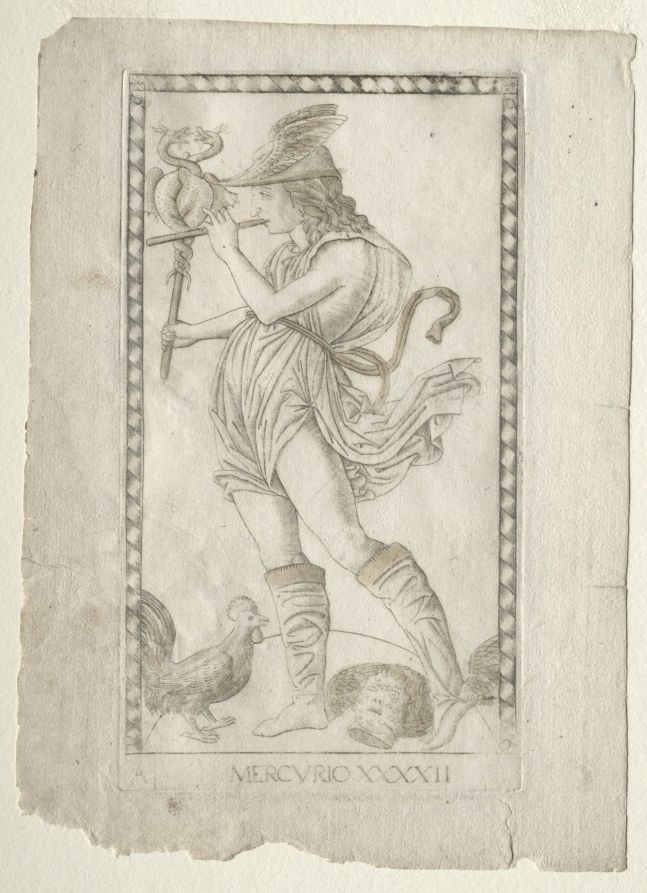
Cleveland's engraving Mercury, from the Tarocchi series and dated before 1467, offers unusually clear evidence. Its catalog identifies the staff as a caduceus and describes its intertwined winged snakes. The surrounding attributes, including Mercury's winged equipment, establish the figure's identity. This is a Renaissance image looking back to classical tradition, not an ancient Greek object.
When viewing a later Mercury image, ask what job the staff is doing. Is it identifying the god, illustrating a myth, or representing a planet in an astronomical scheme? Those functions can coexist. An attribute does not have to stand alone as a logo to be symbolically important. Our guide to symbolism in art explains this distinction between an identifying attribute and a free-standing emblem.
Copying the caduceus character
The Unicode character ☤ is named CADUCEUS and has the code point U+2624. It provides a text version of the emblem, not an exact reproduction of a particular artifact. Its appearance depends on the font and device, so inspect it before using it in a label where the number of snakes must remain obvious.
For historical interpretation, keep the order of evidence simple: identify the form, check the object or institution, then explain the meaning appropriate to that context. That approach avoids both the “universal healing symbol” myth and the equally misleading idea that a symbol can never change its use.
In the museum
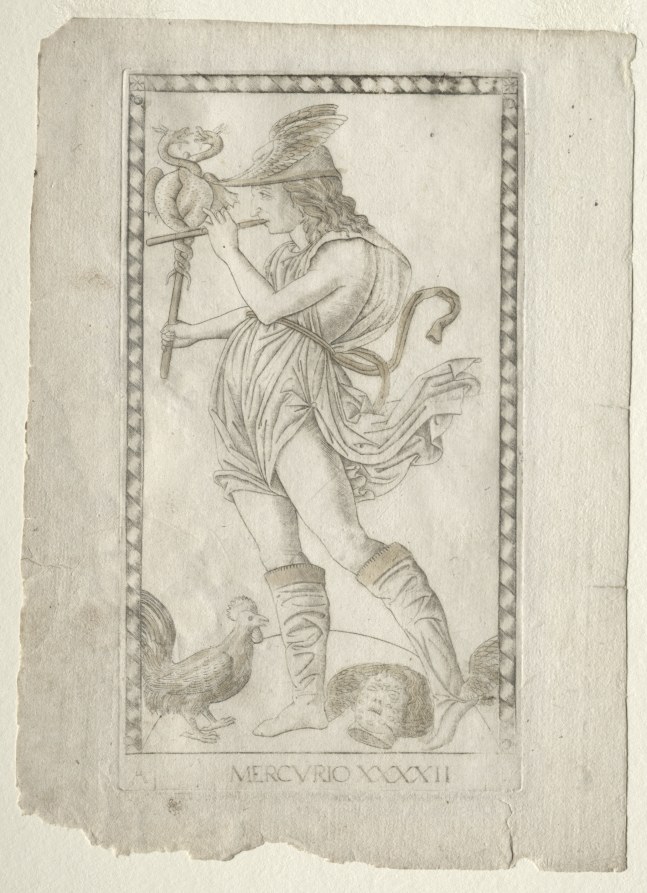
Renaissance engraving of Mercury holding a two-snake caduceus at the left while playing a flute. This is a later image of the classical god, not an ancient Greek artifact.
before 1467 · Italy, Ferrara, 15th century · The Cleveland Museum of Art · 1924.432.42 · CC0
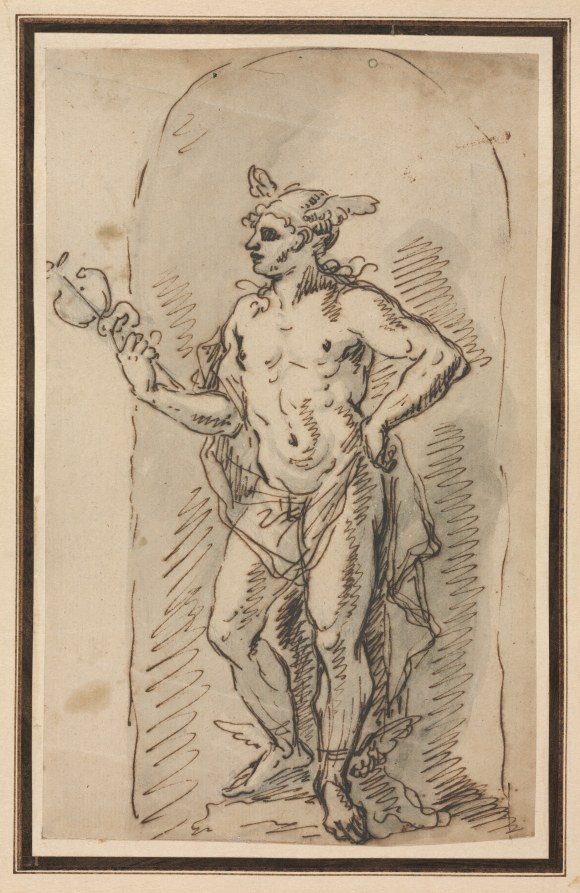
Eighteenth-century drawing of Mercury holding a diagonal caduceus whose snake-topped end reaches the left edge. This is a later image of the classical god, not an ancient Greek artifact.
1700s · Italy · The Cleveland Museum of Art · 1998.314 · CC0
Frequently asked questions
What does the caduceus mean?
Historically it identifies Hermes or Mercury and is associated with heralds, negotiation, and commerce. Some modern institutions also use it to signify medical services.
Is the caduceus the same as the Rod of Asclepius?
No. The caduceus has two snakes and often wings; the Rod of Asclepius has one snake and is the ancient healing emblem.
Why do doctors use a symbol with two snakes?
The two-snake caduceus gained modern medical associations through institutional adoption, including its use by U.S. Army medical officers in 1902. That use is later than its classical association with Hermes.
Can I copy and paste the caduceus?
Yes: ☤ is Unicode U+2624, CADUCEUS. Font support and appearance vary.