Learn
Symbolism in Art: Meaning, Movement, and Examples
A skull, a severed lock of hair, or an impossible red landscape can carry an idea beyond what it depicts. Learn to distinguish a supported interpretation from a guess.
Symbolism in art is the use of visible forms to suggest meanings beyond their literal appearance. An object, figure, color, gesture, or arrangement can express an idea such as mortality, devotion, power, or independence. A painted skull depicts a skull; in a particular setting, it may also ask viewers to consider their own deaths.
The term also names Symbolism, a late nineteenth-century artistic and literary movement that favored suggestion, imagination, and inner experience over straightforward description. These two meanings overlap, but they are not interchangeable: a Renaissance portrait can contain symbolism without being a Symbolist painting. For the broader concept, start with what symbolism is or our concise definition of symbolism.
What is a symbol in art?
A symbol is something represented in a work that carries meaning beyond itself. That meaning may come from a religious tradition, a familiar social convention, the artist's individual choices, or relationships established within the image. The evidence matters more than a dictionary-style equation.
For example, a dog in a portrait may be a household pet, a display of wealth, a suggestion of fidelity, or several of these at once. Its placement, the other figures, the painting's purpose, and knowledge of contemporary customs help determine which reading is persuasive. Calling every painted dog a symbol of loyalty would erase these differences.
Symbolic art does not have to look strange. A carefully naturalistic still life can convey ideas about passing time. Conversely, an unusual image is not automatically a puzzle with one hidden answer. Artistic symbolism can make an idea legible, but it can also make that idea more complicated or uncertain.
Symbol, motif, allegory, and iconography
- Symbol: a visible element carrying additional meaning, such as a skull reminding viewers of mortality.
- Motif: a recurring element, such as a flower repeated across a series. Repetition alone does not establish what it means.
- Allegory: a representation organized around another level of meaning, often using personifications or a sustained narrative.
- Iconography: the identification and study of subjects, attributes, and imagery. Recognizing a saint through an identifying object is an iconographic task; interpreting the work's wider significance requires further context.
Symbolism as an art movement
The historical movement took shape in the late nineteenth century. As the Metropolitan Museum of Art explains, Symbolism initially developed as a French literary movement in the 1880s. Jean Moréas published his manifesto in Le Figaro in 1886. The French term symbolisme refers to this movement, not to a separate visual technique.
Symbolist artists sought ways to evoke ideas and subjective experience rather than simply describe the material world. Myth, dreams, religious feeling, desire, and anxiety offered subjects that could not be exhausted by faithful observation. Gustave Moreau, Odilon Redon, and Paul Gauguin are important figures in this history, although their pictures do not share one uniform style.
Moreau's detailed mythological scenes and Gauguin's broad, simplified areas of color demonstrate that variety. A common concern was what an image could suggest beyond what it showed. The movement's history also includes works made before the 1886 manifesto, so that publication should not be treated as a starting gun for every Symbolist painting.
It is useful to distinguish Symbolism from Surrealism, the later twentieth-century movement. Both can involve dreamlike imagery, but similar subject matter does not make their historical contexts or aims identical. Likewise, Frida Kahlo's use of symbolic self-portraiture does not make her a member of the nineteenth-century Symbolist movement.
Six examples of symbolism in art
These artworks show several ways meaning can operate: through a conventional object, a mythological confrontation, the arrangement of a scene, or a personal act. The interpretations below separate museum-supported context from readings that remain open.
1. Jan van Eyck, The Arnolfini Portrait, 1434
A small dog stands between the two figures in Van Eyck's richly detailed interior. The National Gallery's account notes the association between dogs and marital faithfulness. That makes fidelity a relevant symbolic possibility, rather than an arbitrary modern invention.
Nevertheless, the painting should not be reduced to a checklist in which each furnishing has one secret meaning. The room also presents material possessions and social standing. A detail can contribute to that convincing setting while carrying an additional association.
This work offers a useful warning about overinterpretation. The woman's rounded silhouette is often called a pregnancy symbol, but the National Gallery explains that she is holding up a bulky, fashionable gown. Before interpreting a feature, first establish what it actually depicts. The apparent clue may be an unfamiliar historical convention.
2. Hans Holbein the Younger, The Ambassadors, 1533
Two elaborately dressed men stand beside shelves of instruments and books. Near their feet, a long, strange shape cuts across the foreground. Seen from an oblique angle, it resolves into a skull. This perspective distortion is called anamorphosis.
The skull functions as a memento mori, a reminder of death. In a portrait displaying learning, status, and worldly accomplishment, it introduces a radically different scale of value: neither knowledge nor position removes human mortality. The viewer must also change position to recognize it, making the act of looking part of the experience.
The National Gallery identifies a partly concealed crucifix in the upper-left corner as a suggestion of Christian redemption. Death is therefore not the painting's only religious reference. Interpretations of the instruments and books involve the period's political and religious divisions; they deserve more care than the assertion that every object has a settled code.
3. Gustave Moreau, Oedipus and the Sphinx, 1864
Moreau paints the Greek hero confronting the Sphinx, a creature with a woman's head and an animal body. Their close encounter gives the myth an intense psychological focus. The Met's collection record dates the work to 1864; its essay on Symbolism places Moreau's treatment of the Sphinx within the movement's visual background.
The picture illustrates how a narrative subject can become a vehicle for broader ideas. The confrontation invites consideration of danger, knowledge, and the challenge of confronting what is unknown. These are interpretive possibilities grounded in the encounter, not a translation of the Sphinx into one universally fixed meaning.
It also shows why the date of a manifesto is not a rigid boundary. Moreau's painting predates Moréas's text by more than twenty years, yet his imaginative treatment of myth helped establish imagery important to later Symbolist artists.
4. Paul Gauguin, Vision of the Sermon (Jacob Wrestling with the Angel), 1888
Breton women in distinctive white headdresses occupy the foreground while Jacob wrestles with an angel beyond them. A diagonal tree divides the picture, and a startling red field replaces an ordinarily colored landscape. The National Galleries of Scotland connects the scene to the biblical sermon the women have heard.
The wrestling belongs to their imagined vision rather than to everyday observation. Gauguin makes that distinction through composition, simplified shapes, and non-naturalistic color. Symbolic meaning is therefore not restricted to identifiable objects: the entire organization of the painting can express the relationship between outward appearance and inward belief.
It would be misleading to explain the red ground simply as “red means anger.” Here, its meaning depends on the visionary subject and the painting's departure from ordinary space. Color participates in the work's structure instead of behaving like a label pasted onto an emotion.
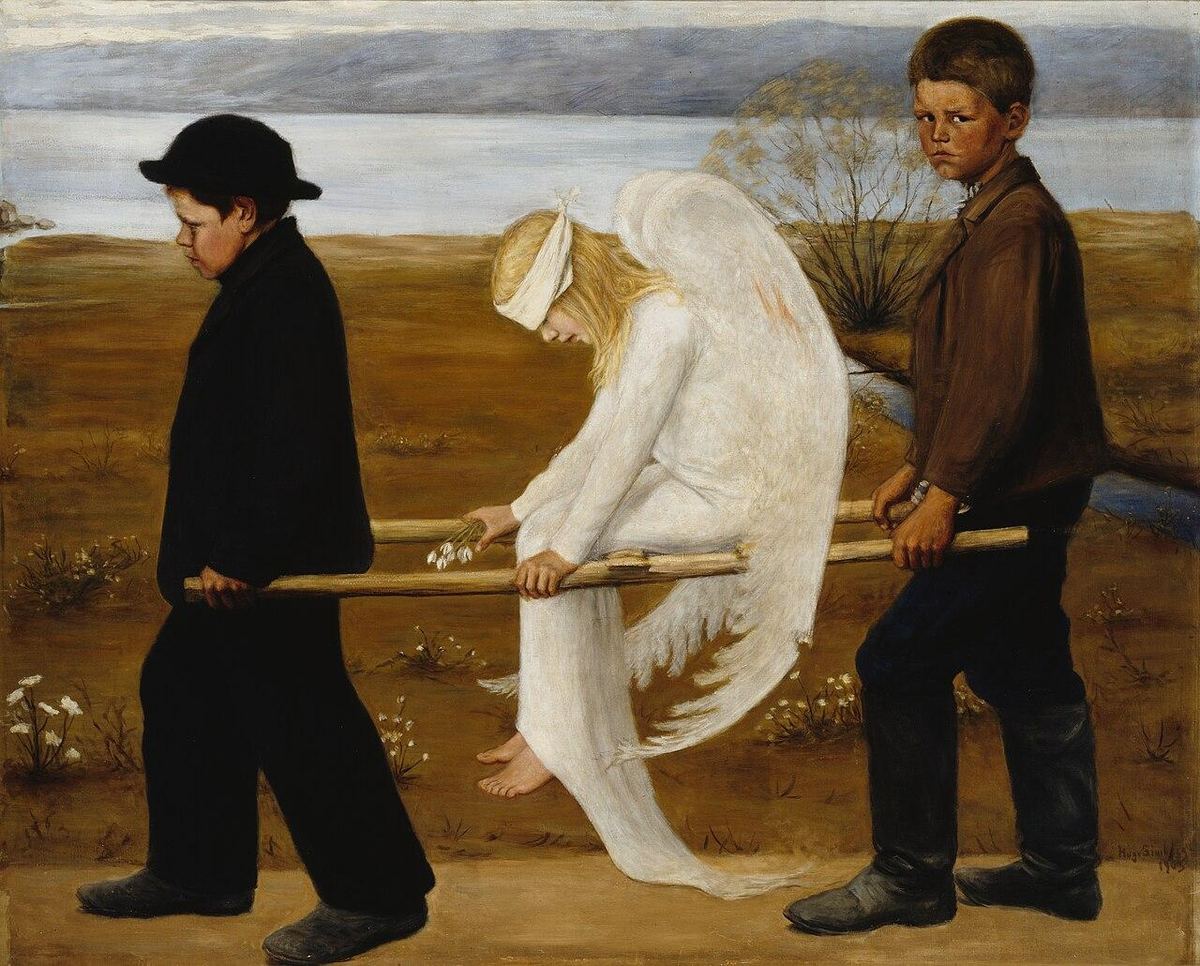
5. Hugo Simberg, The Wounded Angel, 1903
Two boys carry an angel on a stretcher. Her eyes are bandaged, and a wing is wounded. The Finnish National Gallery records the painting as a 1903 work in the Ateneum collection. Its combination of an everyday act of carrying and an extraordinary injured being makes the familiar scene unsettling.
The Ateneum's presentation of the work emphasizes its openness to interpretation. When Simberg first exhibited it, he supplied a dash in place of a title. Readers should be wary of explanations claiming that one detail proves a single authorized message.
Compassion, vulnerability, or wounded innocence are possible responses to the figures and their actions. The important distinction is between saying that the scene can suggest vulnerability and claiming that Simberg left a definitive key equating each figure with an abstract idea. Ambiguity is part of the painting's power, not a failure to decode it.
6. Frida Kahlo, Self-Portrait with Cropped Hair, 1940
Kahlo sits in a large suit, scissors in hand, with cut hair scattered around her. The Museum of Modern Art places the painting after her 1939 divorce from Diego Rivera and discusses both separation and newly asserted autonomy.
The severed hair is not just an isolated emblem. Its significance emerges through Kahlo's self-presentation, the scissors, her clothing, and the song lyrics painted above her. Together, these features raise questions about gender expectations, desirability, loss, and independence. No quotation of the lyrics is needed to recognize that words also participate in the visual argument.
This is an example of personal symbolism informed by biography and social convention. It does not license the claim that cut hair always means liberation in art. The date, artist, and particular arrangement of details make that reading plausible here.
How to interpret symbolic meaning in an artwork
- Describe before explaining. List what is visibly present: objects, figures, colors, gestures, scale, and placement. “An elongated shape lies near the feet” is observation; “death interrupts worldly success” is interpretation.
- Identify the work. Establish the artist, title, date, medium, and original setting when known. A title may direct interpretation, but check whether the artist supplied it.
- Research the relevant context. Consult the holding museum, scholarly catalogues, and sources from the tradition represented. An association documented in one place and period is not automatically universal.
- Read details together. Ask how a proposed meaning relates to neighboring objects and the overall composition. In Holbein, the skull gains force from the surrounding display of achievement.
- State the strength of the evidence. Distinguish an artist's documented explanation, a museum's interpretation, and your own supported possibility. Use “suggests” when certainty is not warranted.
A practical classroom paragraph can follow this sequence: identify a detail, explain its visual role, introduce contextual evidence, then offer an interpretation. Finish by acknowledging a relevant alternative or limit. This produces a stronger argument than collecting possible meanings from unrelated symbol lists.
Do colors, flowers, and animals have fixed meanings?
Usually not across all art. Conventions can be strong within particular traditions, but dates, settings, and accompanying imagery affect their application. Our guides to color symbolism, flower symbolism, and birds as symbols offer starting points, not universal answer keys.
Be especially cautious when interpreting religious imagery outside its own context. A lotus in a Buddhist image should not be explained solely through a modern Western flower dictionary. First establish which tradition and figure are represented, then consult appropriate historical or religious sources.
Strong art analysis connects form, context, and evidence. It can explain a recognizable convention without pretending every image is transparent, and it can value ambiguity without declaring that every interpretation is equally convincing. For another medium, compare symbolism in literature, where repetition, narration, and plot establish meaning over time. Explore the Learn hub for the wider framework.
Frequently asked questions
What is symbolism in art in simple terms?
It is the use of something visible, such as an object, color, or gesture, to suggest an idea beyond its literal appearance. The meaning depends on the artwork and its context.
What is the difference between symbolism and Symbolism?
Lowercase symbolism describes a way of making meaning that appears across many periods and cultures. Capitalized Symbolism names a historical artistic and literary movement associated especially with the late nineteenth century.
What is a clear example of symbolism in a painting?
The distorted skull in Hans Holbein the Younger's The Ambassadors (1533) is a reminder of mortality. Its presence complicates the portrait's display of learning, status, and worldly achievement.
Can an artwork have more than one symbolic meaning?
Yes. Several meanings can coexist when supported by the image and historical context. Hugo Simberg's The Wounded Angel (1903), for example, is presented by the Ateneum as a work open to multiple interpretations rather than one definitive decoding.
Sources & further reading
- The Metropolitan Museum of Art: Symbolism, Heilbrunn Timeline of Art History
- National Gallery: Jan van Eyck, The Arnolfini Portrait, 1434
- National Gallery: Hans Holbein the Younger, The Ambassadors, 1533
- The Metropolitan Museum of Art: Gustave Moreau, Oedipus and the Sphinx, 1864
- National Galleries of Scotland: Paul Gauguin, Vision of the Sermon, 1888
- Finnish National Gallery: Hugo Simberg, The Wounded Angel, 1903
- Ateneum Art Museum, The Other World of Hugo Simberg: The Wounded Angel
- Museum of Modern Art: Frida Kahlo, Self-Portrait with Cropped Hair, 1940
- National Galleries of Scotland: Symbolism
- National Gallery glossary: Allegories
- National Gallery glossary: Iconography
- National Gallery glossary: Attribute