Learn
A Clear Definition of Symbolism, with Examples
Symbolism lets something concrete carry meaning beyond itself. Learn the key terms, see documented examples, and build an interpretation that the evidence supports.
Symbolism is the use of an object, image, action, person, or other element to represent meaning beyond its literal identity. A symbol remains something recognizable, such as a bird, a flower, or a letter, while also suggesting an idea, feeling, belief, or relationship. The connection comes from the particular work, a cultural convention, or both.
A simple definition of symbolism is using one thing to stand for something more. The important next question is: what evidence connects the thing to that additional meaning? A flower does not automatically mean love, and a dark room does not automatically mean death.
For a broader introduction, visit what symbolism is and how it works. The Learn hub connects definitions with close readings, cultural context, and visual examples.
Symbol, symbolism, and symbolic meaning
A symbol is the particular element carrying an additional meaning. Symbolism is the use of that element, or the larger pattern of such uses. Symbolic meaning is the idea or association it carries in context.
In Nathaniel Hawthorne's The Scarlet Letter (1850), the embroidered letter A is a symbol. Hawthorne's use of that letter throughout the novel is symbolism. The shame imposed on Hester Prynne, and the changing judgments attached to her, belong to its symbolic meaning.
This distinction helps when writing an assignment. Instead of saying that a novel contains “a symbolism,” identify “a symbol” and explain how the author uses it. “The novel's symbolism” can refer to the broader system of letters, colors, places, and other meaningful details.
The Poetry Foundation's definition of a symbol emphasizes a connection between something available to the senses and something else, often abstract. Symbolism gives a reader or viewer a concrete way to encounter an idea that cannot simply be pointed to.
Literal meaning and symbolic meaning can coexist
A symbol usually does not stop being itself. The raven in Edgar Allan Poe's “The Raven” (1845) is a bird that enters a room and speaks a repeated response. Its presence also develops a relationship with the speaker's grief and his inability to escape remembrance.
The literal action matters. The bird stays, the speaker questions it, and its repeated answer deepens his distress. Those details create the interpretation; they are not disposable packaging around a secret definition.
Consider an invented classroom example. A character keeps repairing a broken kitchen chair that belonged to her father. Literally, she is fixing furniture. If the story repeatedly connects those repairs with memories of him, the chair may also symbolize her effort to preserve a relationship after his death. Without those connections, calling the chair a symbol of grief would be speculation.
Specific examples of symbolism in literature and art
The raven: Edgar Allan Poe, “The Raven” (1845)
The bird's persistent presence makes grief seem inescapable. Here there is unusually direct supporting evidence: in “The Philosophy of Composition” (1846), Poe describes the raven as an emblem of continuing, sorrowful remembrance.
That statement supports a reading of this particular poem. It does not establish that every raven, in every culture or story, symbolizes the same thing. A useful interpretation stays attached to the work being discussed.
The scarlet A: Nathaniel Hawthorne, The Scarlet Letter (1850)
Hester's letter begins as an imposed badge of sexual transgression and public shame. Later, some members of the community associate it with her ability and helpfulness. Chapter 13 explicitly records their reading of the A as “Able.”
The shift shows that a symbol need not have one fixed meaning. Hawthorne makes the community's changing interpretation part of the story. An essay that calls the letter only a symbol of sin misses the novel's interest in who gets to define another person.
Lilies: Paolo Veronese and workshop, The Annunciation (about 1580)
In this painting, Gabriel approaches Mary holding white lilies. The Cleveland Museum of Art identifies the flowers as symbols of Mary's purity and innocence. Their meaning belongs to the Christian subject and its established visual conventions.
Notice the difference between an observation and an interpretation. “Gabriel holds white lilies” describes what is visible. “The lilies signify Mary's purity” explains their role using the museum's contextual evidence. Both statements are useful, but they do different work.
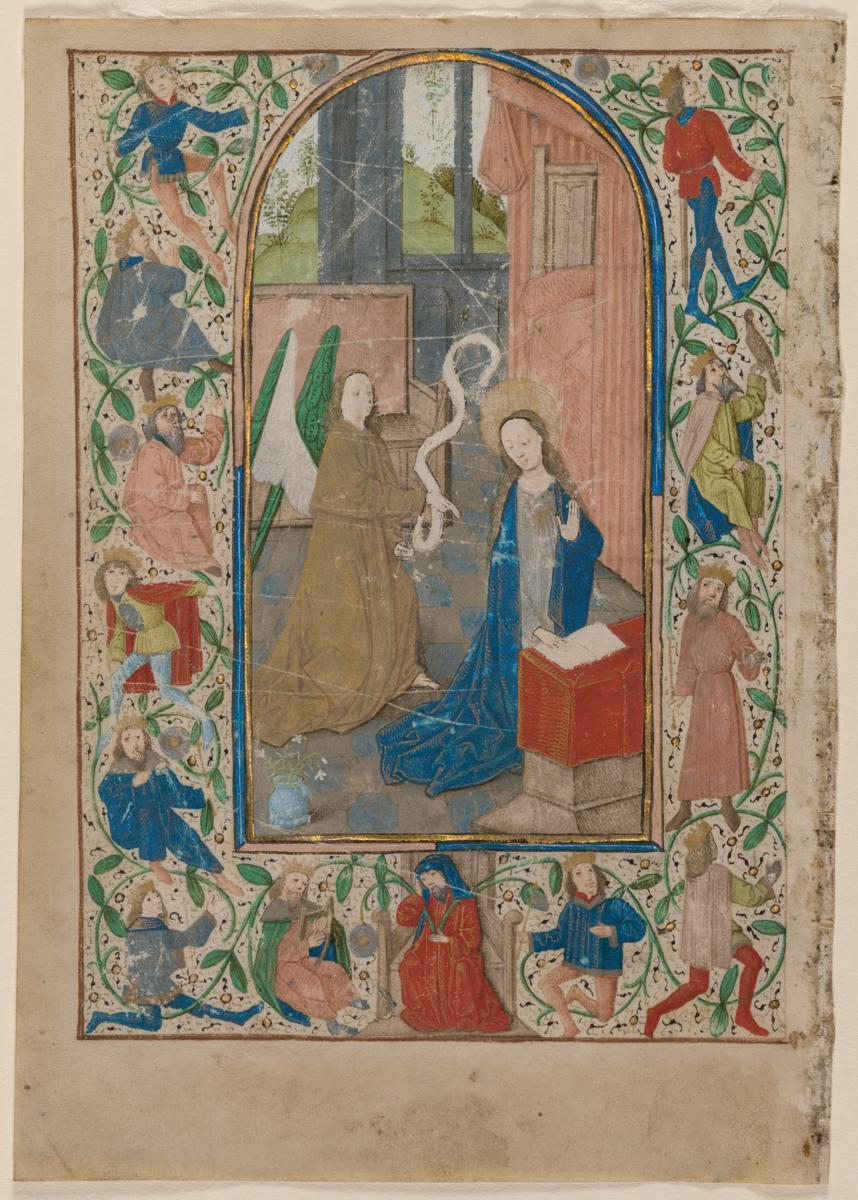
A family tree: Leaf from a Book of Hours: The Annunciation (recto) (1470s)
The Flemish manuscript leaf featured on this page places an Annunciation scene inside a decorated border. Its maker is not named in the museum record. The Cleveland Museum of Art explains the marginal Tree of Jesse as a representation of Jesus's human descent through the royal house of Judah.
The tree turns a relationship across generations into a visible branching form. Identifying it requires more than noticing that a plant appears: the figures, subject, and established Christian imagery explain what this particular tree represents.
A useful caution: William Carlos Williams, “The Red Wheelbarrow” (1923)
Not every memorable object needs a one-word symbolic translation. Williams's short poem, first published as “XXII” in Spring and All, concentrates attention on a wheelbarrow, rainwater, and chickens. A reader might explore dependence or ordinary labor, but should not claim that the wheelbarrow has a universally agreed hidden meaning.
The University of Virginia's edition provides the text and publication context. Start with the poem's actual arrangement of words and objects before assigning an abstract meaning. Sometimes the strongest observation concerns attention, imagery, or form rather than symbolism.
For additional worked readings, see examples of symbolism, symbolism in literature, and symbolism in art.
Symbolism versus metaphor, motif, theme, and allegory
These terms overlap, but they ask different questions. The following examples are invented teaching examples, not quotations from published works.
| Term | Main question | Example |
|---|---|---|
| Symbolism | What meaning does this element carry beyond itself? | A locked gate comes to represent a family's exclusion of an outsider. |
| Metaphor | What is described as something else? | Calling a hostile household a fortress compares it to a defensive building. |
| Motif | What image, idea, or feature recurs? | Gates, fences, and closed doors appear throughout a story. |
| Theme | What larger idea does the work explore? | A story explores how fear of outsiders damages a community. |
| Allegory | How does a narrative sustain a further level of meaning? | A journey through towns named Suspicion and Welcome dramatizes competing moral attitudes. |
A metaphor makes or implies a comparison. A symbol can develop meaning without anyone stating a comparison: the gate may simply appear at significant moments. The same passage can use both devices, so these are helpful distinctions rather than sealed categories.
A motif is defined by recurrence, not necessarily by symbolic meaning. Repeated meals might organize a narrative without each meal standing for one abstract idea. A symbol can appear only once if the work gives it enough significance.
A theme is an idea explored by the whole work; a symbol is one means of exploring it. “Isolation” names a possible theme. “The locked gate makes the family's isolation visible” connects a concrete symbol to that theme.
An allegory develops a further level of meaning across a narrative, often involving characters, settings, and events together. The Poetry Foundation's allegory entry describes this sustained figurative structure. One symbolic object does not automatically make an entire novel an allegory.
Conventional symbols and symbols created by a work
A conventional symbol draws on associations shared within a particular community, period, or practice. The lilies in the Annunciation painting are an example. Their use depends on a Christian visual tradition, not on a natural law about white flowers.
A work-specific symbol gains much of its significance from its immediate setting. The repaired chair in the invented example would depend on that character's memories. A reader does not need a universal dictionary of chair meanings to understand it.
Many symbols combine the two. A writer can begin with a familiar association and then complicate it. A wedding ring, for instance, might initially suggest commitment within a story but later become associated with obligation or a relationship's loss. That possibility is a reading strategy, not a claim that rings always have those meanings.
Be cautious with lists that assign one meaning to every animal, color, or number. Ask whose usage is being described, when it occurred, and what evidence establishes the connection. A dictionary can suggest questions; it cannot replace the particular work.
How to identify symbolism without overreading
- Describe the literal element. Name the object, action, sound, or image before explaining it.
- Locate its significant appearances. Note repetition, placement at a turning point, unusual emphasis, or changes over time.
- Trace its connections. Which characters, emotions, conflicts, or ideas appear alongside it?
- Check relevant context. Consult a museum, scholarly edition, or reliable account of the tradition when the meaning depends on historical knowledge.
- Test your interpretation against the whole work. Look for details that complicate it, not just details that agree.
- State the claim at the right strength. Use “suggests” or “can be read as” for an inference, and identify direct documentary support when it exists.
Repetition alone is not proof: a bus may recur because a character takes it to work. Conversely, a single action can become symbolic if its placement and consequences give it unusual weight. Ask what the interpretation helps explain that a literal summary leaves unresolved.
How to write a symbolism explanation
A practical sentence pattern is: In [work], [specific element] suggests [meaning], because [observable evidence]. This matters because [connection to the work's larger concern].
For Hawthorne, that might become: “In The Scarlet Letter, the changing interpretation of the embroidered A suggests that public judgments are unstable. The community later associates it with Hester's ability, complicating the shame it originally imposed.”
This is stronger than “A symbolizes sin” because it identifies a change and explains why it matters. Add chapter or page references according to the edition you are using. For an artwork, name visible details and cite the museum's interpretation where appropriate.
Does symbolism also name an art movement?
Yes. Capitalized Symbolism can refer to a late nineteenth-century literary and artistic movement. The Metropolitan Museum of Art's history of Symbolism describes its literary beginnings and the importance of Jean Moréas's 1886 manifesto.
This historical label is narrower than the general device. A Renaissance Annunciation can contain symbolism without belonging to the Symbolist movement. Check whether a source is defining a method of representation or discussing a particular historical movement.
The most useful definition remains a starting point, not a decoding key: symbolism connects something concrete with further meaning. A good explanation names the connection, shows the evidence, and allows the work to be more complicated than a one-word answer.
Frequently asked questions
What is a short definition of symbolism?
Symbolism is using something concrete, such as an object, image, or action, to represent meaning beyond itself. The surrounding work or a particular cultural tradition establishes the connection.
What is the difference between a symbol and symbolism?
A symbol is the particular element carrying an additional meaning. Symbolism is the use of that element or a larger pattern of symbols within a work.
Is symbolism the same as metaphor?
No. Metaphor makes or implies a comparison; symbolism lets an element carry additional meaning. A passage can use both, but a symbolic object does not require an explicit comparison.
Can a symbol have more than one meaning?
Yes. A symbol's associations can change across a work or differ among its characters. In The Scarlet Letter, the community's changing understanding of Hester's A is part of its significance.
Does every detail in a story symbolize something?
No. Details can establish setting, develop character, create sensory imagery, or advance the plot without representing an abstract idea. A symbolic reading needs support from the work or relevant historical context.
Sources & further reading
- Poetry Foundation: Symbol
- Poetry Foundation: Allegory
- Shakespeare's Globe: Teacher Glossary, including metaphor, motif, and theme
- University of Virginia, Literature in Context: Edgar Allan Poe, The Philosophy of Composition (1846)
- Library of Congress: Edgar Allan Poe and The Raven
- The Scarlet Letter (1850), digitized second-edition page recording the reading Able
- Cleveland Museum of Art: Paolo Veronese and Workshop, The Annunciation, c. 1580
- Cleveland Museum of Art: Leaf from a Book of Hours: The Annunciation (recto), 1470s
- University of Virginia, Literature in Context: William Carlos Williams, XXII [The Red Wheelbarrow] (1923)
- Metropolitan Museum of Art: Symbolism, Heilbrunn Timeline of Art History