Learn
Symbolism in Literature and How to Read It
Symbols turn concrete details into carriers of larger ideas. Explore six examples in fiction, drama, and poetry, and learn to support your own interpretations.
Symbolism in literature is the use of a concrete detail, such as an object, animal, place, or action, to suggest meanings beyond its literal role. Gatsby’s green light is a light on a dock, but it also gives visible form to a longing he cannot satisfy. A strong interpretation explains both levels and shows how the text connects them.
Symbols are not secret codes with one correct translation. Their meanings develop through description, repetition, contrast, and characters’ responses. The examples below show how to read those clues in fiction, drama, and poetry without turning every incidental detail into a hidden message. For the wider concept, start with what symbolism is or our concise symbolism definition.
What makes something a literary symbol?
A symbol remains part of a work’s literal world while gathering additional significance. A locked door can block someone’s entrance and suggest exclusion. To argue that it does both, a reader needs evidence: perhaps the door appears at decisive moments, separates social groups, or receives unusually charged description.
The Poetry Foundation’s definition of a symbol emphasizes something perceptible that points beyond itself, often toward an abstraction. That relationship is more useful than a memorized dictionary of meanings. Ask what a detail does here, in this particular work.
Repetition helps, but it is not compulsory. A single, carefully placed object can carry symbolic weight. Equally, something may recur simply because the setting requires it. A sailor’s rope is not automatically fate; the language and structure must give you a reason to make that connection.
Types of symbols in literature
These are useful overlapping categories, not a fixed classification that every writer follows.
- Conventional symbols draw on associations an audience may already recognize, such as a crown suggesting monarchy. Those associations depend on culture and historical context.
- Contextual symbols acquire their force within one work. Gatsby’s particular dock light matters because of its location, its owner, and the attention he gives it.
- Objects and visible marks make abstract pressures tangible: a letter worn on clothing can turn public judgment into something a character must physically carry.
- Places and journeys can organize a story’s ideas about belonging, freedom, separation, or choice. Their geography still matters literally.
- Actions and natural images can also become symbolic. Washing may suggest an attempt at moral cleansing; a damaged flower may suggest injured love.
A conventional association is a starting question, not a verdict. A writer can adopt it, complicate it, or reverse it.
Examples of symbolism in novels and drama
The green light in F. Scott Fitzgerald’s The Great Gatsby (1925)
The light stands at the end of Daisy Buchanan’s dock, across the water from Gatsby’s home. Gatsby’s reaching toward it makes distance emotionally meaningful: the person and life he wants are visible, yet beyond his grasp. The National Endowment for the Arts reader’s guide identifies the light with an unreachable treasure and the receding future.
“The light means hope” is a defensible beginning, but an incomplete analysis. Whose hope? Gatsby invests Daisy with a future built from his idealized past. The light connects romantic desire to his larger belief that enough determination and wealth can overcome time and social distance.
Notice how this interpretation depends on narrative details, not just the color green. A green lampshade in another novel would not inherit Gatsby’s meaning.
The embroidered A in Nathaniel Hawthorne’s The Scarlet Letter (1850)
Hester Prynne must wear a scarlet letter as a public punishment for adultery. The mark makes the community’s judgment visible, but Hawthorne does not let that judgment control its meaning forever. In chapter 13, some townspeople interpret the A as “Able” because of Hester’s strength and service.
The change is explicit in the digitized 1850 edition. It makes the letter an especially clear example of a developing symbol: the same physical mark can carry shame, imposed identity, and recognition of ability at different points.
A useful essay would track those changes rather than write a list of words beginning with A. Who interprets the letter, and what gives that person authority? Symbolism here is also a struggle over who gets to define another human being.
Blood and washing in William Shakespeare’s Macbeth (c. 1606–1607)
Blood in Macbeth has immediate physical consequences: people are wounded and murdered. It also becomes a way of thinking about guilt that cannot simply be rinsed away. After Duncan’s murder in Act 2, scene 2, Macbeth imagines his bloody hands staining an entire sea.
Later, Lady Macbeth tries to wash away blood that is no longer visibly present. The contrast between bodily washing and persistent guilt gives the action its symbolic force. It is not merely that red equals violence; the play makes a material stain stand for the consequences of a deed.
The Folger Shakespeare Library’s discussion of blood as a stage property is a useful reminder that this symbol is theatrical as well as verbal. An audience sees bodies, hands, costumes, and gestures, not just words on a page.
Poetry with symbolism: three close-reading examples
The raven in Edgar Allan Poe’s “The Raven” (1845)
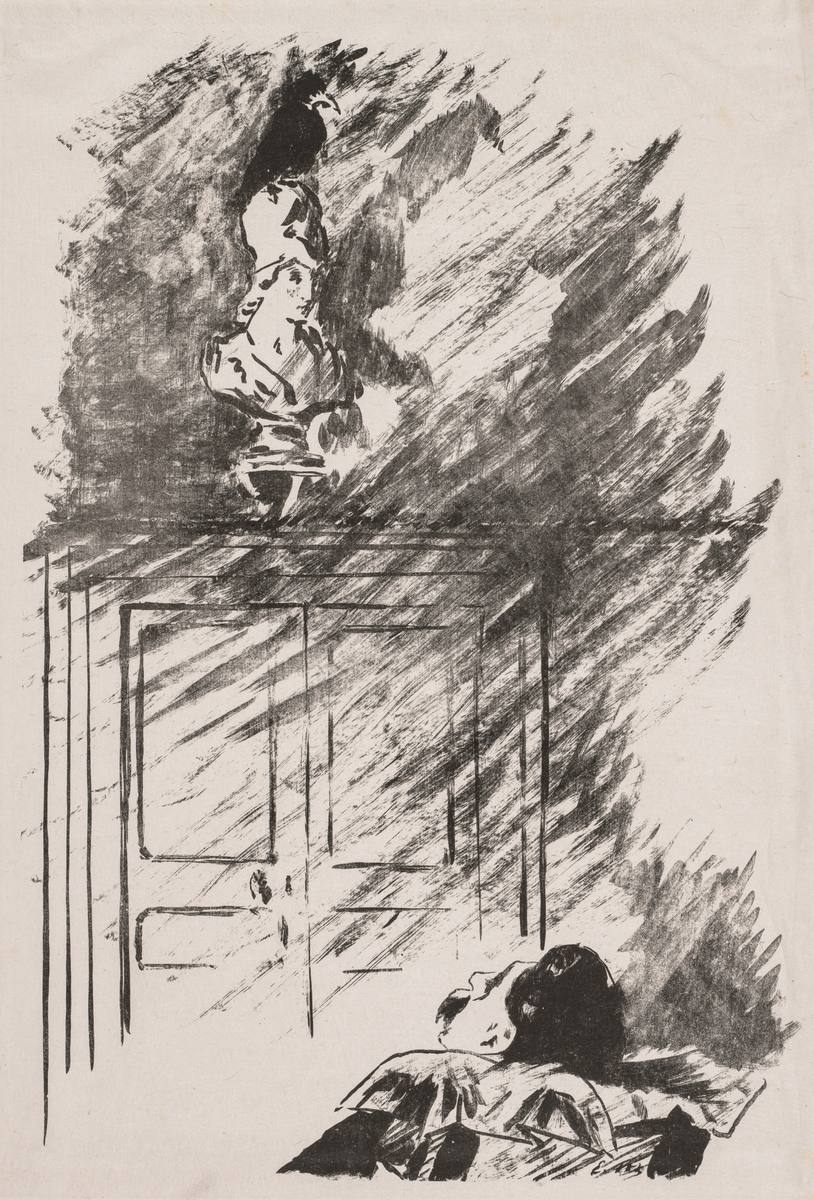
Poe’s speaker, mourning Lenore, receives a visit from a talking bird. The raven repeats “Nevermore,” and the speaker increasingly hears that answer as a judgment on his hopes for relief and reunion. The bird can be read as an embodiment of grief that will not leave, while the speaker’s questions help give its repetition that force.
This distinction matters: the poem does not require us to believe that a supernatural messenger has delivered objective truth. We can instead study how a grieving mind turns a repeated sound into an apparently final answer. The University of Toronto’s text lets readers follow that escalation stanza by stanza.
The featured image is Édouard Manet’s Perched upon a Bust of Pallas (1875), made for Stéphane Mallarmé’s French translation of Poe. The Cleveland Museum of Art’s object record identifies the scene. Its high bird and upturned human face offer a visual counterpart to the poem’s unequal encounter, not proof of a single authorized interpretation.
The flower and worm in William Blake’s “The Sick Rose” (1794)
Blake addresses an ailing rose invaded by an invisible worm. The poem brings together a flower, darkness, secrecy, joy, and destructive love. Those connections make it reasonable to read the rose as more than a botanical specimen: it may suggest beauty or love exposed to a concealed destructive force.
The eight-line poem leaves that force unnamed. Sexual harm, secrecy, and corrupted love are interpretive possibilities, not interchangeable facts that Blake labels for us. A careful reading states which possibility it is arguing and explains the supporting language.
The date also deserves care: the poem belongs to Songs of Experience (1794), though individual surviving impressions can be later. The Met’s copy, for example, is dated “[1794] printed ca. 1825.” A poem’s publication date and the date of a museum object illustrating it need not match.
The paths in Robert Frost’s “The Road Not Taken” (1915)
Two diverging paths readily suggest choices in a life. But Frost complicates the familiar claim that the speaker boldly chooses a clearly unpopular route. In the poem’s account of the actual walk, the paths have been worn about equally; the decisive difference appears in the story the speaker imagines telling later.
The Academy of American Poets’ discussion explores that tension. The roads can suggest not just choice but the human habit of creating a meaningful life story from decisions whose alternatives we cannot fully know.
This is a practical warning against relying on a famous final line alone. An interpretation of a symbol must survive the rest of the poem, including details that make the preferred explanation less comfortable.
Symbolism vs. metaphor, motif, imagery, theme, and allegory
These terms describe different aspects of writing, so one passage can involve several at once.
- Metaphor presents one thing in terms of another. Symbolism lets a particular detail carry additional significance across a passage or work. A metaphor can help establish a symbol.
- Imagery appeals to the senses. A described stain is visual imagery; it becomes symbolic when the writing connects it to something such as guilt.
- Motif is a recurring detail or pattern. Repeated washing is a motif in Macbeth; the act’s relationship to guilt gives that pattern symbolic meaning.
- Theme is an idea the work explores. The green light is a concrete symbol, while the difficulty of recovering the past is a thematic concern.
- Allegory develops figurative meaning through a more sustained narrative arrangement of characters, places, and events. Symbolism does not require that everything fit such a scheme.
The Poetry Foundation’s entries on motif and allegory help clarify the distinction. Do not label a whole novel an allegory simply because one object has symbolic significance.
How to identify and analyze a symbol
- Start literally. Identify what the detail is, where it appears, and what happens around it. Do not skip its ordinary function.
- Look for emphasis. Note repetition, striking description, placement at a turning point, or a character’s unusually intense response.
- Gather a pattern. Compare appearances. Does the meaning change? Do different people understand the object differently?
- Propose a specific connection. Replace “the light symbolizes dreams” with a claim about Gatsby’s longing for a future organized around Daisy.
- Test competing explanations. Find details that resist your claim. Revise the interpretation rather than ignoring them.
- Explain the effect. Show what readers understand differently because the idea has been embodied in this object, scene, or action.
A useful paragraph structure is claim → evidence → explanation → significance. Name the symbol and your interpretation, cite a short passage with the appropriate page or line reference, explain the wording, and connect it to the work’s larger concern.
For example: Hawthorne makes the scarlet letter a contested public sign rather than a permanent definition of Hester. In chapter 13, the community’s “Able” reading grows from her actions. The changing interpretation shows that the imposed mark cannot fully contain her identity. This is analysis because it explains a relationship, not merely a label.
Common symbols are possibilities, not an answer key
Water may suggest cleansing, danger, separation, or a route to freedom. A bird may suggest confinement as readily as flight. Darkness may conceal something, protect someone, or simply mark the time of day. Before assigning a familiar meaning, ask who experiences the image and what the surrounding language actually does.
Nor does a plausible interpretation establish an author’s private intention. “The scene supports a reading of guilt” is a textual argument; “the author secretly meant guilt” is a biographical claim that needs different evidence. Several interpretations can be persuasive, but they are not all equally well supported.
Continue with symbolism examples across everyday life and culture or compare how visible objects work in symbolism in art. The Learn hub brings the definitions and subject guides together. Across media, the best habit is the same: describe precisely before interpreting.
Frequently asked questions
What is symbolism in literature in simple terms?
Symbolism happens when a concrete detail in a literary work suggests something beyond itself. Gatsby’s green dock light is a physical light and a focus for his longing. The connection needs evidence from the work, not just a dictionary of familiar meanings.
What are examples of poems with symbolism?
Edgar Allan Poe’s “The Raven” (1845), William Blake’s “The Sick Rose” (1794), and Robert Frost’s “The Road Not Taken” (1915) offer useful examples. Their bird, flower, and paths gain meaning through the particular language and situations of each poem.
What is the difference between a symbol and a motif?
A motif is a recurring detail or pattern. A symbol carries significance beyond its literal role. The same detail can be both: repeated washing in Macbeth forms a motif and can symbolize an attempt to remove guilt.
Can a symbol have more than one meaning?
Yes. A symbol can change over a work or mean different things to different characters. Hester’s scarlet letter, for instance, receives a new interpretation as “Able.” Multiple readings are possible, but each must account for the text’s details.
How do I avoid overanalyzing a symbol?
Begin with the literal situation, then look for emphasis, repetition, contrast, or a character’s response. Test your explanation against the whole passage or work. If the interpretation rests only on a general association such as red equals anger, it needs stronger evidence.
Sources & further reading
- Poetry Foundation: Symbol
- National Endowment for the Arts: The Great Gatsby reader's guide
- Nathaniel Hawthorne: The Scarlet Letter, digitized 1850 second edition, page 179 (scan page 199)
- Folger Shakespeare Library: Macbeth, Act 2, scene 2
- Folger Shakespeare Library: Not for the faint of heart
- Folgerpedia: Macbeth, date of composition
- University of Toronto, Representative Poetry Online: The Raven
- Cleveland Museum of Art: Perched upon a Bust of Pallas
- Poetry Foundation: William Blake, The Sick Rose
- The Metropolitan Museum of Art: Songs of Experience, The Sick Rose
- Academy of American Poets: The Road Not Taken, The Poem Everyone Loves and Everyone Gets Wrong
- Poetry Foundation: Motif
- Poetry Foundation: Allegory