Learn
What Is Symbolism? Meaning, Examples, and How to Read It
Symbolism gives concrete details meaning beyond their literal identity. Learn how it works through five specific works and an evidence-based reading method.
Symbolism is the use of an object, image, action, character, or other concrete detail to suggest meaning beyond its literal identity. A light can be a light and also represent hope. A bird can belong to a story's physical world while making grief, freedom, or confinement easier to imagine. The particular meaning comes from context, not from a universal code.
That distinction makes symbolism useful in literature, art, religion, and ordinary communication. It lets something visible carry an idea that is difficult to state directly. This guide explains how to recognize that extra meaning, test an interpretation, and write about it with evidence. For a shorter reference, see our definition of symbolism.
What does symbolism mean in practice?
A symbol is the particular thing doing the representing. Symbolism is the use of that relationship within a work or practice. A painted skull is a symbol; arranging it beside an extinguished lamp to encourage reflection on mortality is symbolism.
The literal level does not disappear. If a character receives a key, it may actually unlock a door. Depending on the surrounding story, it might also suggest trust, permission, ownership, or exclusion. Its symbolic force depends on who gives it, who can use it, and what happens when access changes.
Symbols need not have one neat equivalent. Saying that a key “means freedom” can be a useful first observation, but it may miss a story in which freedom for one person depends on another person's imprisonment. A strong interpretation explains the relationship rather than substituting one word for another.
The Oregon State Guide to Literary Terms emphasizes that symbols point beyond themselves and that the same detail can support different associations. Start with the work in front of you before reaching for a list of standard meanings.
Five examples of symbolism, with works and dates
1. The green light in F. Scott Fitzgerald's The Great Gatsby (1925)
The green light at the end of Daisy Buchanan's dock is a real feature of the setting. Gatsby can see it across the water. Its placement makes physical distance visible, while his attention to it connects that distance to his desire for Daisy and the future he imagines with her.
The National Endowment for the Arts reader's guide identifies the light with an unreachable goal. It is more precise to connect the light to Gatsby's particular longing than to claim that green always means hope. The light matters because of its location, Gatsby's behavior, and the novel's treatment of desire.
2. The bird in Edgar Allan Poe's “The Raven” (1845)
A raven visits a grieving speaker and repeats a single answer. As the speaker asks increasingly painful questions about his lost Lenore, the bird becomes inseparable from his inability to escape remembrance. The symbol develops through the encounter, not simply through the bird's dark feathers.
In his essay “The Philosophy of Composition”, Poe describes the raven's eventual emblematic role in relation to unending, mournful remembrance. This is unusually helpful authorial evidence. It does not mean that every raven in every poem has the same function. Our guide to bird symbolism explores why species and setting matter.
3. The embroidered A in Nathaniel Hawthorne's The Scarlet Letter (1850)
Hester Prynne is forced to wear a scarlet A as punishment for adultery. At first the community imposes a public meaning on her clothing. Yet the richly embroidered letter is also something Hester has made, and its significance becomes more complicated as readers encounter her conduct and other people's judgments.
Britannica's account of the novel draws attention to the tension between a badge of shame and a beautifully worked object. That tension is important: symbolism can expose disagreement about meaning. Hester, her neighbors, and the reader do not have to understand the same mark in the same way.
4. The skull in Pieter Claesz's Still Life with a Skull and a Writing Quill (1628)
Claesz places a human skull among ordinary objects, including writing materials, an overturned glass, and a lamp with a dying wick. The objects are carefully observed, but their arrangement does more than record a tabletop. It invites viewers to consider life's brevity and the limits of worldly achievement.
The Metropolitan Museum of Art's object record explicitly identifies the skull, glass, and wick as signs of transience. This is a historically grounded interpretation of a particular painting, not a claim that all still lifes are coded warnings about death.
5. The flowers in Odilon Redon's Violette Heymann (1910)
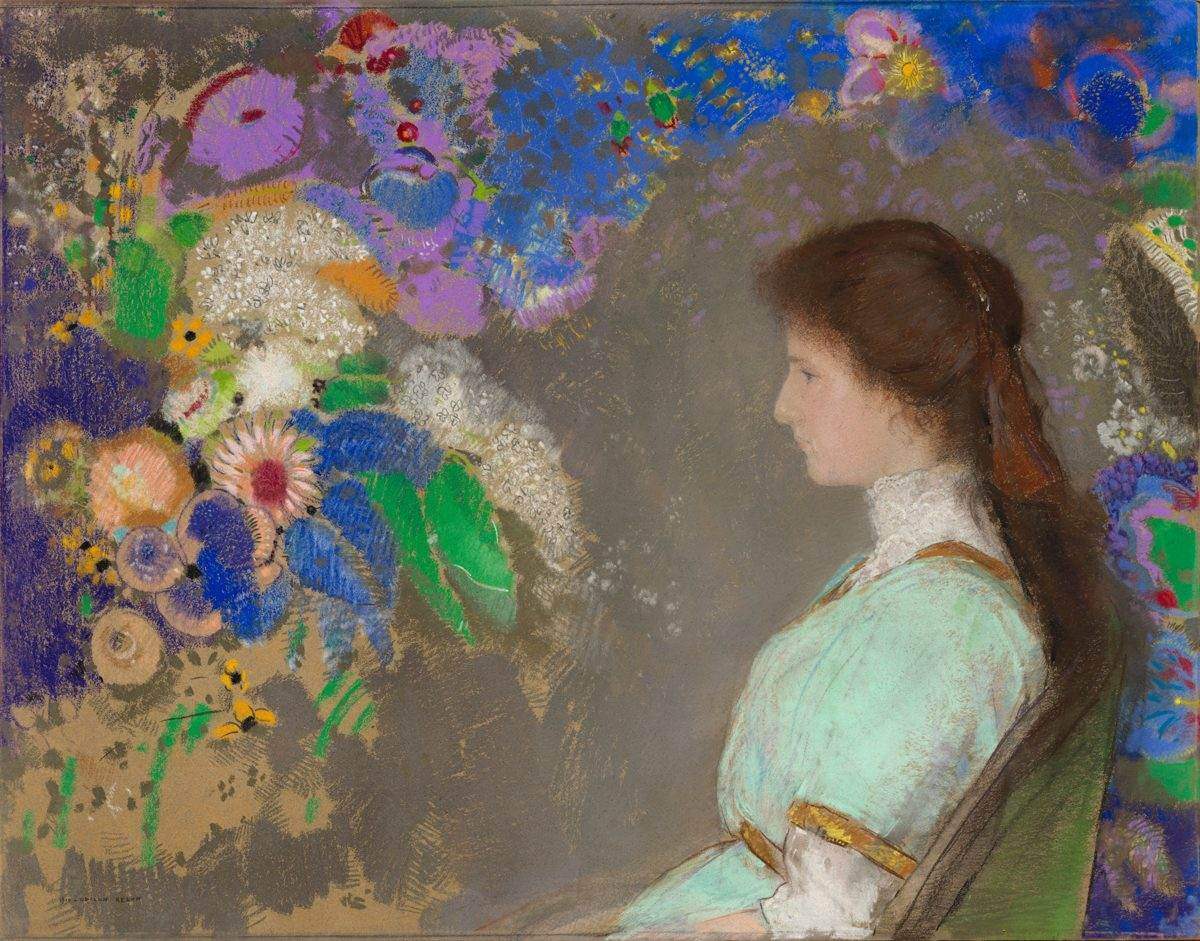
In the featured image, Redon places a young woman's profile beside a profusion of colorful blossoms. The Cleveland Museum of Art describes the portrait's dreamlike quality and its subject's absorbed appearance. The flowers help create an imaginative atmosphere rather than merely identifying a room or garden.
This example also teaches restraint. The museum's interpretation supports discussing reverie and an inward-looking mood. It does not justify assigning a secret, exact message to every flower. Sometimes symbolic suggestion is intentionally less definite than an emblem with a fixed label.
Symbolism, metaphor, motif, and allegory: what is the difference?
These terms overlap, but they describe different features of a work. Keeping them separate helps explain how an effect is made.
| Term | Main question | Useful distinction |
|---|---|---|
| Symbol | What concrete detail suggests something beyond itself? | The thing remains part of the literal scene. |
| Metaphor | What is being understood through a comparison? | One thing is described in terms of another. |
| Motif | What meaningful element recurs? | Repetition is central; the element may or may not be symbolic. |
| Allegory | How does a narrative sustain another level of meaning? | Characters, places, and events participate in an extended figurative structure. |
Consider an invented example. “Her promise was a bridge” is a metaphor. An actual bridge that two estranged sisters repeatedly refuse to cross could become a symbol of their separation. Bridges appearing throughout the story form a motif. A narrative in which travelers named Mercy and Pride cross a landscape of moral trials would have an allegorical structure.
A single work can use all four techniques. The Poetry Foundation's definition of allegory stresses extended figurative meaning across a narrative. A symbol, by contrast, does not require a whole plot to correspond to another story or argument.
How to recognize symbolism: a five-step method
1. Describe what is literally present
Record the object, action, material, color, and location before interpreting them. “A locked gate separates the house from the road” is an observation. “The gate represents fear” is a claim that still needs support. Separating those stages prevents a conclusion from disguising itself as evidence.
2. Notice emphasis, repetition, and change
Does the writer return to the detail at important moments? Does the artist place it centrally or contrast it with surrounding objects? Does it break, disappear, change owners, or become newly visible? Repetition is useful evidence, but a single prominently placed object can also matter.
3. Connect the detail to a larger concern
Ask what conflict, emotion, or question the detail helps express. In Gatsby's case, the light connects a visible distance with an imagined future. A convincing interpretation links the physical detail to the work's concerns instead of attaching an abstract noun without explanation.
4. Check historical and cultural context
Look for museum records, scholarly commentary, or sources from the relevant tradition. A religious attribute may have a documented meaning that a modern viewer would not recognize. Equally, a familiar modern association may not apply to an earlier object. Our learning guides separate general reading methods from histories of specific symbols.
5. Test a competing explanation
Could the object simply serve the plot? Does another interpretation explain more details? Look for evidence that challenges your first answer. You do not need to eliminate every alternative, but you should be able to explain why your reading fits better than an unsupported guess.
What does this symbolize? Why context comes first
When someone asks “What does this symbolize?”, the most useful next question is “Where does it appear?” A picture of a rose on a greeting card and a fading rose in a memorial painting may invite different readings. The species alone cannot settle the question.
Useful context includes the maker, date, location, intended audience, accompanying words, and neighboring images. In literature, identify who notices the object and whether that person's account is trustworthy. In art, distinguish the object's original setting from the museum gallery where it is now displayed.
Symbols can be conventional, specific to a particular work, or both. An audience may recognize an existing association, while the artist complicates it. Avoid statements such as “white always means purity” or “water always means rebirth.” Our guide to color symbolism treats color meanings as contextual associations rather than universal facts.
Interpretation also has limits. Not every curtain, cloud, or cup carries a special message. A detail becomes a stronger candidate when its treatment helps explain something important about the work. Unusual emphasis, repeated contrasts, documented conventions, and changes in use are better evidence than a dictionary match.
Is symbolism the same as the Symbolist movement?
No. Lowercase symbolism names a broad representational practice. Capitalized Symbolism can name a historical literary and artistic movement associated with suggestion, subjectivity, dream, and imaginative experience.
The Met's history of Symbolism traces the French literary movement's emergence in the 1880s and the importance of Jean Moréas's manifesto of 1886. It also discusses artists, including Redon, whose work helped establish pictorial Symbolism.
A painting does not belong to that movement merely because it contains a symbol. Claesz's 1628 still life predates it by centuries. Conversely, a Symbolist work may communicate through an elusive atmosphere rather than a set of objects that can each be translated into a single meaning. See symbolism in art for the fuller distinction.
How to write a paragraph about symbolism
Build the paragraph around a claim, an observable detail, and an explanation of how they connect. Include the work's title and creator so your reader knows what evidence you are discussing.
For example: “In Fitzgerald's The Great Gatsby (1925), the green light makes Gatsby's desired future appear both visible and distant. Its position across the water from his home gives his longing a physical shape. The light therefore suggests more than Daisy's location; it helps reveal the gap between imagining a future and possessing it.”
This paragraph does not rely on a long quotation or a claim about every green object. It identifies a feature, explains its role, and limits the interpretation to the work. If your assignment requires quotations, choose a short passage and provide the edition's page number or another appropriate locator.
Avoid the empty conclusion “This makes the reader want to read on.” Explain instead what the symbol helps readers understand about power, grief, desire, identity, or another specific concern. For more models, continue with examples of symbolism and symbolism in literature.
Frequently asked questions
What is symbolism in simple words?
Symbolism is using something concrete, such as an object, image, or action, to suggest an idea beyond itself. Its meaning depends on how and where it appears.
How can I tell whether something is a symbol?
Look for emphasis, repetition, change, and connections to the work's larger concerns. Check relevant cultural context and explain the evidence rather than relying on a fixed list of meanings.
Does a symbol have to appear more than once?
No. Repetition can strengthen a symbolic reading, but a single detail can carry meaning through its placement, contrast, dramatic importance, or documented cultural associations.
Is there only one correct meaning for a symbol?
Not always. Several interpretations may be defensible, but they need evidence. A reading that explains the work's details is stronger than one based only on a personal association.
Can an ordinary object be both literal and symbolic?
Yes. Gatsby's green light is a light on Daisy's dock and also a focus for his longing. The symbolic meaning works through the object's literal place in the story.
Sources & further reading
- Oregon State University: What Is Symbolism?
- Poetry Foundation: Symbol
- Harvard: Guide to Poetic Terms
- National Endowment for the Arts: The Great Gatsby Reader Resources
- National Endowment for the Arts: The Great Gatsby
- Edgar Allan Poe: The Raven
- Edgar Allan Poe: The Philosophy of Composition
- Johns Hopkins University Libraries: The Raven
- Britannica: The Scarlet Letter
- Britannica Students: The Scarlet Letter
- The Metropolitan Museum of Art: Pieter Claesz, Still Life with a Skull and a Writing Quill, 1628
- Cleveland Museum of Art: Odilon Redon, Violette Heymann, 1910
- Poetry Foundation: Allegory
- The Metropolitan Museum of Art: Symbolism