Learn
Infinity Symbol Meaning, History, and Uses
The infinity symbol ∞ represents something without a finite bound. Its mathematical history is documented in John Wallis’s seventeenth-century work; personal meanings are later uses.
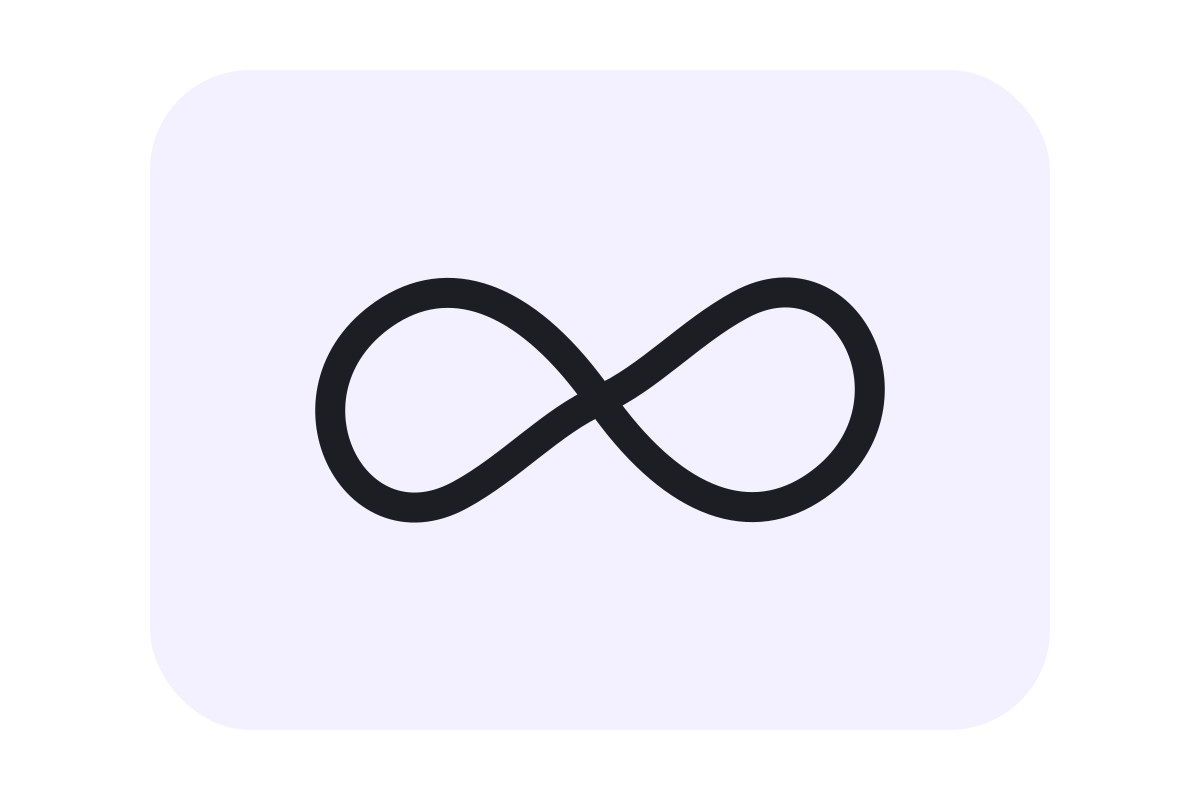
The infinity symbol ∞ is the sideways, figure-eight-shaped sign used for infinity: something without a finite bound. Infinity symbol meaning depends on the setting. In mathematics it has technical uses; on jewelry or in graphic design it commonly suggests an enduring bond or something imagined as endless.
The sign is not an ancient universal emblem with one fixed spiritual explanation. Its documented mathematical story is associated with John Wallis in 1655. Distinguishing that history from later symbolic uses helps explain why the same small loop can belong on a calculus page and on a keepsake.
What does ∞ mean in mathematics?
Infinity is not simply a very large ordinary number. There is no largest counting number that finally turns into infinity: another one can always be added. The sign often marks the absence of a finite bound, although its precise role depends on the mathematical system and expression.
For example, an interval extending toward positive infinity does not include a final enormous endpoint. A limit written with infinity can describe growth without bound. In other settings mathematicians discuss infinite sets and compare their sizes, but a single ∞ character does not by itself explain those distinctions.
This is why arithmetic with the sign needs care. Ordinary rules for finite numbers cannot simply be transferred to every expression involving infinity. “Infinity minus infinity” is not automatically zero. The surrounding definition or limiting process matters more than the attractive simplicity of the glyph.
For everyday reading, start with a modest translation: “unbounded in the direction or sense specified here.” That is more useful than treating the mark as a mysterious number. A textbook's definitions remain the authority for its technical notation.
Who introduced the infinity symbol?
The English mathematician John Wallis used the sign in De sectionibus conicis, published in 1655. The Edward Worth Library's account of his work identifies this publication as the place where he first gave the symbol its mathematical meaning. Oxford's historical account of Wallis also identifies the infinity sign among the notational innovations associated with him.
These are claims about mathematical notation, not a claim that nobody had ever drawn two joined loops. Similar-looking decorative marks can arise independently. To establish a symbol's history, an identifiable dated use and its intended meaning are stronger evidence than a matching shape.
Wallis's work belonged to seventeenth-century debates about curves, areas, and methods involving infinitesimal quantities. The notation survived far beyond that immediate setting. Modern readers can recognize his sign without accepting every feature of the mathematical reasoning of his period.
Why is infinity drawn as a sideways eight?
The visual description is clear; the reason for Wallis's choice is less secure. Several origin stories circulate, including connections with older numeral forms or other looped signs. They should not be presented as his own explanation unless supported by a source showing that he gave it.
A common mistake is to turn the shape into an explanation of infinity itself: a line returns to where it began, so it can be followed repeatedly. That is a helpful metaphor for endless continuation, not a proof of what Wallis intended. A closed circle can offer the same metaphor, while the mathematical concept has a much wider scope.
The name “lemniscate” is also associated with figure-eight-shaped curves. It is useful when discussing geometry, but not every printed infinity glyph is a carefully plotted instance of one particular equation. Typography and mathematical curve classification are related subjects, not identical ones.
Infinity symbol meaning in love and jewelry
Outside mathematics, an unending loop is an intuitive image for a relationship intended to last. Infinity designs may therefore express lasting affection, friendship, commitment, or remembrance. Initials, names, hearts, or a date can make that intended dedication more specific.
These are contemporary personal meanings, not a single mandatory code. A necklace does not establish whether someone means romantic love, family connection, or continuity through change. When interpreting a gift, the giver's explanation and the inscription are better evidence than a generalized symbolism list.
Compare the infinity sign with the Claddagh, whose hands, heart, and crown belong to a distinct Irish jewelry tradition. Both can be given as tokens of affection, but shared use does not give them a shared origin. Our guide to love symbols places these choices in a broader context.
Is infinity the same as an ouroboros?
No. The ouroboros is a serpent or similar creature biting its own tail. Some later designs twist that creature into a figure-eight form, but the identifying feature is the creature and its self-enclosing bite, not just the outline.
An infinity sign has no required animal, head, scales, or narrative. A visual resemblance can encourage modern designers to combine the two. It does not prove that Wallis borrowed his notation from a serpent emblem or that every infinity pendant carries an alchemical meaning.
The same principle applies to knots and interlace. Some Celtic knot designs suggest continuity through their unbroken paths. Calling all of them infinity symbols loses the distinctions that make their individual histories interesting.
How to copy and use ∞
The character is ∞, Unicode U+221E, with the official character name INFINITY. It is a mathematical symbol rather than a rotated number eight. Copying the actual character preserves its identity in searchable text; using an image or manually rotating an 8 does not.
Its appearance varies by font: loops may be rounder or flatter, and the crossing may be tighter or more open. Those are typographic choices, not different official meanings. If the mark is missing or appears as a box, the selected font or application may lack support.
For a clear caption, choose the meaning appropriate to the object: “infinity sign in a mathematical expression” or “infinity motif used to suggest lasting connection.” Avoid assigning healing powers or a specific ancient religious origin. A precise description leaves room for personal meaning without inventing historical evidence.
Frequently asked questions
Who invented the infinity sign?
John Wallis introduced its documented mathematical use in De sectionibus conicis in 1655.
Does ∞ mean forever in a relationship?
It can express that intention in modern personal design. It has no single compulsory romantic meaning.
Is infinity a number?
It is not an ordinary finite number. Its technical meaning depends on the mathematical setting.