Cultures
Fleur de Lis Meaning, History, and Royal Symbolism
The fleur-de-lis is a stylized flower best known as an emblem of French royalty. Its later uses include religious imagery, civic identity, and French-speaking heritage.
The fleur de lis, usually written fleur-de-lis or fleur-de-lys, is a stylized flower with an upright central petal and two outward-curving side petals. Its best-known historical meaning is French royal authority. In other settings it can represent French cultural heritage, a city or institution, or Christian ideas attached to the flower’s form.
The French name means “lily flower,” but this emblem is not a botanical field drawing. It is a highly adaptable graphic device. Its meaning depends on where it appears: a medieval royal shield, an English stained-glass window, and a modern civic badge do not make exactly the same statement.
What does the fleur-de-lis symbolize?
French monarchy is the strongest historical association. A golden fleur-de-lis on a blue field became a recognizable element of the French royal arms. Repeated flowers could signal the king’s authority and connections to the crown, so the motif appeared far beyond shields, including on clothing, furnishings, coins, and architectural decoration.
Outside a specifically royal setting, the emblem can indicate an association with France or French-speaking heritage. That later meaning is visible in North America. It does not mean that everyone using the device supports monarchy; symbols can remain recognizable after the political systems that established them have changed.
In heraldry, a fleur-de-lis is a charge: a figure placed on a shield. It is not automatically a complete coat of arms. The colors, number of flowers, arrangement, and neighboring figures all matter when identifying particular arms. A single isolated outline rarely identifies a family, dynasty, or city by itself.
When did it become a French royal emblem?
The specialist heraldry resource Heraldica distinguishes secure evidence from earlier possibilities. It identifies the flower as a heraldic charge from the twelfth century and says its adoption by Philip II of France, who ruled from 1180 to 1214, is certain. Association with his father Louis VII is possible, but the evidence should not be made more definite than it is.
Earlier flowerlike forms are not necessarily examples of an already established French royal emblem. Similarity of shape alone cannot demonstrate an unbroken political tradition. This is especially important when a popular retelling carries the flower all the way back to the conversion of Clovis without separating legend from documentation.
Stories about a lily divinely given to Clovis helped connect royal power with Christianity. They are part of the symbol’s later explanatory tradition, not eyewitness records establishing its original heraldic use. A symbol can acquire a powerful origin story centuries after the events that story describes.
Why are there sometimes three fleurs-de-lis?
The French royal arms were once scattered with many golden flowers. The later version with three is commonly distinguished as “France Modern,” while the scattered design is called “France Ancient.” Britannica dates the reduction to three to Charles V in 1376 and reports its association with honoring the Trinity.
This is different from saying that every three-petaled flower originally meant the Christian Trinity. One explanation concerns a documented change in a royal shield; the other tries to establish a universal origin from the number of petals. Historical interpretation is stronger when those two claims remain separate.
For the same reason, the common association of lilies with purity does not make every fleur-de-lis an image of the Virgin Mary. A religious interpretation needs support from the artwork’s setting, inscriptions, or subject. Our guide to Christian symbols places such readings alongside more explicitly Christian emblems.
Museum objects show how the emblem traveled
The Cleveland Museum of Art’s sixteenth-century Heraldic Roundel is an English stained-glass object. Its catalog identifies the lower arms as those of England quartered with France, including fleurs-de-lis. The flowers here belong to a heraldic claim expressed through a combined shield, not to a generic decoration meaning “good luck.”
Looking at the complete roundel rather than one cropped flower changes the interpretation. The quartered arms and neighboring motifs supply the information needed to understand the device. This is a practical example of why an emblem’s companions matter as much as its outline.
Cleveland’s Child’s Throne, dated 1822, offers a later French setting. The museum explains that it was made for the young presumed successor to the throne, associated with the last direct Bourbon line. Fleurs-de-lis decorate the upholstery alongside the Gallic rooster. The flowers participate in a deliberate language of dynasty and national identity.
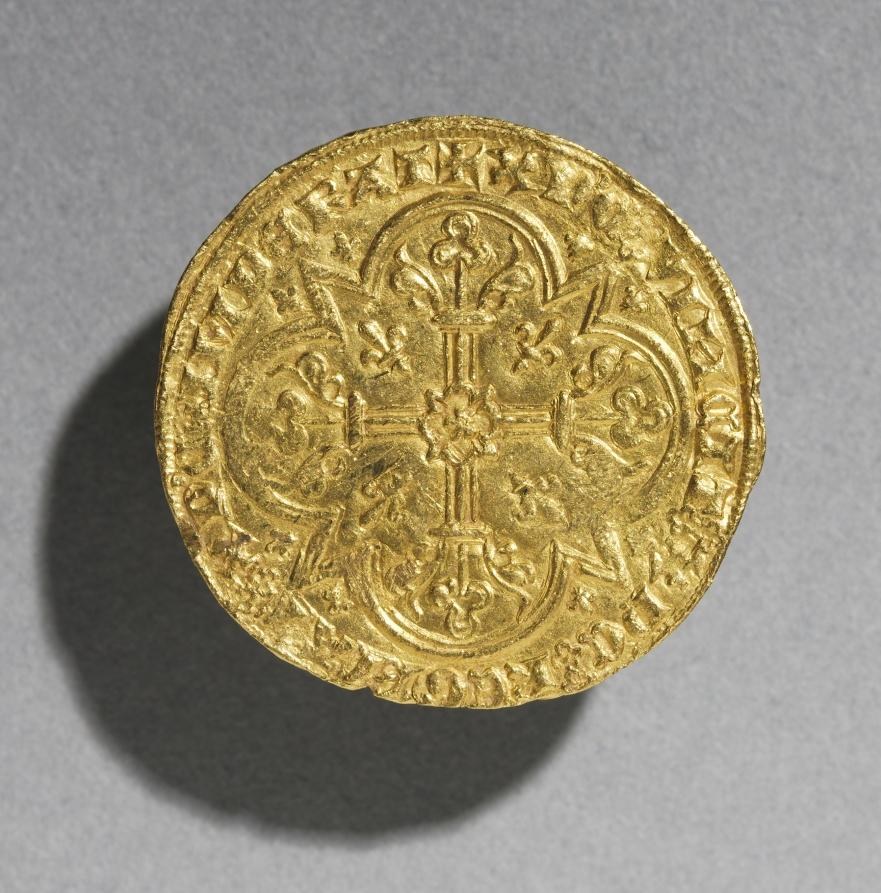
A fourteenth-century gold coin in Cleveland, the reverse of a Mouton d’Or of King Jean le Bon, also places fleurs-de-lis around a cross. The photographed face is not the one showing the lamb that gives the coin its name. This small object carries royal and Christian imagery together.
These objects are separated by centuries and by medium, yet both make the emblem’s political work visible. Neither is evidence that the shape has one timeless spiritual message. They show how a recognizable device could be adapted to different claims about rule and inheritance.
The fleur-de-lis in Québec and Louisiana
Québec’s flag uses four white fleurs-de-lis with a white cross on a blue field. The Québec government dates the official adoption of the Fleurdelisé to January 21, 1948. In this setting the flowers express a historical and cultural connection, rather than functioning as the coat of arms of a reigning French king.
Louisiana’s French colonial past also helps explain the emblem’s strong regional recognition. But a responsible account should not present colonial history as an uncomplicated heritage story. The Historic New Orleans Collection documents branding with the fleur-de-lis as a punishment under French authority. That coercive use belongs beside the emblem’s more celebratory associations.
The same outline can therefore carry pride for one viewer and painful historical associations for another. A modern civic or decorative use should be described in its specific setting, without pretending that later affectionate meanings erase earlier exercises of power.
How to read the symbol accurately
Begin by identifying what is actually shown: one flower or several, a shield or an ornament, a modern logo or a dated artifact. Then ask who commissioned it and which other symbols surround it. The distinction between an emblem and a realistic blossom also matters; our flower symbolism guide discusses flowers in broader artistic settings.
For copying the character, Unicode provides ⚜ at U+269C, named FLEUR-DE-LIS. A typed glyph is useful for a plain visual reference, but it does not reproduce the legally or historically specific design of every organization that uses the motif. As the study of symbolism in art shows, recognizable shape and precise meaning are related, not identical.
In the museum
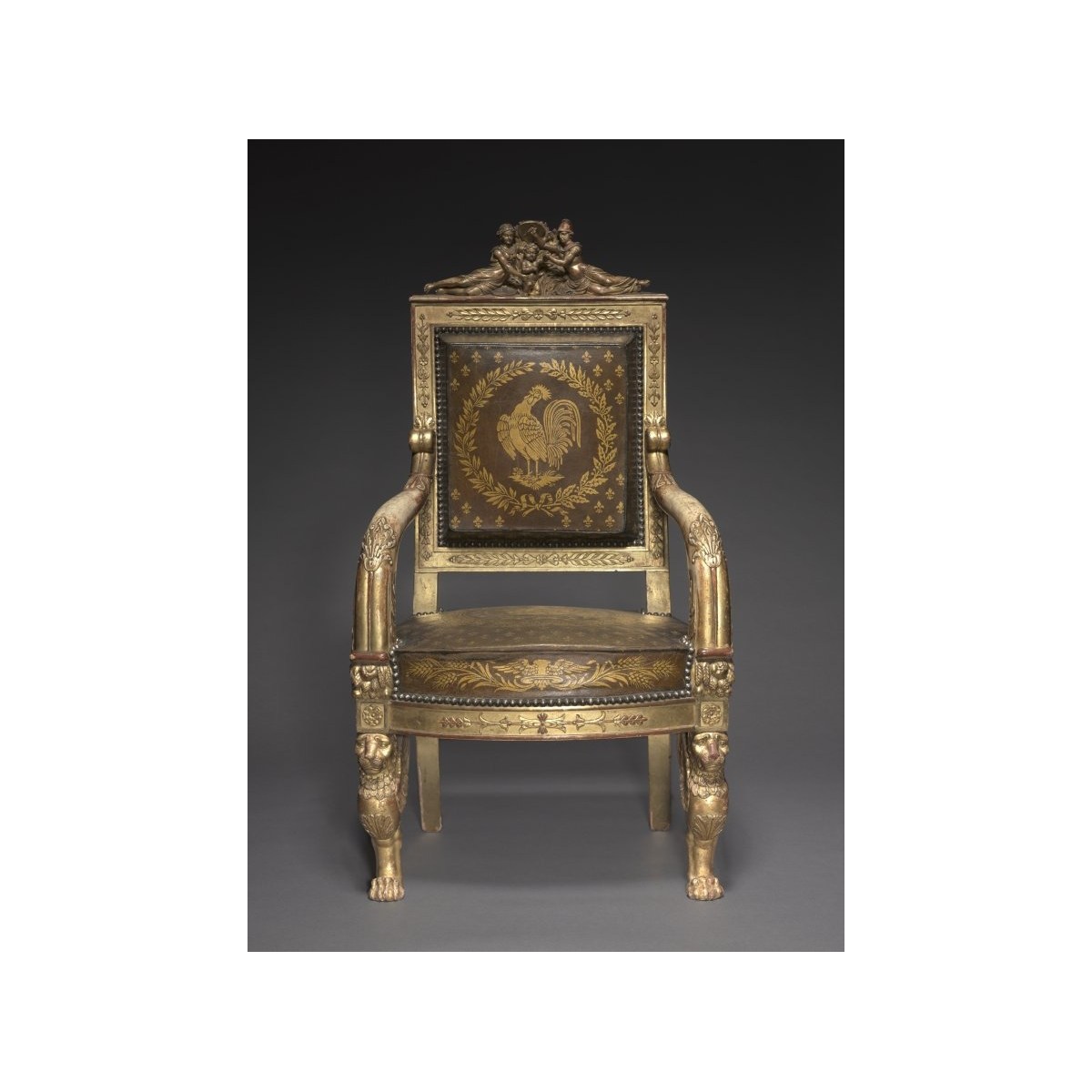
Fleurs-de-lis appear on the upholstery of this French royal child’s throne.
1822 · France, Paris · The Cleveland Museum of Art · 1988.58 · CC0
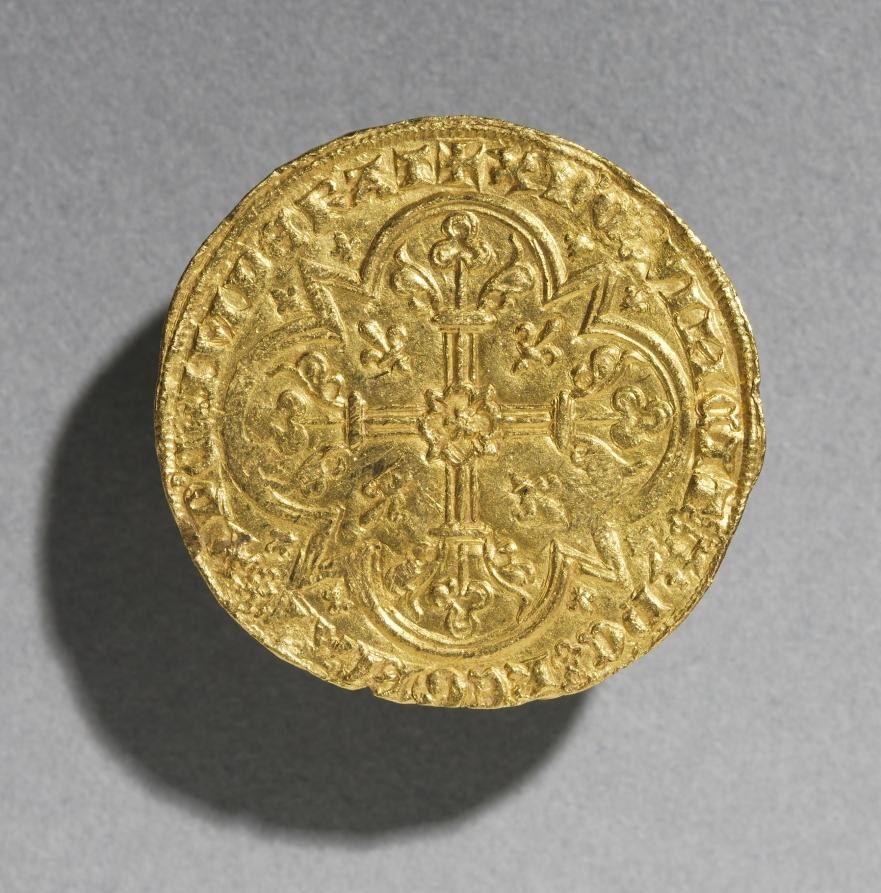
Gold coin reverse with a central cross and fleurs-de-lis in the surrounding ornament. The title’s “Golden Sheep” refers to the other face.
1350–1364 · France, Gothic period, 14th century · The Cleveland Museum of Art · 1964.372.b · CC0
Frequently asked questions
What does fleur-de-lis mean in English?
The French name means lily flower. As an emblem it is a stylized flower, not a precise botanical image.
Is the fleur-de-lis a religious symbol?
It can have Christian interpretations in particular contexts, but it is also a royal, heraldic, civic, and decorative emblem.
Why is the fleur-de-lis on Québec’s flag?
It reflects the province’s French historical and cultural connections. The Fleurdelisé became Québec’s official flag in 1948.