Cultures
Eye of Providence Meaning and Documented History
The radiant all-seeing eye is best understood through its Christian, Masonic, and American civic settings.

The Eye of Providence is an eye, often inside a triangle and surrounded by rays, representing divine watchfulness or care. Its best-known American appearance is above the unfinished pyramid on the reverse of the Great Seal of the United States. The design is not evidence of a secret organization controlling the country: its documented explanation refers to providence and the American cause.
The same general image appears in Christian art and Masonic imagery, but its setting changes its emphasis. A church, a lodge object, a government seal, and a modern poster do not automatically make the same statement. Identifying where an example was made is more reliable than treating the eye as a universal secret signature.
What does the Eye of Providence mean?
Providence means divine care or guidance. The eye makes watchfulness visible; rays give it a radiant, otherworldly setting. In Christian contexts, a triangle can connect the sign with the Trinity. In a Masonic setting, an all-seeing eye can remind members of moral accountability before God, often described in Masonic language as the Great Architect of the Universe.
Those meanings overlap without being identical. An emblem of divine oversight may emphasize care, judgment, guidance, or responsibility. A caption should therefore explain the tradition and object, rather than promise a single hidden translation. The phrase “all-seeing eye” is also broader than one exact design: some examples omit a triangle or surround the eye with clouds.
The eye above the pyramid on the Great Seal
Congress adopted the Great Seal on June 20, 1782, after several committees had worked on proposals. The National Archives traces the final arrangement to Secretary of Congress Charles Thomson, drawing on earlier designs, with revisions by William Barton. This was a documented design process, not an unexplained emblem that appeared fully formed.
The reverse combines an unfinished pyramid, the eye in a radiant triangle, the date 1776 in Roman numerals, and two Latin mottos. Thomson explained the pyramid in terms of strength and duration. He connected the eye and the motto above it with providence favoring the American cause. That contemporary explanation is the starting point for interpreting the seal.
The two major Latin phrases are often misrepresented. Annuit Coeptis is conventionally rendered “He has favored our undertakings,” referring to providence in this context. Novus Ordo Seclorum means “a new order of the ages,” marking a new American era. It is not the phrase “new world order.” Treating an approximate English slogan as a literal translation changes the historical evidence.
The unfinished pyramid and the eye are separate components joined in one composition. A triangle is not itself a pyramid, and an eye inside a triangle does not automatically refer to the American seal. Looking at the whole arrangement helps distinguish a Christian church decoration from an adaptation of the national design.
Why is it on the dollar bill?
The back of the American one-dollar note reproduces both sides of the Great Seal. The pyramid and eye appear on the left; the eagle side appears on the right. The U.S. Currency Education Program identifies the floating eye by name as the Eye of Providence. It is therefore not an unofficial detail hidden by an engraver.
Both sides of the seal appeared together on the Series 1935 one-dollar silver certificate. The seal itself was already more than a century old. Keeping those dates separate matters: 1782 is the adoption of the seal, while 1935 concerns its appearance in that banknote design. Neither date establishes the first appearance of an eye in a triangle in world art.
Is it a Christian or Masonic symbol?
It can be either, depending on context. In Christian art, the radiant eye can signify God's watchfulness and, when enclosed by a triangle, the Trinity. Masonic use similarly links the all-seeing eye with divine awareness and moral conduct, but belongs to a different institutional and ritual setting. The existence of both uses is not proof that one group secretly owns all examples.
For a broader introduction, see Christian symbols and our guide to Masonic symbols. Those categories overlap historically in some visual conventions without becoming interchangeable. The chi rho, for example, explicitly spells a monogram of Christ; a generic radiant eye does not.
A useful physical example is Cleveland's Masonic Pitcher, made in Staffordshire around 1800. An eye with radiating lines is visible above the central scene on its decorated front. Here the cataloged Masonic context and the surrounding emblematic imagery explain why an all-seeing eye appears on an ordinary vessel. It is a visible historical object, not a speculative connection drawn from a photograph of a celebrity.
Does it prove Illuminati involvement?
No. A resemblance between images does not establish membership, ownership, or coordination. The Great Seal has surviving proposals and contemporary explanations. Those records provide a much stronger basis for interpretation than claims that any triangle, covered eye, or pointed hand gesture identifies a secret organization.
The BBC's historical survey notes the conventional religious character of the sign and distinguishes it from later conspiracy narratives. Modern entertainment and graphic design can also quote the eye precisely because audiences recognize those narratives. A designer's use may be playful, critical, religious, or conspiratorial. Its intention needs evidence specific to the work.
This does not mean symbols have no political force. The seal plainly presents a claim about national beginnings and divine favor. Reading that public message critically is different from adding an undocumented secret one. An explanation is stronger when it can say who made the design, when, and what the designers wrote about it.
Is it the same as the Eye of Horus or evil eye?
No. The Eye of Horus belongs to ancient Egyptian religious imagery and has a distinctive stylized shape. The evil eye concerns a harmful gaze and, in many contexts, objects intended to avert it. The Eye of Providence represents divine oversight in its documented European and American uses.
Eyes are an obvious visual metaphor for seeing and awareness, so they recur in many societies. That broad resemblance is not enough to establish a direct line of descent between specific signs. In particular, calling the American eye “really Egyptian” skips the actual records of the seal's design.
How to identify it responsibly
Start with the visible features: a single eye, triangle, rays, clouds, or pyramid. Then check the object's maker, date, inscriptions, and setting. Name the symbol only as precisely as the evidence permits. A radiant eye may be confidently identified while its exact original interpretation remains uncertain.
There is no dedicated Unicode character that reproduces the complete Eye of Providence. An ordinary eye character or a triangle is not an exact copy of the historical design. The illustration here is a modern schematic rendering, not a reproduction of a museum artifact or an official government seal.
In the museum
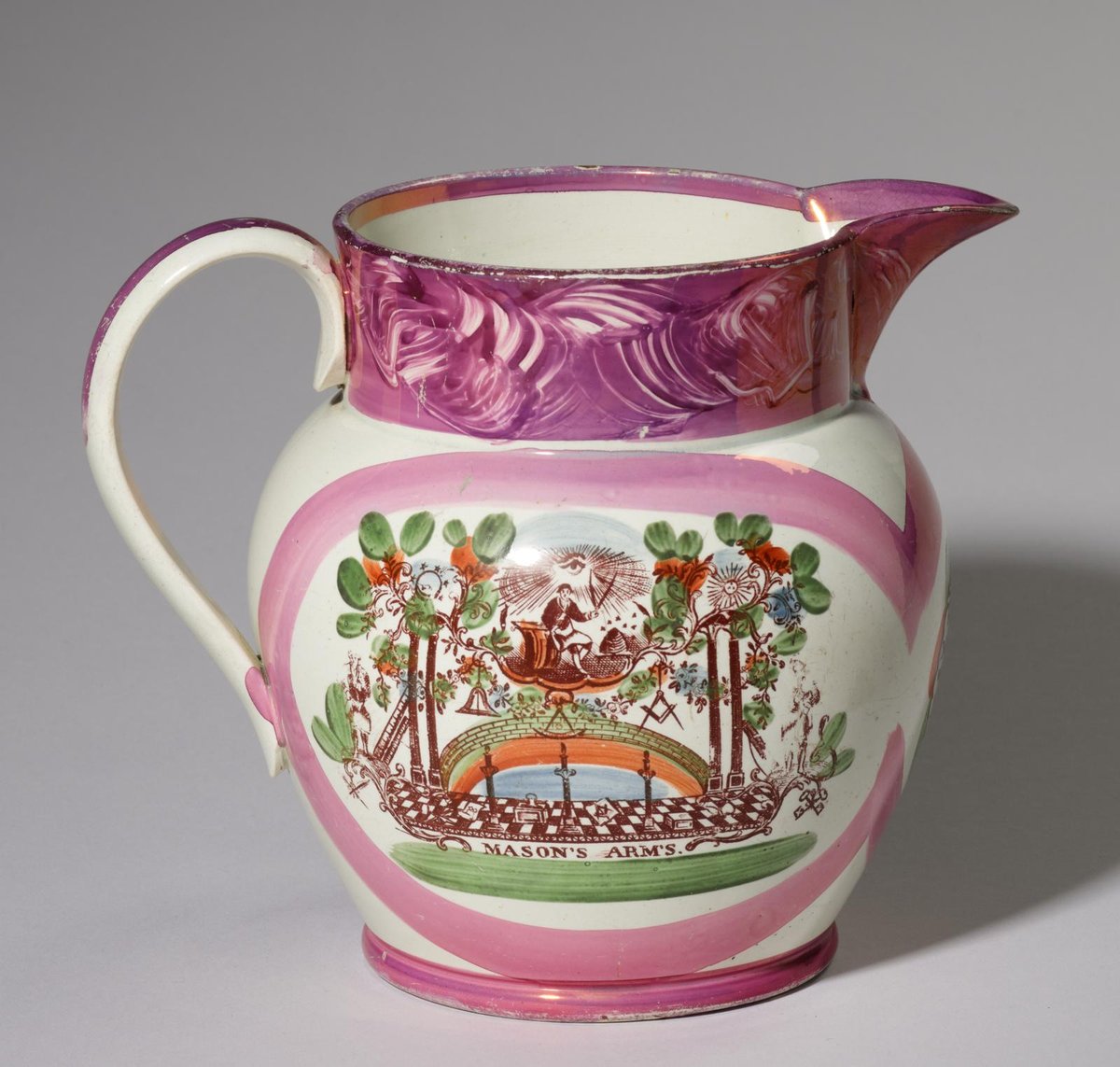
Masonic pitcher with a radiant single eye above the central scene, visible on the decorated front. The eye is shown without a surrounding triangle.
c. 1800 · England, Staffordshire, late 18th-early 19th Century · Cleveland Museum of Art · 1924.247 · CC0
Frequently asked questions
What is the eye above the pyramid called?
It is the Eye of Providence. On the Great Seal it refers to divine providence in relation to the American cause.
Is the Eye of Providence an Illuminati symbol?
Its appearance alone does not prove Illuminati involvement. The Great Seal has a documented public design history and a contemporary explanation referring to providence.
What does the triangle mean?
In Christian settings it can signify the Trinity. Interpret a particular example using its setting and documentation rather than assuming the same meaning everywhere.
Is it the same as the Eye of Horus?
No. They are distinct signs with different forms, histories, and religious contexts. A shared eye motif does not establish direct descent.
Sources & further reading
- U.S. Bureau of Engraving and Printing: Currency Notes
- National Archives: Original Design of the Great Seal
- Founders Online: Report of the seal committee, August 1776
- U.S. Department of State: The Great Seal of the United States
- U.S. Currency Education Program: Symbols in the Seal
- BBC Culture: The Eye of Providence
- Provincial Grand Lodge of Aberdeenshire East: The All-Seeing Eye
- Cleveland Museum of Art: Masonic Pitcher