Cultures
Masonic Symbols and Their Meanings
A source-led guide to Freemasonry's tools and emblems, with regional differences, museum evidence, and common myths kept separate.
 Square and compasses
The builder's tools as an ethical lesson in upright conduct and restraint.
Original illustration · Symbolism.co editors — original vector illustration · CC0-1.0 · Source record · License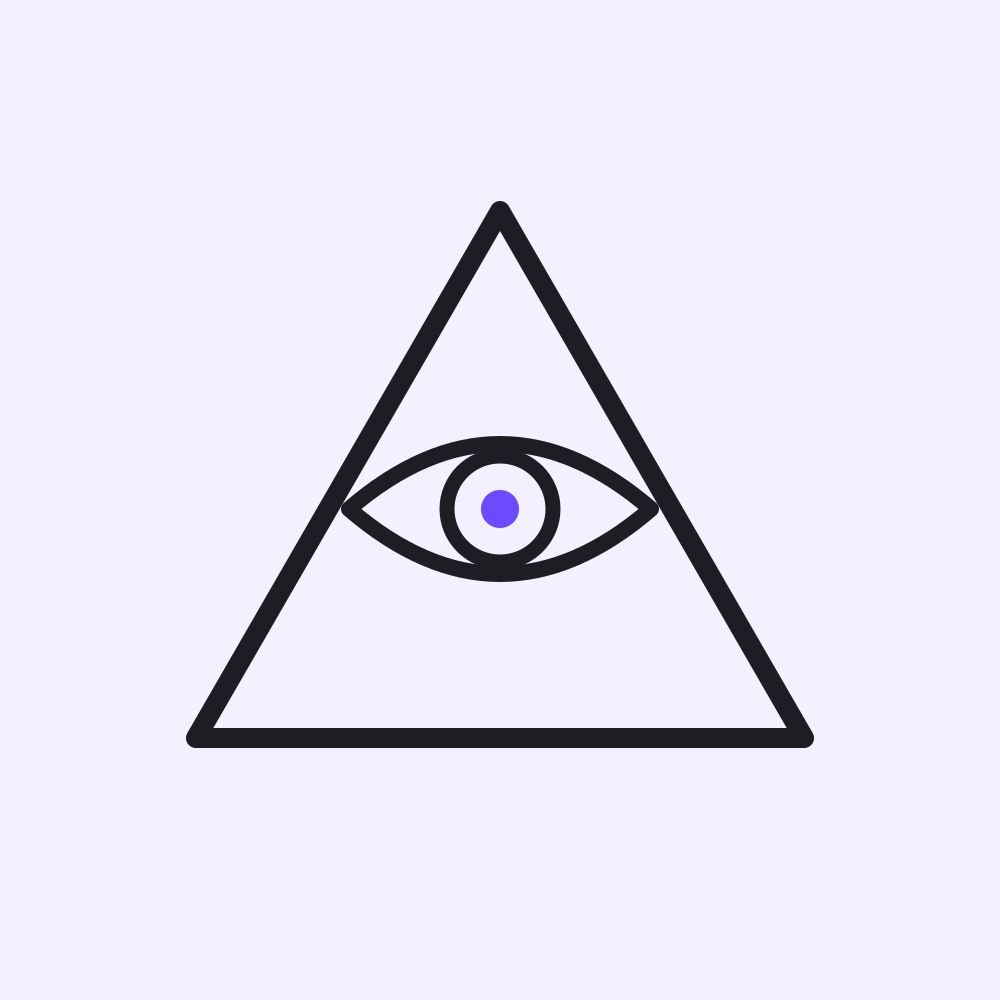 All-seeing eye
Divine awareness and moral accountability; not an exclusively Masonic image.
Original illustration · Symbolism.co editors — original vector illustration · CC0-1.0 · Source record · License Cable-tow
Connection, dependence, and obligation in Masonic teaching.
Original illustration · Symbolism.co editors — original vector illustration · CC0-1.0 · Source record · License Point within a circle
The individual and the bounds or community within which conduct is shaped.
Original illustration · Symbolism.co editors — original vector illustration · CC0-1.0 · Source record · LicenseMasonic symbols use builders' tools, architectural forms, and familiar images to teach ethical lessons. The best-known emblem is the square and compasses: the square suggests honest, upright conduct, while the compasses suggest self-restraint and keeping behavior within proper bounds. In many American examples, a letter G adds associations with geometry and God.
Those are broad readings, not a single worldwide code. Freemasonry consists of different grand lodges, rites, and related organizations whose practices vary. A useful explanation of a Masonic symbol identifies the organization, place, period, and object before assigning a meaning. The following guide uses published Masonic sources and actual museum objects, not claims about hidden control of world events.
What is the Masonic symbol called?
The familiar interlaced emblem is called the square and compasses. “Compass” is common in everyday American descriptions, but “compasses” is the traditional name for the two-legged instrument used to draw circles. The square is the tool used to check a right angle. Together they turn the equipment of building into a metaphor for building character.
The Scottish Rite's Northern Masonic Jurisdiction cautions that the exact origin of the combined emblem is unknown. The tools belong to a longer craft history, but their appearance in an older illustration does not automatically establish a Masonic connection. It is safer to distinguish evidence for tools from evidence for a fraternity's use of those tools as its emblem.
Masonic symbols and meanings at a glance
| Emblem | Common published interpretation | Important qualification |
|---|---|---|
| Square and compasses | Ethical conduct and self-restraint | Forms and ritual explanations vary. |
| Letter G | Geometry and God | Especially familiar in American examples; not required everywhere. |
| Apron | Membership and the dignity of work | Decoration can indicate office, degree, or jurisdiction. |
| Rough and finished ashlars | Improvement of character | These are shaped building stones used metaphorically. |
| All-seeing eye | Divine awareness and moral accountability | The image is not exclusively Masonic. |
| Sun | Light, truth, and knowledge | Setting and neighboring emblems refine the reading. |
| Cable-tow | Connection, obligation, and dependence | Published explanations differ by tradition. |
What does the G in the Masonic logo mean?
The G has more than one published explanation. The Scottish Rite Northern Masonic Jurisdiction identifies geometry as one central reading: the mathematical knowledge underlying the builder's art becomes an image of order, learning, and disciplined work. God, often referred to in Masonic language as the Great Architect of the Universe, is another familiar reading.
The Grand Lodge of Ohio notes that the G is common in American square-and-compasses emblems but less common in England and some other settings. Its absence does not make an emblem incomplete or inauthentic. Nor should “Great Architect” be read as the proper name of a separate Masonic deity. The expression allows members of different religious backgrounds to use shared architectural language.
These explanations concern particular Masonic traditions. They do not mean that every capital G on jewelry is Masonic, or that a viewer can determine a wearer's complete religious beliefs from a ring.
The square, compasses, level, and plumb
The square tests an angle; metaphorically, it tests whether conduct is right. The compasses establish a boundary, making them useful for teaching restraint. Together, they ask a member to consider both obligations to others and control of personal impulses.
The level and plumb extend the same teaching method. A level offers an image of equality, while a plumb line provides an image of uprightness. In actual building, neither instrument replaces the others. In moral teaching, their different tasks likewise make different points. Flattening them all into “wisdom” loses the specificity that makes the metaphor work.
Masonic officer's jewels can take the shape of tools. The United Grand Lodge of England's published plates, for example, distinguish a Senior Grand Warden's level from a Junior Grand Warden's plumb rule. A tool-shaped pendant can therefore identify an office as well as express an ethical idea.
The apron, gavel, and ashlars
The apron recalls the protective clothing of working stonemasons. In modern lodge settings it is ceremonial regalia and a marker of membership. UGLE explains that a member begins with a white leather apron and may wear more elaborate forms as his Masonic career develops. The exact decoration needs to be read within the relevant organization.
The gavel can refer to shaping or correcting rough material, a metaphor for removing undesirable habits. It is important to distinguish that teaching image from the practical use of a gavel to manage a meeting. An object can be functional and symbolic at once.
An ashlar is a building stone. The contrast between rough and more perfectly shaped ashlars expresses a process of improvement rather than a claim that a person becomes morally flawless after a ceremony. The Scottish Rite describes work on the rough ashlar as an ongoing task. The imagery asks for continued effort, not possession of a supernatural shortcut.
The all-seeing eye is not proof of a conspiracy
The Eye of Providence, or all-seeing eye, can signify divine knowledge and the responsibility to act well even when no other person is watching. Freemasonry uses the image, but did not invent every form of it. Christian and other European visual settings provide important context for its wider circulation.
The Masons of California explicitly distinguish the eye from the popular notion of a “Masonic pyramid” on the dollar bill. Shared use of an image is not evidence that one organization designed or controls every object bearing it. The U.S. Great Seal must be researched through its own documentary history, rather than treated as a puzzle solved by resemblance alone.
This also separates the eye from the Egyptian Eye of Horus. Both involve eyes, but their forms, histories, and religious settings are different. Similarity is a reason to compare carefully, not to declare a single unbroken secret tradition.
The sun, blazing star, and point within a circle
The sun readily lends itself to ideas of illumination and knowledge. The Scottish Rite Northern Masonic Jurisdiction describes it as a symbol of truth, enlightenment, and the continuing pursuit of knowledge. In lodge imagery, “light” commonly works as an ethical and intellectual metaphor, not simply as a reference to astronomy.
The blazing star does not have one fixed explanation in every Masonic system. The Grand Lodge of Maine's handbook connects it with the divine Architect as guide. Other published traditions develop different emphases. It is best to identify whose interpretation is being used instead of claiming that one paragraph explains every five-pointed star in Masonic art.
The point within a circle also receives developed explanations. Maine's handbook describes the point as the individual, the surrounding circle as the brethren, and accompanying elements as moral and religious guidance. Elsewhere, emphasis may fall on the boundary of a member's conduct. A plain geometric dot and circle outside a Masonic setting cannot carry all that meaning on its own.
The cable-tow and Tubal-cain
A cable-tow is a cord used in Masonic ceremonial imagery. The Grand Lodge of Maine interprets it through dependence, connection to fellow members and humanity, and dependence on God. Other Masonic writing stresses obligations and the limits of what a member can reasonably undertake. These are descriptions of a symbolic lesson, not evidence of literal supernatural binding.
Tubal-cain belongs to a different category: a named biblical figure rather than one universally recognizable logo. Genesis 4:22 associates him with metalworking. Masonic teaching can use him as an emblematic craftsman, linking skilled labor with the fraternity's broader language of building and making.
Some modern “Tubal-cain symbol” jewelry uses pictorial wordplay or a rebus. Without an object record or a source from the issuing body, it should not be labeled an ancient standard Masonic sign. A claim that one pendant unlocks the entire meaning of a degree is not supported by the existence of a biblical craftsman's name.
Cross and crown, Eastern Star, and six-pointed stars
A cross and crown can combine Christian ideas of suffering, fidelity, and heavenly reward. In a Masonic-related setting, first ask which body or order used the object. An emblem associated with a Christian chivalric body should not be presented as the universal badge of every Craft lodge or every Freemason.
The Order of the Eastern Star is a distinct Masonic-related organization, not another name for Freemasonry as a whole. Its five-pointed star associates its points with Adah, Ruth, Esther, Martha, and Electa, and with lessons drawn from their stories. Its own publications connect its name with the star of Bethlehem.
Why is the Eastern Star sometimes shown with a point downward? Orientation is part of particular organizational practice, not automatic evidence of Satanism. The General Grand Chapter's own publication notes that New York uses a differently oriented star. Geometry alone is not a reliable statement of theology.
Likewise, a six-pointed star in a fraternal design should not erase the Star of David's Jewish identity. The object, inscription, and issuing organization determine whether a specifically Jewish reference is intended.
What two museum objects actually show
Cleveland's Masonic Pitcher, made in Staffordshire about 1800, moves lodge imagery onto a domestic ceramic vessel. Its printed design visibly gathers an eye, pillars, a checkered floor, and working-tool imagery. That grouping makes its identification much stronger than the presence of any one isolated geometric shape.
The museum's photograph Seated Masonic lodge master and wife, about 1852–53, shows regalia worn by a particular person. The sitter holds a gavel and wears decorated ceremonial clothing. It documents the social presentation of membership; it does not, by itself, identify every detail of the couple's beliefs or the history of their lodge.
A practical method for identifying Masonic emblems
Look first for an inscription, lodge name, maker, or date. Then compare the entire design with the relevant grand lodge's publications or a museum catalog. Distinguish a Craft emblem from an officer's jewel, a rite's badge, or a related order's insignia. Our cultures collection provides other examples of why setting matters.
Finally, separate historical evidence from a fraternity's moral interpretation. Both can be worth explaining, but they answer different questions. Modern Freemasonry has documented early modern and eighteenth-century history; using older biblical or architectural imagery does not prove institutional descent from ancient Egypt or Solomon's builders. A careful reading is usually more interesting than a conspiracy because it restores the people, materials, and settings that made the symbols meaningful.
In the museum
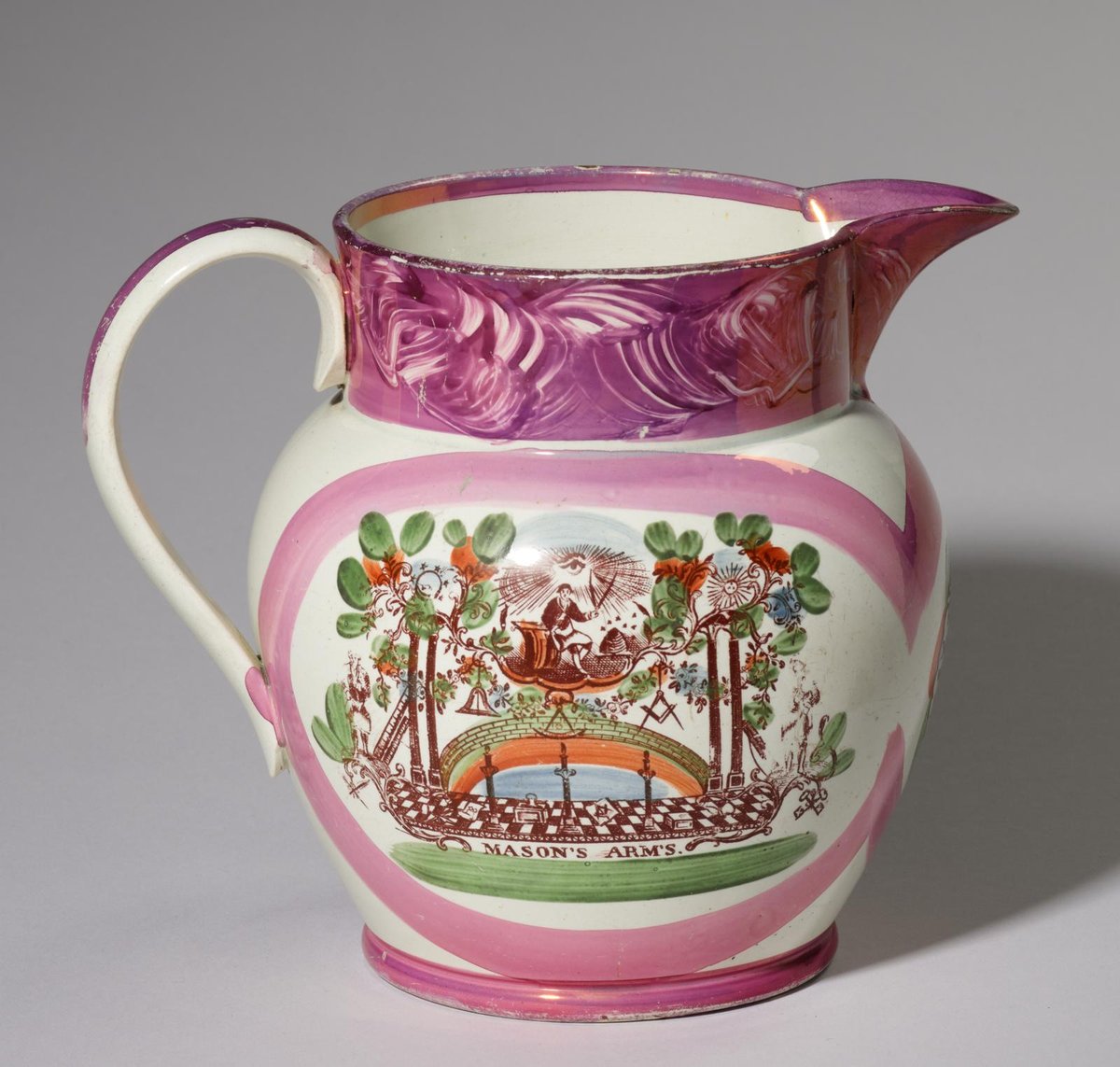
Masonic Pitcher, about 1800; Staffordshire, England. The printed scene includes an eye, pillars, working tools, and a checkered floor. Cleveland Museum of Art, 1924.247.
c. 1800 · England, Staffordshire, late 18th-early 19th Century · Cleveland Museum of Art · 1924.247 · CC0
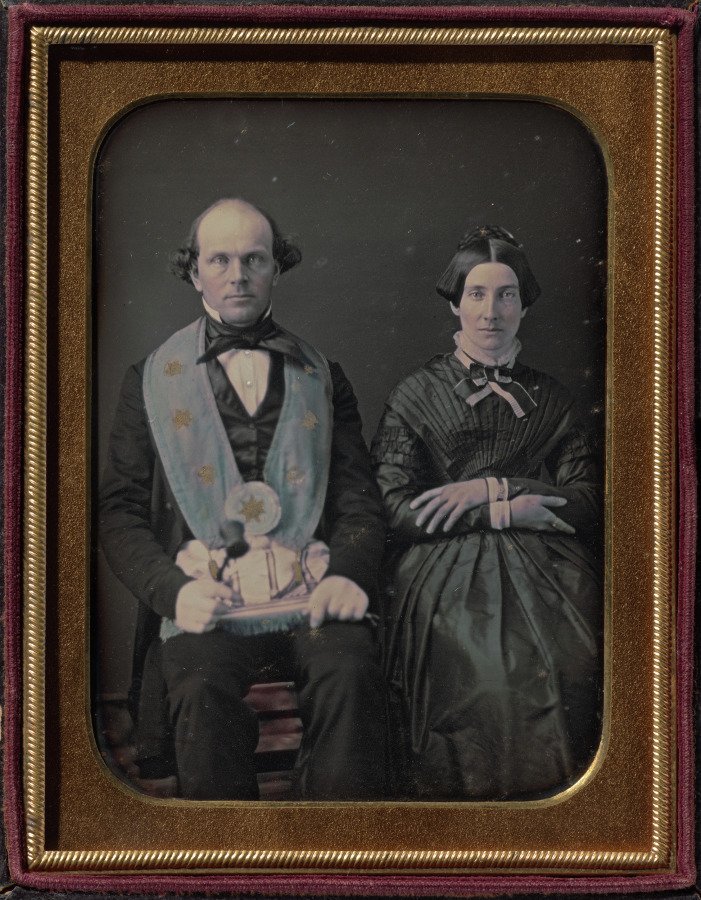
Seated Masonic lodge master and wife, about 1852–53; America. The lodge master wears decorated regalia and holds a gavel. Cleveland Museum of Art, 2021.97.
c. 1852–53 · America · Cleveland Museum of Art · 2021.97 · CC0
Frequently asked questions
What is the Masonic symbol called?
The most recognizable Masonic emblem is the square and compasses. It combines a tool for checking right angles with an instrument for drawing circles.
What does the Masonic G mean?
Common published interpretations include geometry and God, often described as the Great Architect of the Universe. The G is especially familiar in American emblems and is not used everywhere.
Is the all-seeing eye only a Masonic symbol?
No. Masons use it to express divine awareness and moral accountability, but the Eye of Providence also appears in non-Masonic religious and civic art.
What does the Masonic sun symbol mean?
Masonic sources commonly connect the sun with light, truth, knowledge, and enlightenment. Its specific role depends on the surrounding design and the tradition using it.
Why is the Eastern Star upside down?
The point-down orientation belongs to particular Eastern Star practices and is not, by itself, a statement of Satanism. The organization associates its star with biblical lessons, and orientation can vary by jurisdiction.
Are Masonic symbols ancient Egyptian symbols?
Modern Freemasonry uses imagery from several older traditions, but visual borrowing is not proof of direct institutional descent from ancient Egypt. Its documented history must be studied separately from its allegories.
Sources & further reading
- Scottish Rite Northern Masonic Jurisdiction: Masonic Symbolism
- Scottish Rite Northern Masonic Jurisdiction: Origins of the Square and Compasses
- Scottish Rite Northern Masonic Jurisdiction: The Masonic Letter G
- Grand Lodge of Ohio: The Square and Compasses
- Masons of California: Freemasonry Symbols Explained
- Grand Lodge of Maine: Handbook for Masons, Chapter III continued
- United Grand Lodge of England: Frequently Asked Questions
- United Grand Lodge of England: History of Freemasonry
- United Grand Lodge of England: Authorized regalia plates
- Order of the Eastern Star in Australia: Origins and Symbolism
- General Grand Chapter, Order of the Eastern Star: 2024 second-edition journal, New York visit
- Cleveland Museum of Art: Masonic Pitcher
- Cleveland Museum of Art: Seated Masonic lodge master and wife