Cultures
Evil Eye Meaning and the Protective Eye Amulet
The evil eye is a belief about harm caused by an envious gaze. The familiar eye-shaped charm is traditionally intended to avert that harm, not to cause it.

The evil eye is a belief that a person’s gaze, often associated with envy, can bring harm or misfortune. The eye-shaped charm commonly sold under the same name means almost the opposite: it is traditionally worn or displayed to protect against that feared gaze. Distinguishing the harmful look from the protective object is the first step toward understanding the symbol.
The familiar circular bead is often called a nazar amulet. Its concentric rings resemble an eye watching outward. Blue-and-white examples are especially recognizable today, but neither the wider belief nor the protective use of eye motifs belongs to one color, one country, or a single unchanging tradition.
What does the evil eye symbol mean?
As an amulet, an eye motif generally expresses a wish for protection against envy and the harm believed to follow it. Museums use the term apotropaic for objects intended to avert harmful influences. This describes what people believed an object could do; it does not establish that the object has supernatural powers.
Britannica’s account links evil-eye beliefs especially with envy of prosperity or beauty. The threatening look need not always be understood as a deliberate curse. In some traditions, admiration or praise itself can make a person vulnerable. That helps explain why blessings and qualifying phrases may accompany compliments.
A contemporary pendant can also communicate affection: a giver may intend “may you be safe” rather than a detailed commitment to folklore. Someone else may wear an eye simply because of family custom or the design. An observer cannot reliably determine a wearer’s religion or beliefs from the bead alone.
How old are protective eye beads?
Ancient eye beads provide firmer evidence than confident internet claims about a single origin date. The Cleveland Museum of Art’s Fragment of a Necklace, dated 1540–1296 BCE, includes three amber-colored glass beads decorated with blue-and-white eyes. The museum identifies the stringing as modern: the ancient beads have been assembled into the arrangement now photographed.
That qualification is important. The photograph is evidence for ancient eye-shaped components, not proof that an ancient Egyptian wore this exact necklace in this exact sequence. Museum dates can apply to individual parts rather than to a complete surviving ensemble.
A second Cleveland necklace combines barrel beads dated to Egypt’s Middle Kingdom with eye beads dated to the New Kingdom, specifically 1295–1186 BCE. Its mixed dating makes the same point from another direction. Objects have histories of collecting and rearrangement as well as histories of manufacture.
The Metropolitan Museum of Art’s essay on Egyptian amulets explicitly discusses bracelets with concentric-circle beads used to combat the evil eye. Together, the essay and the surviving beads support a long history for protective eye imagery. They do not prove that every ancient eye bead had precisely the same name or social meaning as a modern souvenir.
One belief, different regional practices
“Evil eye” is a convenient English umbrella term, not the name of a single organized religion. Beliefs about harmful looking occur in different communities, and the responses can include spoken blessings, gestures, beads, and other amulets. The objects should be interpreted through the communities and records associated with them.
For example, the British Museum records a necklace made in Hebron with blue, yellow, and white eye-shaped glass beads, described as protection against the “eye of envy.” The record grounds the meaning in a particular collected object and place. It is stronger evidence than a claim that all people throughout a broad region use one identical charm.
The hamsa hand may also serve a protective purpose, and some hand-shaped pendants include an eye. Yet an open hand and an eye bead are not interchangeable names for the same design. Their histories overlap without collapsing into one universal symbol.
Do different evil-eye colors have fixed meanings?
Modern product descriptions often assign a separate benefit to every bead color, promising love, wealth, confidence, or health. Such charts should not be treated as a universally inherited ancient code. A seller may give a color a new interpretation, while a family or regional tradition may use another explanation or no special color scheme at all.
The Cleveland beads are useful correctives to the idea that the protective eye has always been a flat blue disk. Their amber glass and modeled eyes show a different material solution. The Hebron necklace likewise combines several colors. Historical evidence supports variety more readily than a neat, timeless color dictionary.
Our guide to color symbolism explains why color needs context. If a gift includes an explanation, that tells you something about the giver’s intention. It does not by itself establish what a person in antiquity meant by a similarly colored object.
Is the evil eye the same as the Eye of Horus?
No. The Eye of Horus, or wedjat eye, is a distinct Egyptian motif connected with the restored eye of the god Horus. Its form includes stylized markings rather than only concentric rings. The Met’s amulet essay discusses the wedjat and concentric-circle protective beads as distinguishable forms.
Both may occur in discussions of protection, but a shared function does not make them one symbol. The same applies to the Eye of Providence, whose usual setting and religious associations are different. Start with the actual drawing before assigning a name.
Wearing and interpreting an eye amulet today
A respectful interpretation identifies an amulet as a cultural object rather than making promises about what it can accomplish. There is no reliable basis for treating a charm as a health intervention, a guarantee of safety, or a detector of another person’s intentions. A broken bead is not evidence that a curse has been intercepted.
That caution does not make family traditions or meaningful gifts trivial. An object can carry memory, affection, and a wish for protection without offering measurable supernatural protection. Asking where an amulet came from and how its owner understands it often reveals more than a generic list of “spiritual meanings.”
In the museum
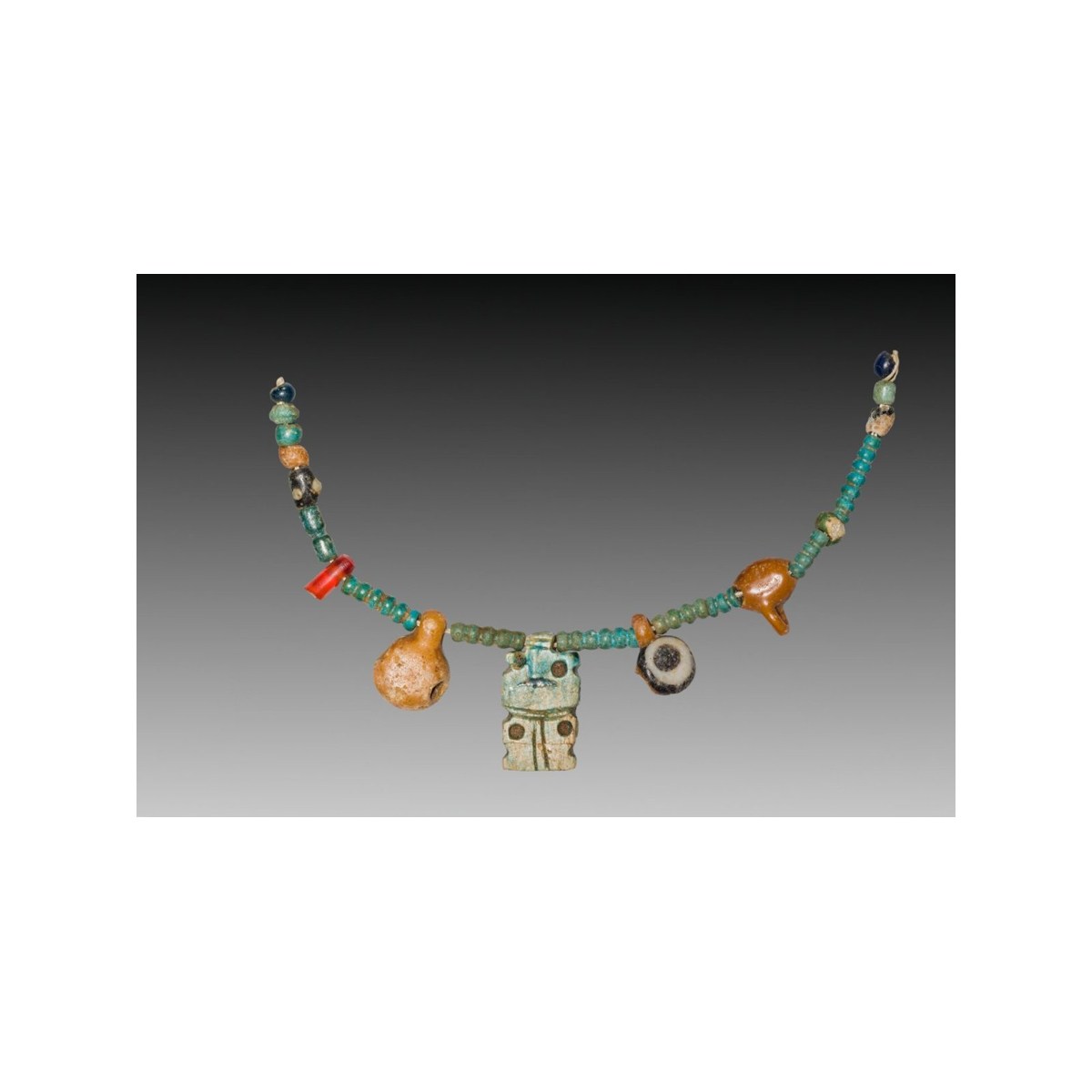
Ancient Egyptian eye beads; the museum’s dates distinguish the components, and the present stringing is not evidence of the original arrangement.
1540–1296 BCE · Egypt, New Kingdom (1540–1069 BCE), Dynasty 18 · The Cleveland Museum of Art · 1915.15 · CC0
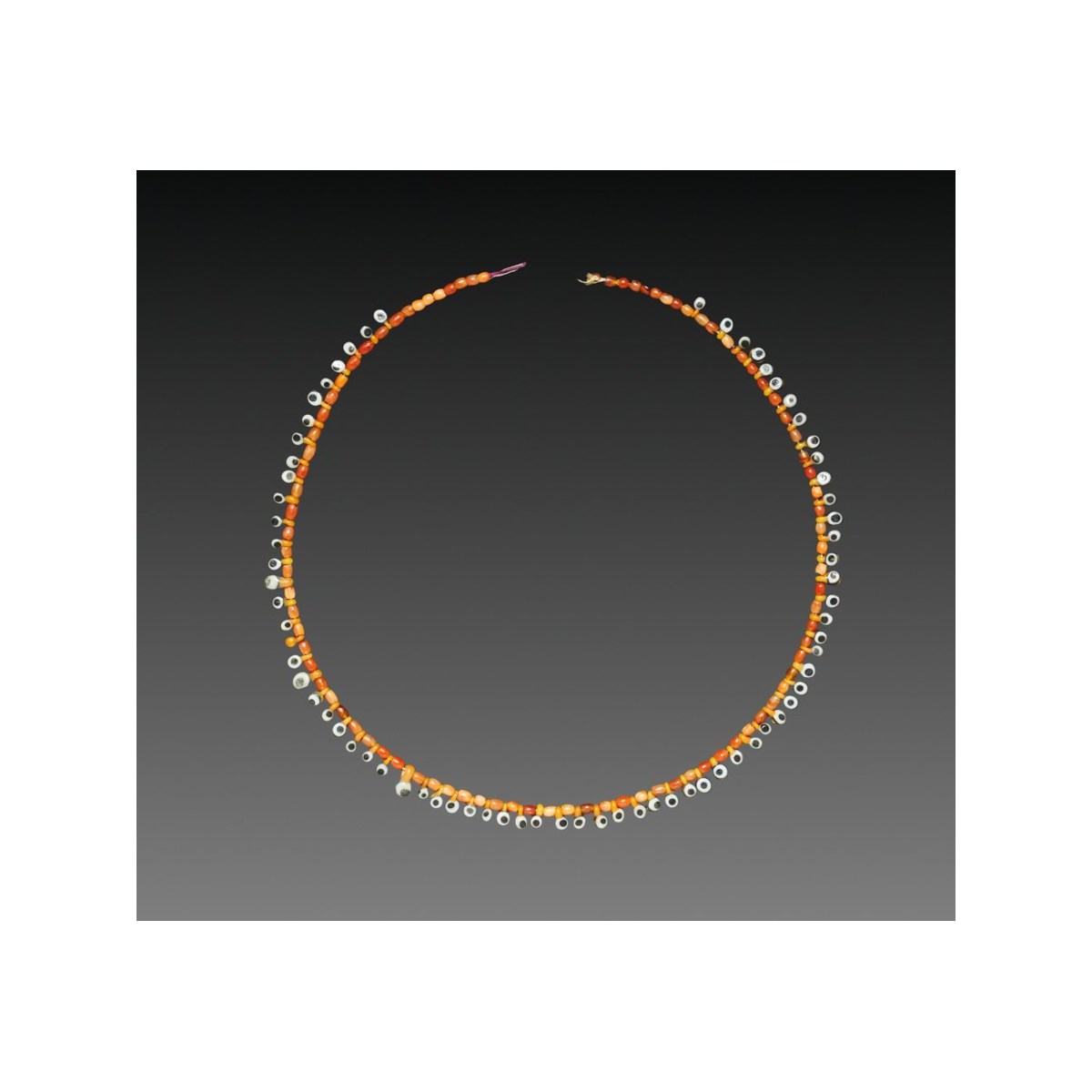
Ancient Egyptian eye beads; the museum’s dates distinguish the components, and the present stringing is not evidence of the original arrangement.
barrel beads: 1980–1801 BCE; eye beads: 1295–1186 · Egypt, Middle Kingdom, Dynasty 12 (barrel beads) and New Kingdom, Dynasty 19 (eye beads) · The Cleveland Museum of Art · 1914.752 · CC0
Frequently asked questions
Is the evil eye symbol evil?
The eye-shaped amulet is usually intended as protection against the feared evil eye, not as a way to cause it.
Does an evil-eye charm have to be blue?
No. Blue examples are familiar, but museum collections document eye beads in several colors. There is no single universal color code.
Does a broken evil-eye bead prove it stopped a curse?
No. That is a folk interpretation, not something a broken object can establish.