Cultures
Torii Gate Meaning at Japanese Shrines
A torii marks the threshold of sacred space. Shrine sources and dated Japanese prints explain its meaning more reliably than a single origin legend.
A torii gate marks an entrance to sacred space, most often at a Japanese Shinto shrine. Its two upright posts and projecting crossbeam create a threshold without needing a door. The central torii gate meaning is the distinction between an everyday setting and a place approached with religious attention and respect.
The gate can stand at the beginning of a shrine approach, within the grounds, or before a natural feature understood as sacred. It is more than a decorative entrance or a generic symbol of Japan: its meaning comes from the sacred place it identifies.
What a torii symbolizes
Kokugakuin University’s Encyclopedia of Shinto defines the torii as a formalized gateway signifying entry to a sacred area. Its account emphasizes the division between the sacred and the ordinary, often translated as the “profane” realm. Here, profane means outside the sacred precinct, not necessarily wicked or offensive.
Crossing a torii therefore changes the terms of a visit. The landscape ahead is not simply another stretch of road. A shrine may be dedicated to particular kami, and the gateway helps establish how that place is encountered.
“A portal to another dimension” is a dramatic modern description, but it can mislead if taken literally. The university’s explanation concerns a religious boundary in a real landscape, not a claim that visitors physically leave the world.
How to recognize a torii gate
The usual form has two posts supporting a horizontal cap beam, called a kasagi, which extends past the posts. A lower tie beam, the nuki, connects the uprights. Variations in their shape and arrangement produce many architectural types.
Some torii have straight, spare outlines. Others have curved upper beams, extra supports, or additional features. The basic silhouette is recognizable even when reduced to a map icon, but an icon cannot communicate the construction history of a specific gate.
Wood and stone are common materials. Kokugakuin’s account also notes metal, concrete, and other materials, with no absolute restriction on what a torii must be made from. A stone gate is not a less authentic torii because it differs from the vermilion wooden gates familiar from photographs.
A shrine can have several gates. The outer approach may have a “first torii,” and gates further inside can mark increasingly sacred areas. A sequence is therefore not necessarily decorative repetition; it can articulate the religious geography of the site.
Why are torii gates red?
Many famous torii are vermilion, especially those associated with Inari shrines. But red is not a defining requirement. Natural wood, stone, and other finishes occur, so color alone cannot establish whether an entrance is a torii.
Fushimi Inari Taisha explains its vermilion in the context of protection against evil influences and the abundance of harvests associated with Inari Okami. Its own account also discusses traditional pigment as a means of preserving wood. This combines religious meaning with the material life of a building.
It is important not to turn that local explanation into an unsupported universal formula. “Red always means the same thing in Japan” is no more reliable than assigning one message to every red object elsewhere. For the broader issue, compare color symbolism; a color’s setting and tradition matter.
Why does Fushimi Inari have so many torii?
Fushimi Inari Taisha in Kyoto is especially known for paths lined with closely spaced gates. The shrine explains that torii offerings express prayers and appreciation. Its official account places the widespread use of these offerings in the Edo period.
The repetition is thus connected with acts of dedication, not with a rule that every shrine must have a tunnel of gates. The shrine’s Senbon Torii, conventionally translated “Thousand Torii,” should be understood within that particular devotional setting.
Seeing a long row of gates can make the form seem like a single architectural spectacle. Remembering the individual offerings restores a different scale: a repeated structure can also record many separate relationships between worshipers and a shrine.
Where did the torii originate?
The origin is not settled. Kokugakuin University summarizes both theories of an indigenous Japanese development and theories proposing influence from abroad. It explicitly states that no single explanation has achieved general acceptance.
The word’s origin is uncertain too. The characters 鳥居 invite a connection with birds, and proposed explanations include a bird perch. Another theory connects the name with passing through and entering. These are theories, not a verified literal account of the first gate.
Popular retellings sometimes connect the gateway with the story of Amaterasu emerging from a cave and the crowing of a rooster. Such associations can belong to religious storytelling, but they should not be presented as archaeological proof that torii began as chicken perches.
A more reliable quick fact is the gate’s documented function. Its beginnings remain debated; its role as a marker of sacred space is much clearer. That is enough to explain its significance without inventing an exact date or a single founding event.
Is a torii Shinto or Buddhist?
The torii is primarily associated with Shinto shrines, and it generally identifies a shrine on Japanese maps. The history is not completely exclusive, however. Kokugakuin notes torii at Buddhist temples as well, including the stone torii at Shitennōji in Osaka.
That exception reflects the complexity of Japan’s religious landscape. It does not make a torii the same as a Buddhist temple gate, or mean that Shinto and Buddhism are identical. Identify a particular site before using its gateway to classify everything inside.
Compare the ensō and the dharma wheel for two different kinds of Buddhist image. A brushed circle, a teaching wheel, and a shrine threshold work in different ways, even when all appear together in modern collections of religious symbols.
Torii gates in museum art
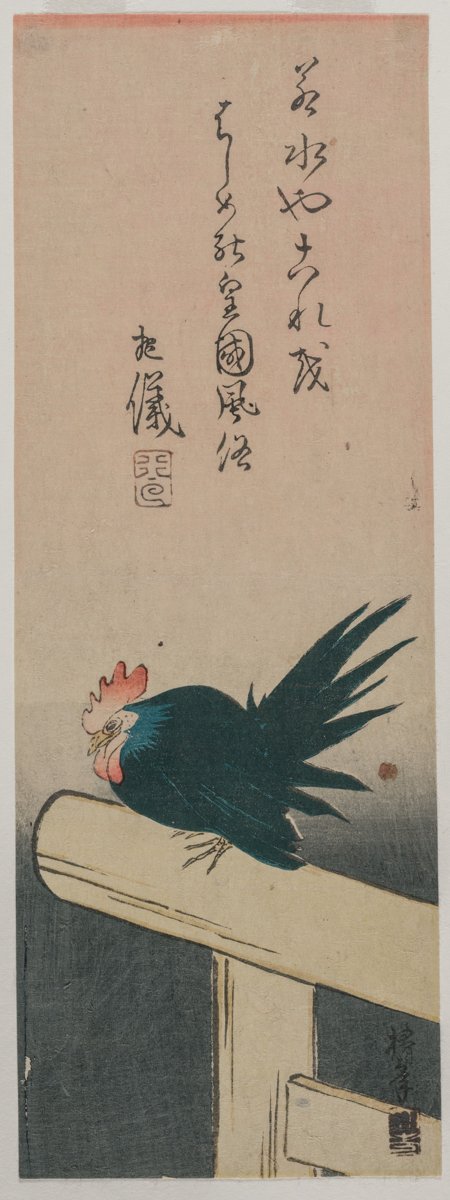
Chinnen’s Green Rooster Perched on Torii (Shrine Gate), dated to the early 1830s by the Cleveland Museum of Art, crops the architecture closely. The bird stands on the upper beam, while the post and lower crosspiece remain visible. The image documents a torii motif in an Edo-period print; it does not prove any theory of the gateway’s origin.
In Hiroshige’s Night Rain at the Azuma Shrine, dated to the mid-1830s, a torii appears beside the route through the wet landscape. Travelers, rain, and the shrine approach place the gateway within lived surroundings rather than isolating it as an emblem. Both prints are CC0 collection images, reproduced with their object records below.
Visiting and copying the symbol respectfully
Japan’s national tourism organization advises visitors to bow before passing a shrine’s torii and to avoid walking in the exact center of the approach. Follow the particular shrine’s signs and guidance, especially where access or photography is restricted.
The character ⛩ is Unicode U+26E9 SHINTO SHRINE, with “torii” listed as an alias. Its HTML numeric reference is ⛩. Some devices display it as a colorful emoji. The small character is useful for identifying a shrine, but it is not a substitute for understanding the religious place the gate marks.
For related motifs and the difference between writing and images, continue with Japanese symbols and their meanings.
In the museum
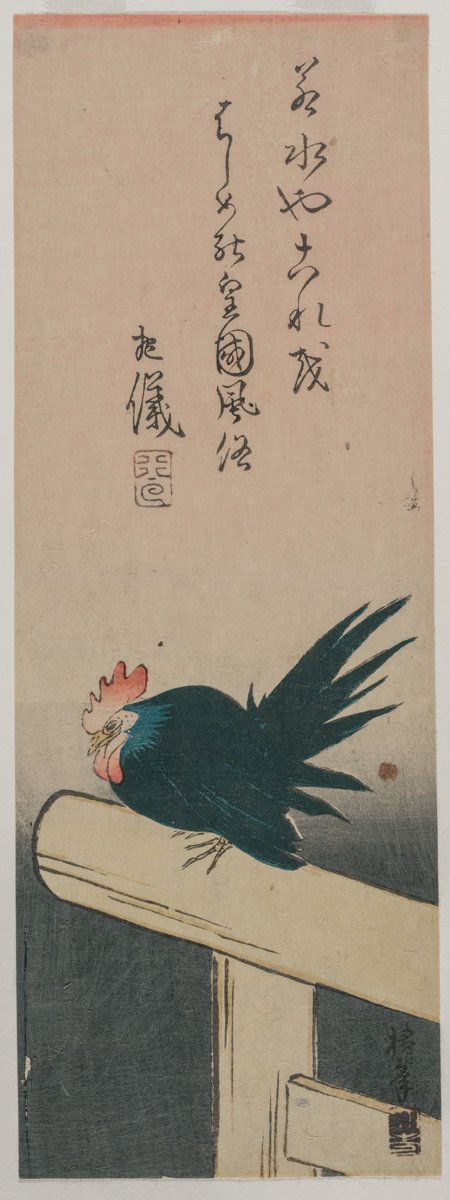
Chinnen, early 1830s. A green rooster stands on the cap beam of a torii; one upright and the lower beam are visible in the cropped composition.
early 1830s · Japan, Edo period (1615–1868) · The Cleveland Museum of Art · 1940.980 · CC0
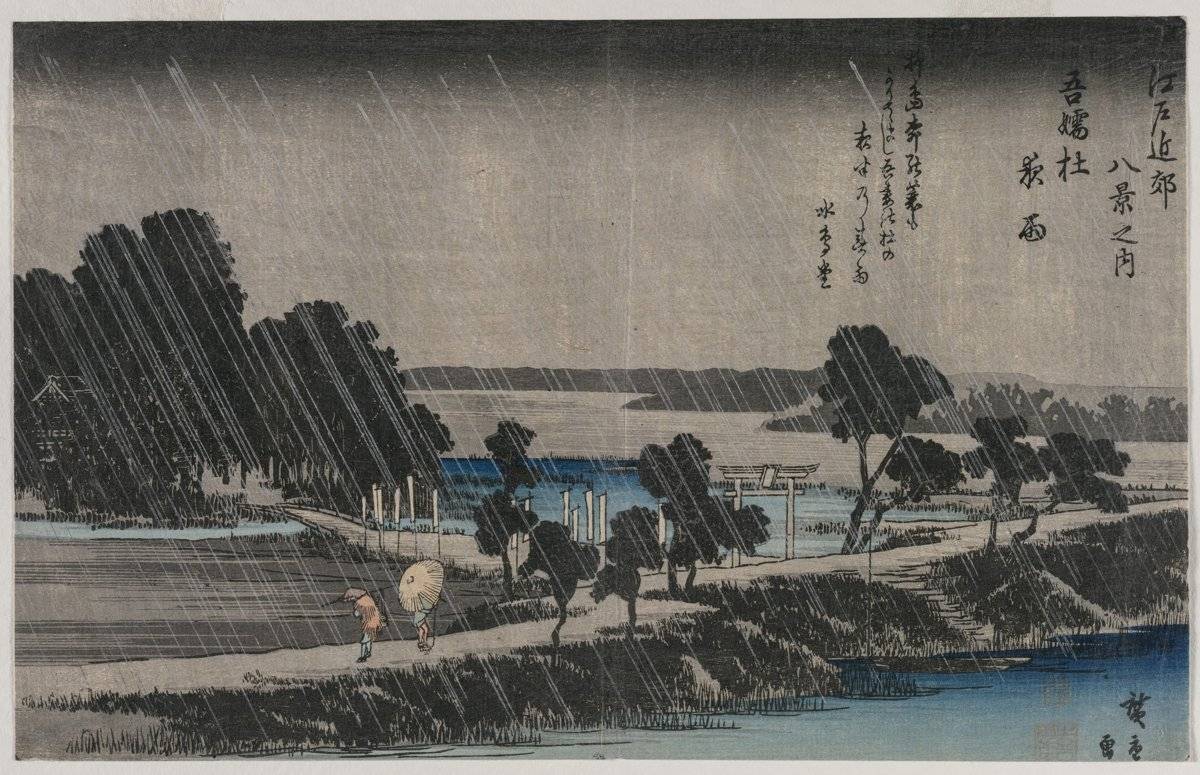
Utagawa Hiroshige, mid-1830s. A torii marks the shrine approach near the center-right of a rain-swept landscape, beyond travelers on the road.
mid-1830s · Japan, Edo period (1615–1868) · The Cleveland Museum of Art · 1942.145 · CC0
Frequently asked questions
What does a torii gate symbolize?
It marks entry into a sacred area, usually at a Shinto shrine. It distinguishes the sacred precinct from its ordinary surroundings rather than functioning simply as a decorative doorway.
Why are torii gates red?
Some are vermilion, but many are not. Fushimi Inari Taisha associates its vermilion with protection against evil influences and abundant harvests, and also notes the preservative role of traditional pigment.
Do torii gates come from bird perches?
That is one theory, not an established origin. Kokugakuin University notes competing explanations for both the gateway and the word torii, with no single accepted answer.
Are torii gates always Shinto?
They are primarily associated with Shinto shrines, but documented exceptions occur at Buddhist temples. A particular site’s history is more informative than an absolute rule.
What does the torii emoji mean?
The character ⛩ is U+26E9 SHINTO SHRINE, with torii as a Unicode alias. It is a compact sign for a Shinto shrine, and its appearance varies by font or emoji platform.
Sources & further reading
- Mori Mizue: Torii, Kokugakuin University Encyclopedia of Shinto
- Fushimi Inari Taisha: Frequently Asked Questions
- Fushimi Inari Taisha: Senbon Torii
- Japan National Tourism Organization: Shrine and Temple Traditions
- Cleveland Museum of Art: Green Rooster Perched on Torii
- Cleveland Museum of Art: Night Rain at the Azuma Shrine
- Unicode: Miscellaneous Symbols, U+262F and U+26E9