Cultures
Djed Meaning in Ancient Egyptian Religion
The djed is an ancient Egyptian pillar-shaped sign associated with stability and permanence. Later it became closely connected with Osiris and his backbone.
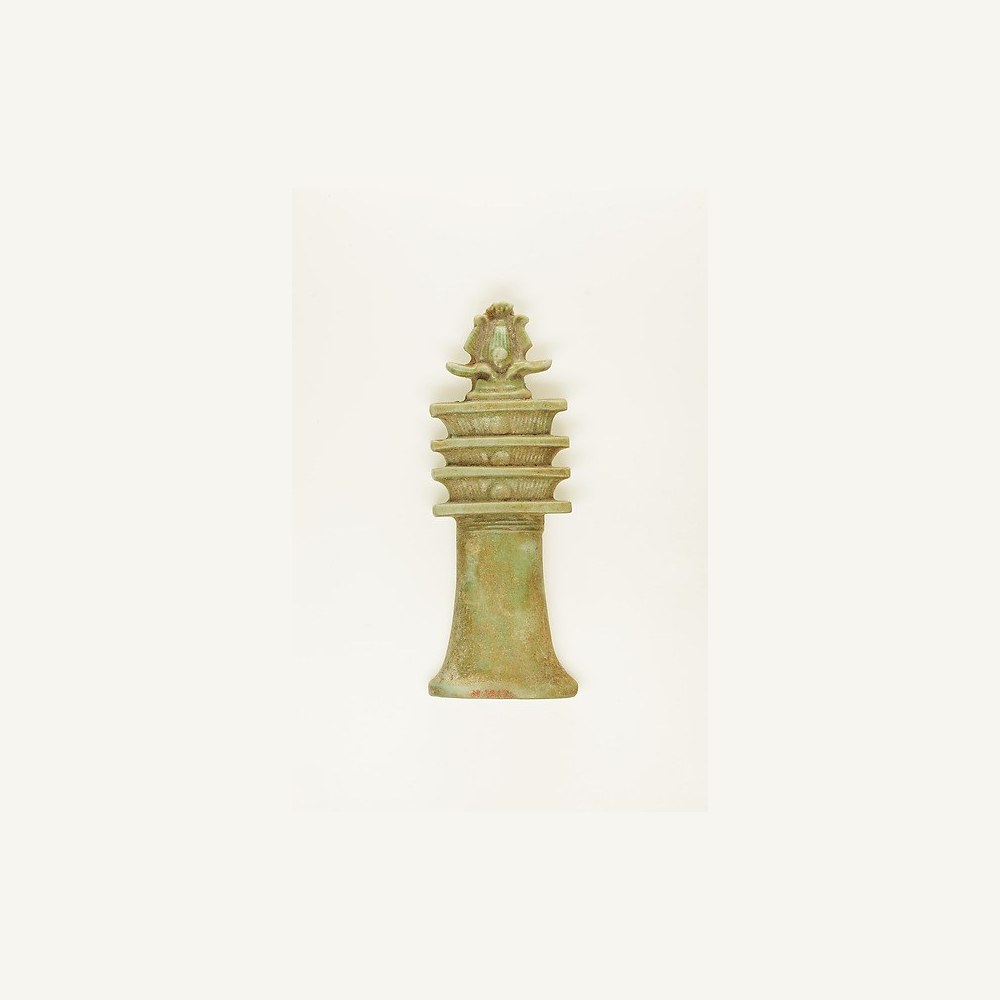
The djed is an ancient Egyptian symbol of stability and permanence, usually shown as an upright pillar with four horizontal bars near its top. In later Egyptian religious use it was closely connected with Osiris and identified as his backbone. Djed meaning is therefore more specific than a general modern slogan about “positive energy”: it belongs to Egyptian ideas about endurance, the body, and renewed life after death.
Surviving amulets make that meaning tangible. The Metropolitan Museum of Art describes djed-pillar amulets as objects intended to ensure permanence and connect the deceased with Osiris, the god revived after death. These are documented religious purposes, not medical claims about what wearing a modern pendant can do.
What does the djed symbolize?
The central meanings are stability, lastingness, and permanence. The djed's upright, stacked form gives those ideas an immediately legible appearance, but its Egyptian meaning is established by historical context and museum scholarship rather than by visual guesswork alone.
Its association with Osiris adds a funerary dimension. The Met explains that the connection became close from the New Kingdom onward. As Osiris's backbone, the pillar could evoke the integrity of a body restored after death. This does not turn every djed into a literal anatomical illustration; it remains a stylized sign with religious associations.
It is useful to keep those layers separate. “Stability” summarizes the sign's meaning. “Backbone of Osiris” identifies an important religious interpretation. “Djed-pillar amulet” describes a physical object made in that form. A responsible caption can combine all three without pretending they are interchangeable definitions.
How to recognize a djed pillar
Look first for the tall vertical support and the set of four projecting crosspieces near the top. A simple amulet may have a broad foot, a narrow shaft, and a small terminal above the bars. More elaborate examples add crowns or other attributes that emphasize a connection with Osiris.
The Met's amulet numbered 10.130.1812 is a particularly useful example. It has the familiar stacked pillar structure and an atef crown at the top, an attribute often worn by Osiris. Another amulet, numbered 15.6.7, has a slimmer silhouette and a less elaborate top. Both belong to the same general symbol type despite the differences.
- Vertical shaft: the pillar-like core.
- Four horizontal bars: the most recognizable identifying feature.
- Base: a support whose proportions vary from object to object.
- Optional additions: crowns and other details that can clarify the religious context.
Material and color are not reliable identifiers by themselves. Several of the surviving examples are made from glazed faience, but a turquoise or green color does not make an otherwise unrelated object a djed. Identify the structure before interpreting the color.
Was it always the backbone of Osiris?
The symbol's physical origin is not certain enough to summarize as a single settled story. Museum descriptions characterize it as a stylized representation of an early cult object, but they use qualified language about its original form. It is better to preserve that uncertainty than to declare that it began as a tree, a bundle of reeds, or an actual spine.
The later Osiris association is much firmer. The Met's explanations distinguish the pillar's basic connection with permanence from its close relationship with Osiris from the New Kingdom onward. That distinction matters because a later interpretation should not be projected automatically onto the earliest possible use of a form.
We do not give an exact first-use year in the quick facts. The museum objects illustrated here have catalog dates, but those dates describe the individual amulets. They do not establish when Egyptians first created or used the djed sign.
Why were djed amulets made?
Amulets gave symbolic forms a place in bodily and funerary settings. The Met describes the djed examples here as funerary amulets intended to secure permanence and relate the deceased to Osiris. A small object could therefore carry an important religious role without being a miniature architectural column.
The intended effect belongs to Egyptian belief and ritual. Saying that an amulet was used to ensure permanence reports the historical purpose assigned to it; it does not endorse supernatural protection or claim that the object demonstrably changed a person's fate. This distinction lets us take the makers' beliefs seriously without turning a reference entry into a promise.
Size also changes how we should look at it. An enlarged museum photograph makes shallow modeling, glaze, and wear easy to inspect. The original was a small made object. Its use, material, and archaeological context provide more information than a clean modern outline alone.
Three museum examples to compare
The slim Met example 15.6.7 is dated to the Late Period–Ptolemaic Period, 664–30 BCE. The broad crosspieces and long narrow shaft make the basic outline especially clear. It shows how a compact amulet could preserve the sign's identifying features.
Amulet 10.130.1812, also dated 664–30 BCE, adds the atef crown. The caption identifies the crown rather than leaving the viewer to mistake it for another set of bars. Here an extra attribute makes the Osiris connection visible as well as interpretive.
A third example, 89.2.539, is cataloged across the Third Intermediate–Ptolemaic Period, approximately 1080–30 BCE. Its fuller proportions offer a useful comparison with the first two. A broad date range is the museum's expression of uncertainty; it should not be silently replaced with a precise year for a tidier label.
Djed, ankh, and Eye of Horus
Egyptian symbols are often sold together, but their meanings should not be collapsed. The ankh is associated with life. The Eye of Horus has its own history of wholeness and protection. The djed's emphasis is stability and permanence, with the Osiris association especially important in funerary use.
Our guide to Egyptian symbols and their meanings places these signs alongside other forms from Egyptian religion. The comparison is most helpful when it retains the differences: three recognizable signs do not become three versions of one universal charm.
A modern djed illustration can communicate the silhouette quickly. A dated museum amulet can show what a maker actually produced, including asymmetry, surface changes, and added attributes. Reading the two together connects a useful dictionary definition with the historical objects that support it.
In the museum
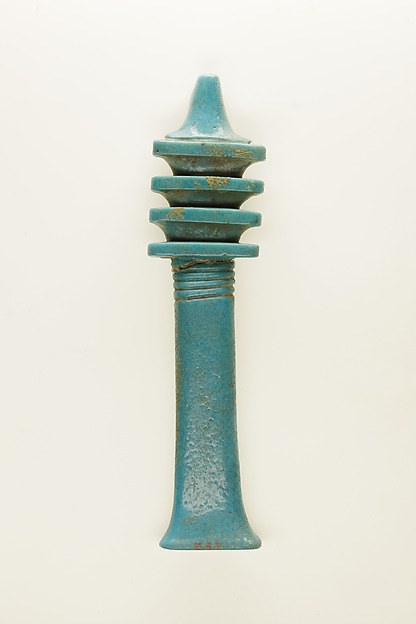
Slender faience djed pillar amulet with four horizontal crosspieces, dated 664–30 BCE.
664–30 BCE · Ancient Egyptian · The Metropolitan Museum of Art · 15.6.7 · CC0
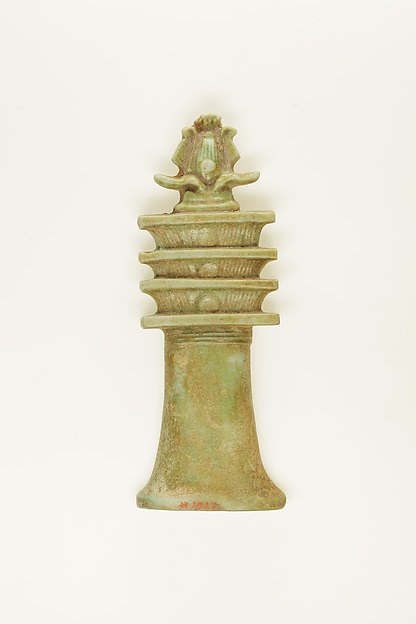
Djed pillar amulet with an atef crown above its four crosspieces, dated 664–30 BCE; the crown links it visually with Osiris.
664–30 BCE · Ancient Egyptian · The Metropolitan Museum of Art · 10.130.1812 · CC0
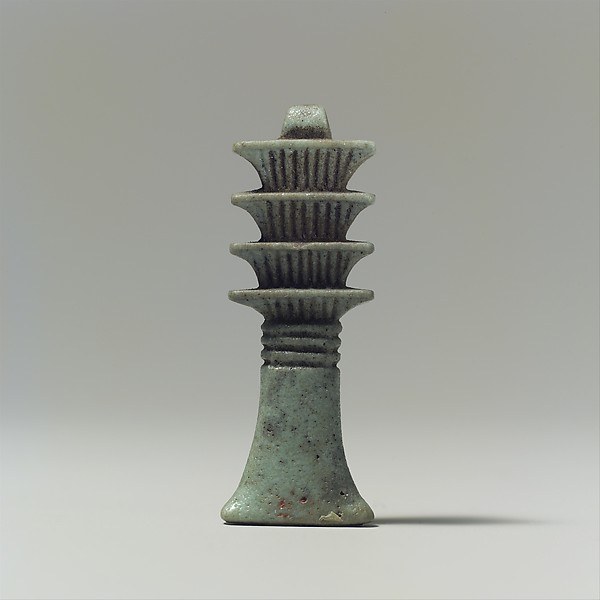
Broad djed pillar amulet, cataloged ca. 1080–30 BCE, showing four stacked crosspieces and a flaring base.
ca. 1080–30 BCE · Ancient Egyptian · The Metropolitan Museum of Art · 89.2.539 · CC0
Frequently asked questions
What does the djed mean?
The djed signifies stability and permanence in ancient Egyptian contexts. It later became closely associated with Osiris and identified with his backbone.
What are the four lines on a djed?
They are the four projecting horizontal crosspieces that make the pillar recognizable. Their presence helps identify the form; speculative universal meanings for each bar should not be assumed.
Is the djed the same as the ankh?
No. The ankh is associated with life; the djed emphasizes stability and permanence. Both can appear in Egyptian religious contexts.
What was the first djed made to resemble?
Its original physical prototype is uncertain. A qualified museum description of an early cult object is safer than declaring a specific natural object to be its proven origin.