Cultures
Triskelion Meaning, Triple Spirals, and Three Legs
Three spirals or three bent legs rotate around a center. Similar outlines appear in different cultures, but their meanings must be read in context.
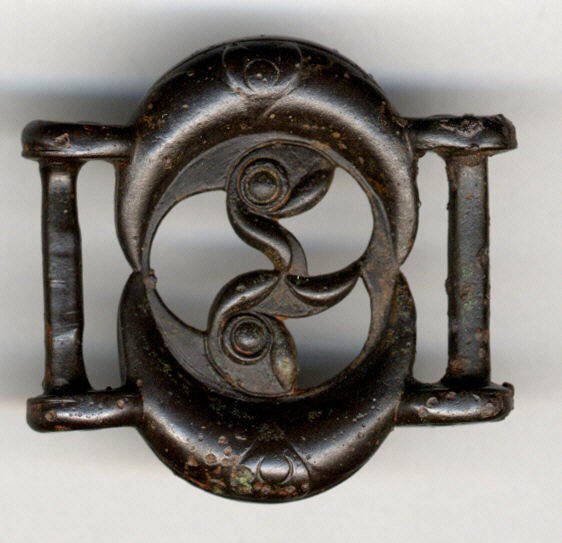
A triskelion is a three-part motif arranged around a common center, usually with a strong impression of rotation. Its best-known forms are a triple spiral and three bent human legs. Triskelion meaning depends on which form, culture, and period you mean: Neolithic carving at Newgrange, Greek coin imagery, and the Three Legs of Mann are related visually, not automatically identical in purpose.
Modern explanations often emphasize movement, cycles, and threefold ideas such as past, present, and future. Those can be meaningful present-day readings. They should not be presented as translations of a surviving explanation from the builders of Newgrange.
Triskelion, triskele, or triskeles?
These names are used for the same broad family of threefold rotating motifs. In ordinary use, “triple spiral” identifies the curving form more precisely, while “three legs” describes the figural form. A design can belong to the broader family without looking exactly like another example placed beside it.
To recognize one, look for three comparable arms placed around a center. Each arm turns in a related way, creating rotational organization rather than a simple row of three separate pictures. The arms may be spirals, legs, or another repeated shape. Their construction, orientation, and surrounding imagery deserve attention.
A three-lobed knot is not necessarily a triskelion. The Celtic knot family is defined by interlace, the appearance of strands passing over and under one another. The triple spiral is defined by coiling arms. Modern designs sometimes combine them, but combining two forms does not make their histories interchangeable.
The triple spiral at Newgrange
Newgrange stands in the Brú na Bóinne landscape in County Meath, Ireland. Heritage Ireland dates the great passage tombs of Newgrange, Knowth, and Dowth to about 3200 BC. Its official site description identifies a large triple spiral on the entrance stone and another triple spiral within Newgrange.
That date is crucial. Newgrange belongs to the Neolithic, or later Stone Age, long before medieval Christian art and the later periods commonly associated with Celtic ornament. Calling its spiral “Celtic” may describe a modern cultural association; it is not a precise archaeological label for the people who built the monument.
Newgrange is also famous for its winter-solstice alignment. Sunlight enters through a roof-box and travels along the passage to illuminate the chamber. This is a documented relationship between architecture and the sun. It does not, by itself, decode the triple spiral into a sentence about the sun, rebirth, or a particular deity.
What did the prehistoric spiral mean?
The short answer is that its exact meaning is not known. Heritage Ireland’s account of prehistoric art explicitly cautions that we cannot say with certainty what the carved designs represent. Their placement in important monuments suggests significance, but significance and a deciphered meaning are different levels of knowledge.
Archaeological setting can narrow a discussion. A motif in a passage tomb belongs to a landscape concerned with the dead, ritual, seasonal observation, and community. Researchers can investigate those relationships. Without a contemporary written explanation, however, selecting one modern triad and calling it the original message is an unsupported leap.
Life, death, and rebirth; land, sea, and sky; body, mind, and spirit; past, present, and future: these are familiar ways people now explain threefold designs. Label them as contemporary interpretations unless a source connects the exact interpretation to a particular historical tradition. Repetition across websites is not independent evidence.
The three-legged form on Greek coins
The triskeles also appears in ancient Greek material, including coins associated with Sicily. A British Museum copper-alloy coin minted at Syracuse and dated 344–332 BC carries a head of Zeus Eleutherios and a triskeles. This named, dated object gives a firmer point of reference than a general claim that the symbol was “used everywhere in ancient times.”
The legs should not be silently replaced by spirals when discussing that coin. Both designs have threefold rotation, but the depicted parts differ. Regional imagery, the issuing authority, and the other side of a coin can matter as much as the isolated emblem.
Likewise, finding related shapes in Ireland and the Mediterranean does not prove an unbroken line of transmission between them. An argument for transmission needs dated intermediaries or other historical evidence. Similarity is a starting point for a question, not the answer to it.
The Three Legs of Mann
The Isle of Man’s emblem is a particularly clear example of a symbol with a specific public identity. Manx National Heritage associates the adoption of the three legs as royal arms with the thirteenth century. It identifies an early surviving depiction on the Manx Sword of State, thought to date to about 1300.
The accompanying motto, Quocunque Jeceris Stabit, is translated by Manx National Heritage as “Whithersoever you throw it, it will stand.” In that setting, the rotating legs can communicate stability or resilience as well as Manx identity. This documented heraldic tradition should not be reduced to a generic modern “Celtic spirituality” meaning.
The same heritage source notes that the reason the kings adopted the emblem is not known for certain. It also distinguishes folklore connecting it to the sea god Manannan from early evidence. A symbol can have a well-established role in later history while retaining uncertainty about how that role began.
Does turning direction change the meaning?
Orientation is worth recording, especially when describing an individual artifact or official emblem. But there is no demonstrated universal rule under which every clockwise triple spiral means one thing and every counterclockwise version means its opposite. Do not import a directional rule from one tradition into all others.
When comparing two images, first check whether one has simply been mirrored. Then ask whether the source treats direction as meaningful. A precise visual description is more useful than an invented spiritual law. The same applies to claims that every threefold motif is necessarily Christian: the prehistoric Irish examples plainly predate Christianity.
Three museum objects, three different settings
The featured image shows a copper-alloy strap attachment dated 100–300 in the Metropolitan Museum of Art. Its openwork center makes the rotating three-armed structure easy to see. The museum catalogs it as Roman or Celtic. That is a broader attribution than “Irish,” and the distinction should remain visible.
The museum examples below also include a Sasanian stamp seal with three curved, headlike arms and an earlier Bactria-Margiana copper-alloy stamp seal with three broad rotating arms. These are genuinely visible geometric comparisons, not claims that the objects belonged to one religion or shared one meaning. Their different places and dates underline why a similar outline cannot establish cultural identity by itself.
The British Museum coin is cited as historical evidence, not reproduced under a falsely claimed CC0 license. Compare Celtic symbols and the Celtic cross for other forms whose modern cultural familiarity should be distinguished from their particular historical settings.
In the museum
An openwork three-armed rotating motif within a strap attachment. The catalog identifies the culture as Roman or Celtic, not more narrowly Irish.
100–300 · Roman or Celtic · The Metropolitan Museum of Art · 2002.483.10 · CC0
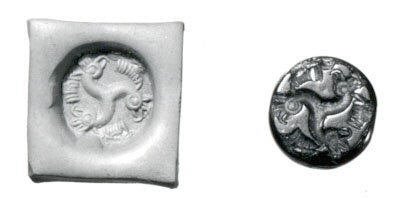
The seal and its impression show three curved, headlike arms rotating around a center. This is a Sasanian example, not evidence of an Irish origin.
ca. 3rd–7th century CE · Sasanian · The Metropolitan Museum of Art · 62.66.22 · CC0
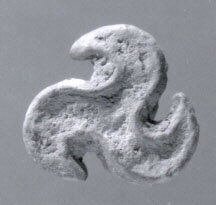
Three broad curved arms form a rotating motif in this copper-alloy stamp seal. Its Bactria-Margiana setting must not be relabeled Celtic.
ca. late 3rd–early 2nd millennium BCE · Bactria-Margiana Archaeological Complex · The Metropolitan Museum of Art · 1983.535.54 · CC0
Frequently asked questions
What does the triskelion mean?
It depends on context. Modern users may associate it with movement and cycles; the Three Legs of Mann has a particular heraldic identity. The exact meaning of the Newgrange spiral is unknown.
Is the triskelion Celtic?
It has strong modern Celtic associations, but the Newgrange triple spiral is Neolithic, and three-legged versions occur in Greek material. The label does not identify a single origin.
Is a triskele the same as a triskelion?
The terms commonly name the same broad threefold rotating motif. Specify triple spiral or three-legged form when the visual distinction matters.
Does it mean the Christian Trinity?
A modern person may give it that meaning, but the prehistoric Newgrange carvings predate Christianity. A Christian reading cannot explain every example.
Sources & further reading
- Brú na Bóinne: Newgrange, Knowth and Dowth — Heritage Ireland
- Mesolithic–Iron Age — Heritage Ireland
- Three Legs of Mann — Manx National Heritage
- Syracuse coin with triskeles, 344–332 BC — British Museum
- Attachment for a Strap — The Metropolitan Museum of Art (2002.483.10)
- Stamp seal — The Metropolitan Museum of Art (62.66.22)
- Stamp seal — The Metropolitan Museum of Art (1983.535.54)