Nature
Gemstone Meanings and Birthstones by Month
A month-by-month birthstone chart and an evidence-aware guide to gem symbolism, from amethyst and ruby to sapphire and diamond.
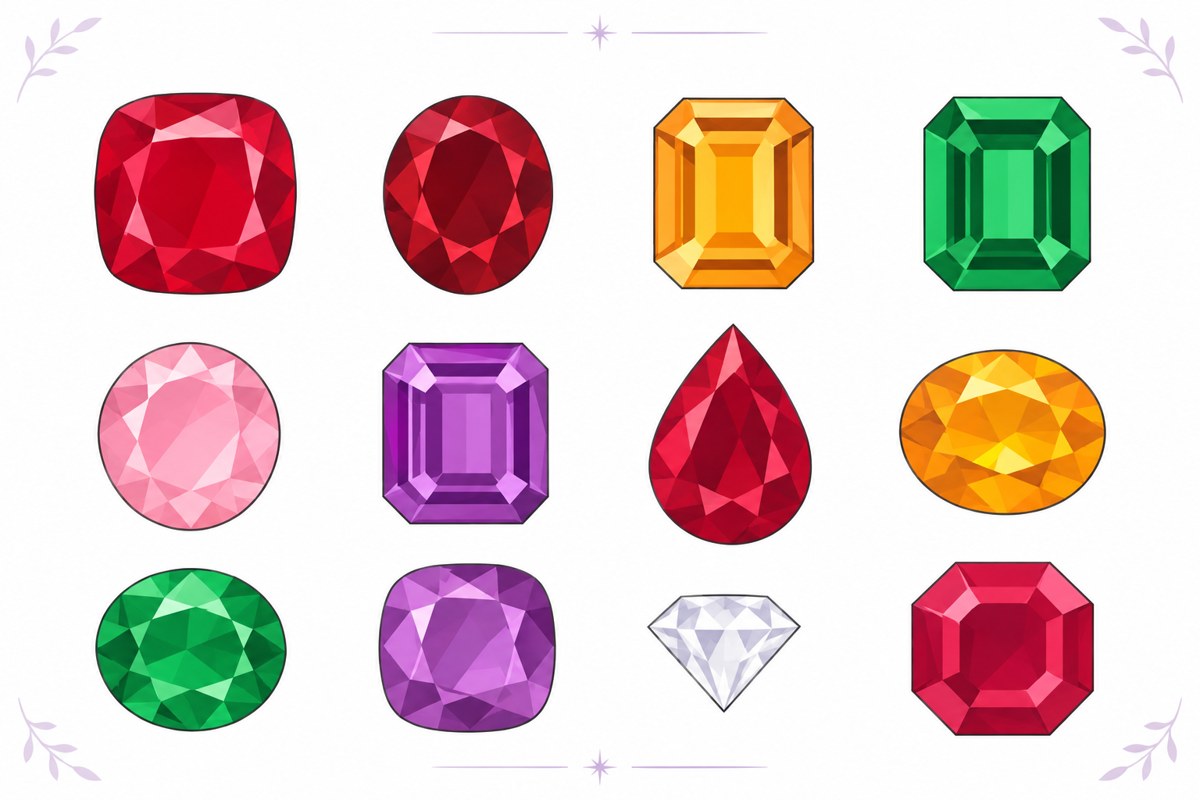
Gemstone meanings are cultural associations attached to gems, such as love for diamond, royal authority for sapphire, or a birth month for garnet. They are not measurable powers inside a stone. A gem can carry a family memory, a religious meaning, a fashion statement, and a commercial message at the same time.
The most useful way to understand gemstone symbolism is to separate three things: what the material is, what a particular community believed about it, and what someone chooses it to mean today. The guide below combines documented historical lore with the modern birthstones by month used by the Gemological Institute of America (GIA).
Gemstone meanings at a glance
This chart is an introduction, not a universal dictionary. Associations can change across periods and places. A green stone in one historical jewel need not have the same meaning as an emerald engagement ring bought today.
| Gem | Documented or common association | Important distinction |
|---|---|---|
| Garnet | January birthdays; its red varieties invite associations with warmth and affection | Garnet is a group of minerals, not one red-only stone |
| Amethyst | Historical ideals of sobriety and clear judgment | The old belief does not make amethyst a remedy |
| Aquamarine | Sea imagery and March birthdays | Its name and blue-green appearance are different from a supernatural power |
| Diamond | Commitment, endurance, and modern engagement traditions | Hardness does not mean it cannot chip |
| Emerald | Green vitality, prestige, and May birthdays | Specific claims about luck or foresight belong to lore |
| Pearl | June birthdays; purity in some jewelry traditions | Pearls form in mollusks and are not minerals |
| Ruby | Life force, status, and intense red beauty | Historic protective beliefs are not evidence of protection |
| Peridot | August birthdays and distinctive yellow-green color | Its identity is the gem variety of olivine |
| Sapphire | Heaven in medieval European religious use; royal prestige | Sapphires occur in colors beyond blue |
| Opal | October birthdays and an ever-changing appearance | A reputation for bad luck is a superstition, not a property |
| Topaz and citrine | November birthdays; warm color associations | They are different gem materials |
| Turquoise, tanzanite, and zircon | December birthdays | They have different histories, compositions, and care needs |
Birthstones by month
A birthstone is a gem linked by convention to a person's birth month. The table follows GIA's month-by-month birthstone guide. Multiple stones for a month are alternatives, not a ranking of authentic and less authentic choices. Lists used by different jewelers, countries, and historical traditions can differ.
| Month | Birthstone or birthstones | How to read the association |
|---|---|---|
| January | Garnet | A birth-month connection that is not limited to dark red gems |
| February | Amethyst | Purple quartz with a long history of symbolic use |
| March | Aquamarine, bloodstone | Two visually very different choices for the same month |
| April | Diamond | A birthday association separate from its engagement-ring role |
| May | Emerald | The green variety of beryl |
| June | Pearl, alexandrite, moonstone | Options include an organic gem and different mineral gems |
| July | Ruby | Red corundum, rather than every red gemstone |
| August | Peridot, spinel, sardonyx | Three alternatives with distinct appearances |
| September | Sapphire | Often blue, but not necessarily |
| October | Opal, tourmaline | Both offer a broad range of appearances |
| November | Topaz, citrine | Two separate materials, not interchangeable names |
| December | Tanzanite, turquoise, zircon | The three choices on GIA's December month page |
Birthstone jewelry can communicate identity without making a claim about destiny. A parent might combine several children's birthstones; a person might wear a loved one's month instead of their own. Explain that choice in a gift note. It gives the jewel a more precise meaning than a generic promise of “positive energy.”
Do not confuse birthstones with zodiac stones. Calendar months and astrological signs divide the year differently, and gemstone-to-sign lists vary. There is no single scientific system that assigns a mineral to a personality. Our guide to zodiac symbols explains that separate symbolic vocabulary.
What individual gemstones symbolize
Garnet: a birthday stone with more than one color
GIA traces the name garnet to the medieval Latin granatus, referring to pomegranate-like red color. That resemblance helps explain why red garnets readily suggest richness and warmth. But garnets are not all red: choosing a green garnet is not choosing a “wrong” January birthstone. Material identification and a familiar visual stereotype are different questions.
Amethyst: sobriety as historical belief
The name amethyst derives from Greek language associated with not being intoxicated. GIA documents the long-standing belief that the purple stone could prevent drunkenness. The useful symbolic meaning is restraint or clear judgment, when that history is intentionally referenced. Wearing amethyst does not prevent intoxication, and the folklore should never substitute for practical safety.
Diamond: endurance and commitment
Diamond's name is linked to the Greek adamas, often translated as unconquerable or invincible. That linguistic history and the material's exceptional hardness make endurance an understandable metaphor. Modern engagement jewelry adds a strong association with commitment. Neither association means a relationship can be judged by the size, cost, or presence of a diamond.
Emerald: green beauty and prestige
GIA's May guide discusses emerald's long admiration and the Roman writer Pliny's praise of its green. A contemporary gift can reasonably use that color to suggest freshness or growth. It should be described as the giver's interpretation, rather than as a fixed code observed by everyone who has worn emerald. Compare the broader context in color meanings and symbolism.
Ruby: life force and authority
GIA records ruby's historic reputation as a “king of precious stones” and its association with life force. The saturated red makes the connection with vitality easy to understand. Some historical accounts also assign protective or medicinal powers to ruby. Those accounts tell us about belief and prestige, not a proven ability of a gem to alter health or events.
Sapphire: heaven and fidelity
GIA's history of sapphire describes medieval clergy wearing blue sapphires to symbolize heaven. Sapphire lore also includes beliefs about chastity and peace. These should remain attributed historical associations, not promises about a wearer's conduct. A yellow or pink sapphire is still sapphire; the familiar heavenly-blue reading belongs especially to blue examples and their setting.
Spinel: why names matter to symbolism
Spinel is a useful warning against reading an old stone name as a modern laboratory identification. GIA notes that famous historical “rubies” have proved to be spinels. A red royal jewel could carry the prestige of ruby in the eyes of its original viewers even if a gemologist would classify it differently today. Historical meaning depends partly on what people thought they saw.
Pearl, moonstone, and alexandrite: three kinds of June gift
June's alternatives illustrate how personal symbolism can grow from appearance. A pearl's soft surface, moonstone's shifting sheen, and alexandrite's color change offer very different visual experiences. GIA identifies all three as June birthstones. A giver may choose one to express gentleness, moon imagery, or change, but those interpretations should be presented as choices rather than universal ancient rules.
Gemstone meanings and “powers”: where to draw the line
Old accounts of gems frequently mix observation, religion, medicine, and legend. A modern reference can report those beliefs without endorsing them. “Medieval wearers associated this stone with protection” is a historical statement. “This stone protects you” is an unverified claim about how the world works.
That distinction is especially important when a shop uses words such as healing, detoxifying, balancing, or curing. A stone can be comforting because of its color, texture, memory, or ritual use. None of those experiences establishes a medical effect. Choose gemstones for beauty, cultural connection, or personal significance, not as a replacement for care or as a guarantee of safety.
Likewise, a gem does not reveal someone's moral character. Wearing sapphire does not prove fidelity; preferring ruby does not diagnose passion or anger. Symbolism communicates through shared stories and individual intentions. It is not a test of personality.
Color, material, and setting all change a gem's meaning
A stone is rarely seen alone. A ruby in a crown, a ruby in an engagement ring, and a ruby in a birthstone pendant belong to different systems of meaning. The crown emphasizes authority; the ring may emphasize a relationship; the pendant may identify a birthday. The material can stay the same while the message changes.
Color names can also mislead. Sapphire is not only blue, garnet is not only red, and a pale green gem is not automatically emerald. A stone's trade description, composition, treatment, and origin are matters for gemological disclosure. Its significance to a family is a separate matter. Ask for both kinds of information when buying an important jewel.
Religious imagery and accompanying motifs add another layer. A gem mounted in a cross is not interpreted in the same way as a loose specimen in a mineral collection. Read the Christian symbols guide for that religious context, rather than assuming the stone alone explains the object.
How to choose a gemstone for a meaningful gift
- Start with a real connection. A birth month, favorite color, inherited design, or shared place gives the choice a clear reason.
- Name the convention. Say “your June birthstone” or “a green stone to mark a new beginning,” not “the ancient universal stone of renewal.”
- Check the material. Ask what the gem is, whether it is natural or laboratory-grown, and what treatments are disclosed. Symbolic value does not remove the need for accurate description.
- Consider how it will be worn. Care and durability differ among gems. A delicate occasional pendant and an everyday ring make different demands.
- Write the meaning down. A short note preserves the specific reason for the gift. Future owners cannot reliably recover that reason from a color chart.
A meaningful gem need not be the most expensive option. A modest birthstone pendant with a clear family story can communicate more than a costly stone chosen only because a list promises luck. The strongest gemstone significance is often the part that can be explained honestly.
Frequently asked questions
What do gemstones symbolize?
Gemstones can symbolize a birth month, commitment, status, faith, or a personal memory. Meanings depend on the material, the object, and the tradition rather than a universal code.
What is my birthstone?
Match your birth month to the chart above. Some months have multiple accepted choices; for example June has pearl, alexandrite, and moonstone in GIA’s guide.
Do gemstones have healing powers?
Historical gem lore records beliefs, not demonstrated medical powers. A gemstone may have emotional or personal value but should not replace care or be treated as a guarantee of protection.
Are birthstones the same as zodiac stones?
No. Birthstones follow calendar months, while zodiac-stone lists follow astrological signs and vary among sources. The two conventions should not be conflated.
Can a laboratory-grown gem have symbolic meaning?
Yes. A person or family can give a laboratory-grown gem a meaning just as they can a mined gem. Accurate disclosure of the material and its origin remains important.
Sources & further reading
- Birthstones by month — GIA
- January birthstone: garnet — GIA
- February birthstone: amethyst — GIA
- May birthstone: emerald — GIA
- June birthstones — GIA
- July birthstone: ruby — GIA
- August birthstones — GIA
- Sapphire history and lore — GIA
- October birthstones — GIA
- December birthstones — GIA
- Spinel — GIA
- Gemstone lore — GIA